| Author |
 Replies: 21 / Views: 10,376 Replies: 21 / Views: 10,376 |
|
Pillar Of The Community
United States
7072 Posts |
|
|
|
Scott Classic has a note following the KGV high values of 1911 to 1923 (1-rupee to 25-rupee values, Scott #93-98; SG 185-191) that says that these stamps were also used to pay for radio licenses, in which case they have a cancel that includes the word "wireless" in some fashion. No picture. They also say the radio usages are only worth 10-15% of regular catalogue value.
I flipped through Gibbons Empire & Commonwealth, and didn't see a similar note. The first several pages of Google results also gave up nothing.
Anyone have any more information? Maybe a scan?
Thanks.
|
|
Send note to Staff
|
|
|
|
|
Pillar Of The Community
Australia
3547 Posts |
|
|
I don't know about radio licences, but those high values frequently turn up with telegraph and telephone cancels. You usually find TEL somewhere in the cancellation. Those are worth about 10-15% of regular values. |
Send note to Staff 
|
|
|
Valued Member
India
159 Posts |
|
|
Hi Yes ! We had to pay Radio Licence Fees for using radios -  And I myself had stood in the queue at our Post office to pay it since we had a radio - "murphy" brand - during those days there were only two main brands - murphy and philips ... I am talking about the 70's. Here is one which I had peeled off from the Licence books years after the system became obsolete - there used to be a book like a bank pass book and you had to renew it every year or your radio would be confisticated 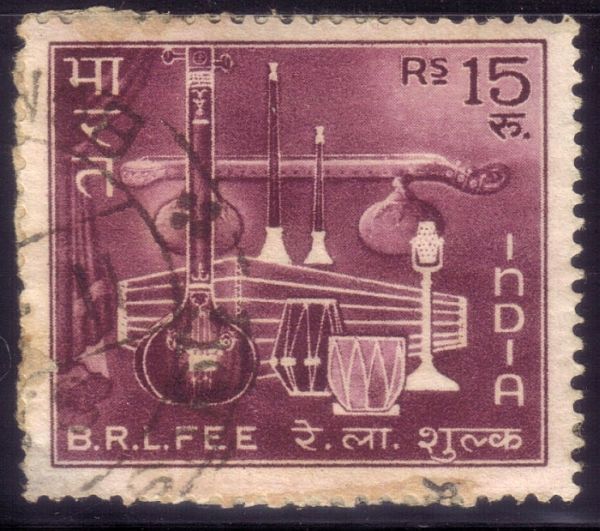 Hope this was informative.. Thomas |
|
Send note to Staff
|
|
|
Pillar Of The Community
United States
7072 Posts |
|
|
Thanks, Thomas. Its great to see an example. Scott mentions that the cancel includes the word "wireless" somewhere. Do you recall that to be true?
I'm looking for a tip that will let me identify these on the various rupee-valued KGVs, especially if only part of the circular date stamp is visible. |
|
Send note to Staff
|
|
|
Valued Member
India
159 Posts |
|
|
Hi Cjd Sorry that I cannot remember - if I had that old licence book  but it was so long ago. The BO... of the stamp is for Bombay. The "BRLFEE" standing for Bombay Radio Licence Fee. Thomas |
|
Send note to Staff
|
|
|
Pillar Of The Community
United States
7072 Posts |
|
|
Bedrock Of The Community
Australia
38679 Posts |
|
|
I believe, the two are not compatible, differing eras. The KG5 may have the "wireless" CDS, however by the time Thomas's stamp was produced normal post office CDS's were used. Radio / TV Book with "Park Street Calcutta" CDS 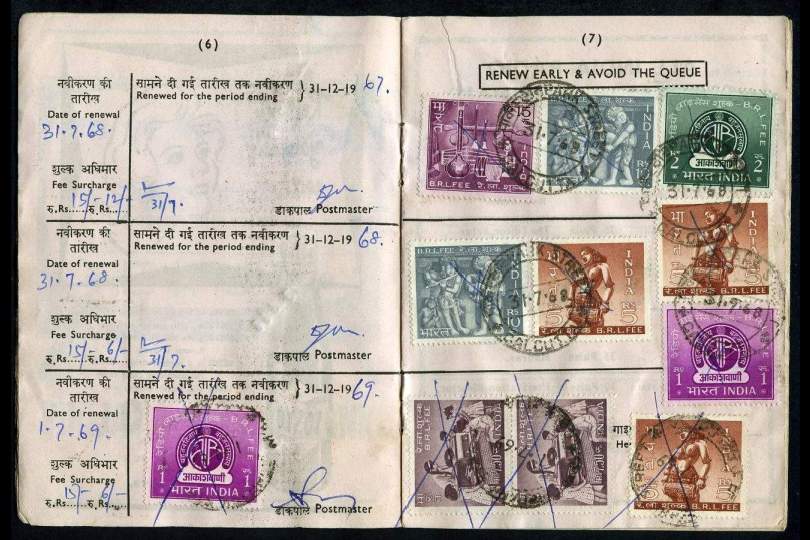 |
|
Send note to Staff
|
|
|
Pillar Of The Community
Australia
3547 Posts |
|
|
I'm sorry, but I still think Scott has its wires crossed. To begin with, radio licence fees must have been a minimal consideration for most of George V's reign anyway. Certainly, in the earlier years - say to 1925 - radios would have been an exotic luxury item. Even by 1936, use of stamps to pay radio licence fees can't have been a significant factor. However, telegraph fees were paid for with postage stamps, and telegraph cancels are common on Edwardian and George V and VI high values. Here is an example of a TELegraph CDS from the British Indian post office at Barwani (where else?), used as a postal cancellation, just to further cloud the issue:   |
|
Send note to Staff
|
|
|
Bedrock Of The Community
Australia
38679 Posts |
|
|
Pillar Of The Community
Australia
3547 Posts |
|
|
Actually, Rod, I paid special attention to that cover because it was an oddity: a cover that travelled entirely within Barwani by the Imperial not the State Post Office. (The cost would have been the same as by the State PO, but the State PO usually seems to have been slightly faster. And the village of Rajpur where the letter originated wasn't so large that it would have been an inconvenience to reach the State PO. Perhaps the State Police Station, which doubled as the PO at Rajpur, was busy on other matters, or the sender had no desire to visit it, for other reasons ...) |
|
Send note to Staff
|
|
|
Pillar Of The Community
United States
7072 Posts |
|
|
I found what I assume to be a radio license usage on a ten rupee KGV:  I invested about fifty cents for the sake of having one for my reference (and now yours). Assuming that this is what I have, you can see why it warranted a note...a fairly dangerous similarity to a postal cancel. Thoughts? |
|
Send note to Staff
|
|
|
Bedrock Of The Community
Australia
38679 Posts |
|
|
I would be very careful, and sceptical.
Employing the compass points on the pmk
"wireless" as a singleton does not fit.
It may be "wire" something
"Wireless Hill PO" or similar.
You are possibly correct in its usage
but until proven would be in my Postmark page
with "possibly etc etc...." written underneath.
10 rupees is also a matter for consideration
perhaps (given the crisp and legible pmk) a stamp
issued in payment for a series of wire accounts
by a company, similar in use to block payment of postage dues
in the US and elsewhere.
|
|
Send note to Staff
|
|
|
Pillar Of The Community
Australia
3547 Posts |
|
|
Rod, I can't recall seeing one of these CDSs, but I'd think the words in the bottom arc were probably something like 'WIRELESS LICENCE'. This one looks to be from Calcutta, but other large cities may have had variations on the inscription.
At the very least, noone is likely to have faked this cancellation ... |
|
Send note to Staff
|
|
|
Pillar Of The Community
United States
7072 Posts |
|
|
I played around with the image a bit, and I think WIRELESS might fit the bottom ring...see what you think. 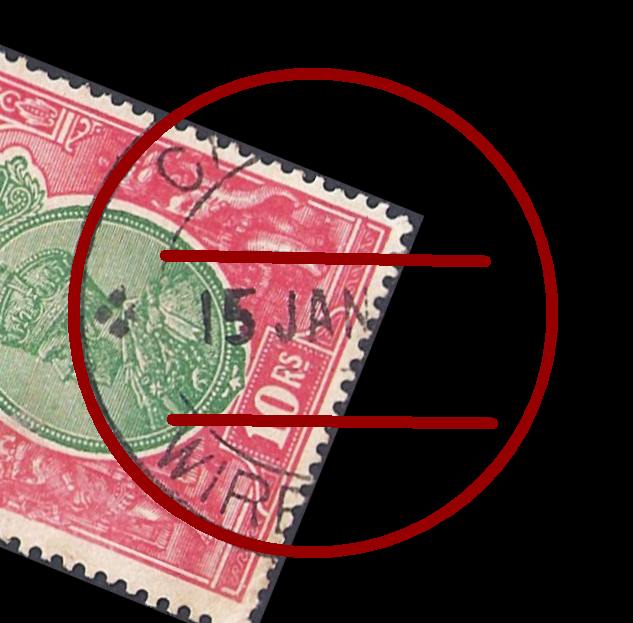 The two straight lines are intended to be approximately parallel, with the bottom line showing the limits available for the rest of the word. |
|
Send note to Staff
|
|
|
Bedrock Of The Community
Australia
38679 Posts |
|
|
I think you're right, and I'm wrong  When I tried must have been an optical illusion. Tony, how much was 10r in say circa 1953? any idea? |
|
Send note to Staff
|
|
|
Pillar Of The Community
Australia
3547 Posts |
|
|
In absolute terms, or purchasing power, Rod? In absolute terms, around 10/-, IIRC. In purchasing power terms, it would probably have paid a local postman for around a week. So, to the Indian man-in-the-street at the time, a significant amount of money. I suppose the younger generation forget that radios were once an expensive item. You had to save up for them, or buy them on the never-never. I have this little bit of reality philately (as opposed to reality TV) on the subject:  and here is the front  The good doctor had fallen behind on the HP payments for his radio, and the next step was for the heavy brigade to come around and beat it out of him. |
|
Send note to Staff
|
|
|
Replies: 21 / Views: 10,376 |
|




 Posted 02/27/2011 11:18 am


