Quote:
But Wenden was such a small town, I wonder why the other larger areas did not issue such stamps?
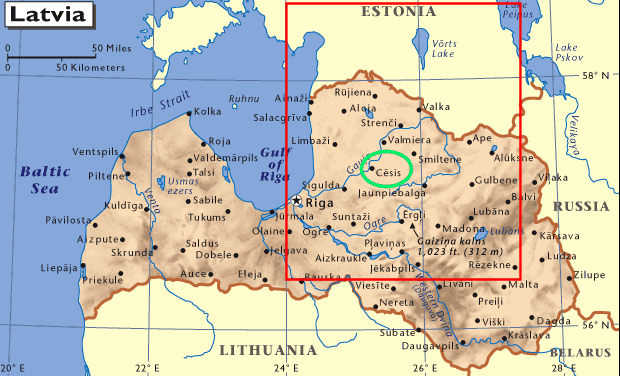
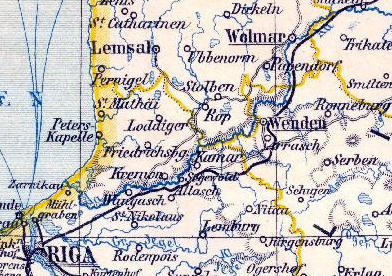
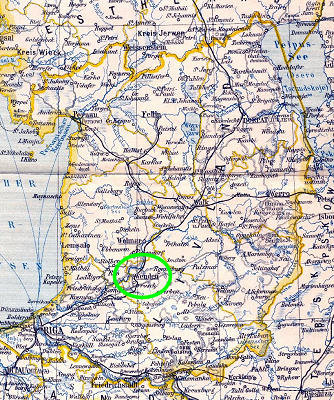
I'm reviving this thread. Wenden may seem like a small town today but in the 1500s it was important because of its fortifications, its castle, situated on trade routes. It was fought over in battles of the Livonian War (between the Russians under Ivan the Terrible) and the Swedes, Poles, Lithuanians. Wikipedia will fill you in a bit.
We forget that before the rise of the Kingdom of Prussia, the major players in central Europe were in the Baltic Region. Russia was growing powerful, Sweden already was, and the Polish-Lithuanian Commonwealth (controlling most of Ukraine) were major powers. Prussia had been merely one among dozens of German principalities but was setting out on its rise, during the 1600s-1700s, to a major power, a kingdom, eventually the nucleus of a unified Germany.
But that lay in the future. In the 1600s, Germany had been fragmented into hundreds of principalities ever since the medieval German-Italian empire fell apart around 1250. German-speaking power was centered also to the east of Prussia, in Austria (and what par otf Hungary had not been overrun by the Turks). Austria ended where Poland-Lithuania began, Poland Lithuania ended where Russia and Sweden began. These were the big players.
Far to the West, the Atlantic Powers: Dutch, English, French, Spanish, Portuguese were fighting over the control of the Atlantic and all the trade routes to the east and to the west, around the globe. Between those Atlantic powers and the central European powers named above, was a checkerboard "wasteland" of German (and Italian) counties, duchies, princedoms, city-states, prince-bishops, and a few dozen other sorts of states. The Thirty Years War was fought over that checkerboard terrain as well as parts of central Europe. France and Spain were involved but not the other Atlantic powers.
And just to add a bit of spice, the Turks were still trying to take Vienna, so to the southeast was another war-frontier. The Poles and Austrians turned them back from Vienna in 1683 and Buda in 1686.
Wenden was not nearly so isolated and insignificant in the 1500s as it might seem today. On the other hand, I don't want to be misunderstood as suggesting it was a major city. It wasn't at all. But it had a strategically important castle. By the 1800s Russia had completed it's rise, divided Poland and the Baltic nations with Prussia and Austro-Hungary. But Wenden remained an administrative center. Sweden had shrunk somewhat, after centuries of war with Russia, was headed toward the neutrality that characterized it in the 20thc.
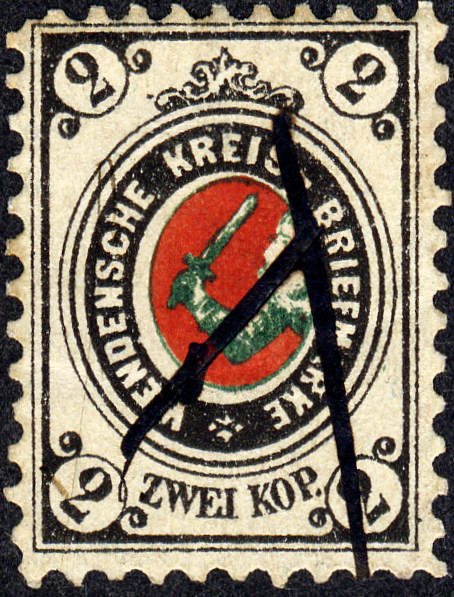
And that's where the stamps came from, from what by the mid-180s was a relative backwater area of Europe, under Russian control. But things had not always been that way.





 Posted 03/22/2014 2:10 pm