| Author |
 Replies: 24 / Views: 8,505 Replies: 24 / Views: 8,505 |
|
Pillar Of The Community
United States
862 Posts |
|
|
I have a small collection of cut squares. If not kept on the envelope is there a standard size once it is cut off the envelope?  |
|
Send note to Staff
|
|
|
|
|
Pillar Of The Community
2664 Posts |
|
|
Rest in Peace
Canada
6750 Posts |
|
|
Ray,
I haven't seen or heard of a standard for these (maybe I didn't listen hard enough!) but I would think at least a quarter of an inch (6 mm) border left around the impression would be OK. Perhaps more, to include cancels or extra stamps attached to the paper. You do not want to cut too close. Too much chance of perhaps ruining it or making a mistake.
Some folks (including me) might say the bigger the better, but I think you would have to be into collecting envelope entires to appreciate whole envelopes or large parts thereof. That usually comes with time, so perhaps leave them as they are and 'sleep on it' as I know my opinion on these changed and changes over time.
spock and other interested folk:
A cut square is an embossed-in or printed-on stamp on an envelope that, years ago and even still now, are cut off the envelope hopefully in a square shaped piece of paper so as to have some margin or border left around the stamp.
A lot of times these were cut off the envelope by cutting around the oval design, so are strictly 'cut ovals' but all of these types of 'stamps' or parts of the envelope indicia are usually called cut squares.
Perhaps cut that way so as they would 'fit in' albums and collection of regular stamps. |
Send note to Staff 
|
|
|
Rest in Peace
Canada
6750 Posts |
|
|
A few cut squares that were cut close around the design. One actually 'cut square' at bottom of page. And a 'cut round'! I haven't as of yet got around to listing these on ebay. Not sure of the demand for such items really or the pricing. Another note I just remembered, the paper of the envelopes sometimes (at least in Canada) has watermarking in the paper so the more paper left behind the better for study purposes also. 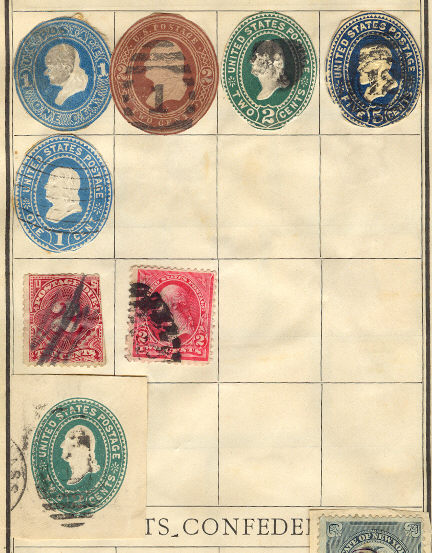 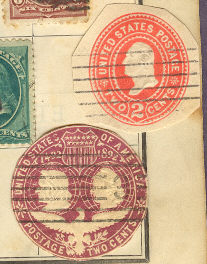 |
|
Send note to Staff
|
| Edited by Puzzler - 04/09/2010 09:19 am |
|
|
Pillar Of The Community
2664 Posts |
|
|
Pillar Of The Community
Canada
4648 Posts |
|
|
Hi All
My impression of a 'cut-square' was the impression cut to a square and not around the design.
I remember that my old Scott "National" album I have has spaces for these but they are illustrated in a 'square' format.IOW - the illustration plus ample margins around it.
Since I have made this statement, I have to ask this - - Do U.S. collectors go more in to cut squares then we do here in Canada??. I ask this because Canadian catalogues for postal stationery (Webbs etc) price them as entires only.
My problem with cut squares is, once they are cut in this format, how does one determine if the design came from a #8 or a #10 size envelope?? The prices for the Canadian counterparts can vary a lot according to the 'entire's' size.
Something to ponder anyway.
Cheers
Bujutsu
|
|
Send note to Staff
|
|
|
Pillar Of The Community
Guatemala
1500 Posts |
|
|
Cut squares must be either square or rectangular. When trimmed around a design as in Puzzler's photos, their monetary value is greatly reduced and generally 0 when done to minimal value examples.
|
|
Send note to Staff
|
|
|
Pillar Of The Community
Guatemala
1500 Posts |
|
|
Oops, I didn't answer your question wayrio. I have not found a standard size for cut squares, and if anyone knows of a standard, please let us all know. However, you might want to consider keeping an entire envelope that is in good condition. If you do cut any make it at least 2" high and wide. IMHO, it would be best to keep the entire cancel intact on a cut square. |
|
Send note to Staff
|
|
|
Rest in Peace
Canada
6750 Posts |
|
|
I think perhaps that because of the way some people 'years ago' kept these 'stamps' there are some that are cut around the design and unfortunately sometimes into the design. The illustrated album page above comes from an album in the early 1900's.
I think that this was done for a variety of reasons. People who did not have any illustrated album to guide them in their cutting or perhaps the choices of the individual collectors at the time? When I was growing up (1960's say) the impression I had was that these were not 'worth' anything except on a full envelope so I generally considered them not collectible.
But some did like the designs and perhaps being somewhat uninformed used what they thought was the best way to keep these or at the least to display them. As the design was (and is) the striking part of the whole piece, and the envelope was just a big nuisance to a 'stamp' collector, they got reduced to what would fit into the provided album squares, as seen mostly in the above example. As time went on and knowledge plus more stamps were acquired the person(s?) actually kept a cut square in 'proper' form on the bottom of the page. |
|
Send note to Staff
|
|
|
Pillar Of The Community
United States
1106 Posts |
|
|
FWIW, The US Scott Specialized values are for very fine cuts. The catalog defines this as: "will have the design well centered within moderately large margins. The margins on 20th century cut squares should be at least 1/4 inch on the cut sides unless indicated otherwise. Cut squares of modern issues should show full tagging bars when they exist." Extremely fine has larger margins. My general policy has always been the more margin, the better. Full cover is best. Dan  |
|
Send note to Staff
|
Experienced stamps need a home too. I'd rather have an example that is imperfect than no example.
I collect for enjoyment, not investment.
APS Member #223433
Postmark Collectors Club Member #6333
Meter Stamp Society Member #1409 |
|
|
Pillar Of The Community
United States
2972 Posts |
|
|
Dan
I would agree with the Scott Specialized definition. I also have some cut squares in my collection. I think that this is generally a US collector category. I prefer a well centered cut square with large margins if I can not acquire an entire envelope. I dislike the postal stationary that has been cut to shape right against the imprints margin. |
|
Send note to Staff
|
|
|
Pillar Of The Community
Canada
737 Posts |
|
|
In 1970, they started printing these stamped envelopes with tagging in the ink that was used to print the "stamp" design. The more recent envelopes have a separate tagging bar to the left of the design - off the top of my head, I'd guess it started around the 25 cent era in the late 1980s. When I come across these, I have a look at them under UV light to find out where I need to trim the piece to avoid snipping off the tagging bar. On some of the designs, it's quite a ways off to the left.
Ryan
|
|
Send note to Staff
|
|
|
Pillar Of The Community
Canada
4648 Posts |
|
|
Hi All
Interesting thread. However, my one question still remains unanswered and that is, for those of you who do collect the 'cut-squares', do you do so disregarding if it is from a #8 or #10 sized envelope. Can US cut squares be discerned from one size or another??
I have a fairly large collection of Canadian postal stationery and a very few cut squares. The cut squares, I have no way of knowing if it was from a #8 or #10 envelope.
I much prefer the entire over a cut-square.
Chimo
Bujutsu
|
|
Send note to Staff
|
|
|
Pillar Of The Community
United States
862 Posts |
|
|
Once again thanks to all for the replies. Its a great way to learn on specific topics.
The cut squares I do have I never do any additional cutting or trimming. I just leave them as is. |
|
Send note to Staff
|
|
|
Pillar Of The Community
United States
1947 Posts |
|
|
It would seem to me that the size of the margins is limited to the distances of the design from the top and right side of the envelope. The other two sides should be of similar distance from the design. If there is too much discrepancy, it is better to have left it as an entire in the first place. |
|
Send note to Staff
|
|
|
Bedrock Of The Community
Australia
38679 Posts |
|
|
This is a page from a US collection a few years ago for $75,000 I would assume the cut square parameters shown would be ideal. 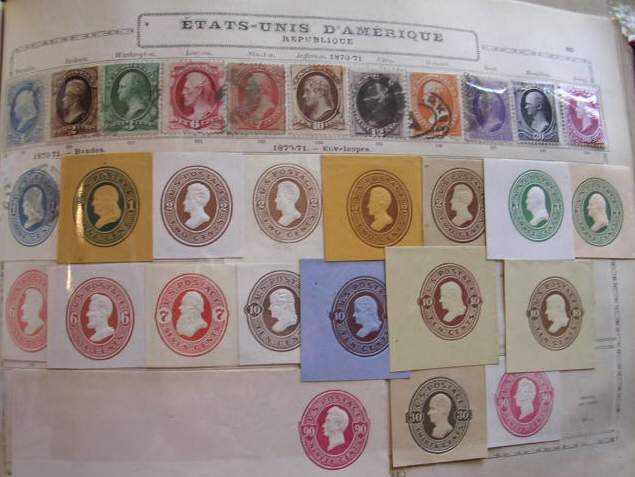 |
|
Send note to Staff
|
|
|
Replies: 24 / Views: 8,505 |
|




 Posted 04/09/2010 07:45 am


