Dear readers,
the information came from research many years ago,
when I first began collecting.
The late Mette Heindorff and I were discussing St Zeno
(the ancient letter carrier) and the Etruscans when the topic spun off into the importance of purple.
(illustrating how magically stamps can have you rambling away
in different directions all at once)
Some other interesting bits of stuff about purple:
Source: Webster's Revised Unabridged Dictionary (1913)
Tyrian \Tyr"i*an\, a. [L. Tyrius, from Tyrus Tyre, Gr. ?.]
1. Of or pertaining to Tyre or its people.
2. Being of the color called Tyrian purple.
The bright-eyed perch with fins of Tyrian dye.
--Pope.
Tyrian purple, or Tyrian dye, a celebrated purple dye
prepared in ancient Tyre from several mollusks, especially
Ianthina, Murex, and Purpura. See the Note under Purple,
n., 1, and Purple of mollusca, under Purple, n.
From Wikipedia, the free encyclopedia
Jump to: navigation, search
Tyrian purple is a purple dye made in the ancient Phoenician city of Tyre from a
secretion of Spiny Dye-Murex (Murex brandaris), a marine snail. A similar dye,
"Hyacinth Purple" was made from the related Banded Dye-Murex Murex trunculus.
The dye was expensive: Aristotle assigns a value ten to twenty times its weight in
gold! The fast, non-fading dye was an item of luxury trade, prized by Romans, who
used it to colour ceremonial robes. Pliny the Elder described the dyeing process of two
purples in his Natural History. The Roman mythographer Julius Pollux, writing in the
second century CE, asserted (Onomasticon I, 45—49) that the purple dye was first
discovered by Heracles, or rather, by his dog, whose mouth was stained purple from
chewing on snails along the coast of the Levant. The myth has been discredited as
mere cultural boasting. Recently, the archaeological discovery of substantial numbers
of Murex shells on Crete suggests that the Minoans may have pioneered the extraction
of Royal purple centuries before the Tyrians. Dating from colocated pottery, suggests
the dye may have been produced during the Middle Minoan period in the 20th–18th
century BCE.
The main chemical constituent of the Tyrian dye was discovered by Paul Friedländer
in 1909 to be 6,6'-dibromoindigo, a substance that had previously been synthesized in
1903. However, it has never been synthesized commercially.
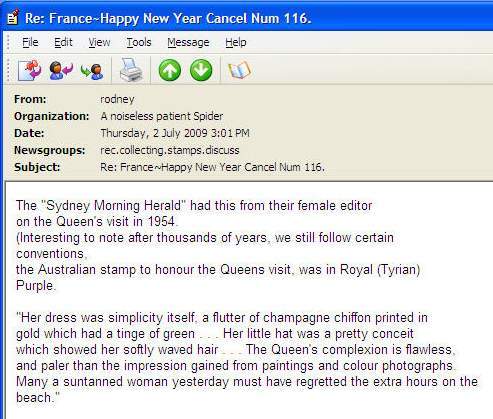
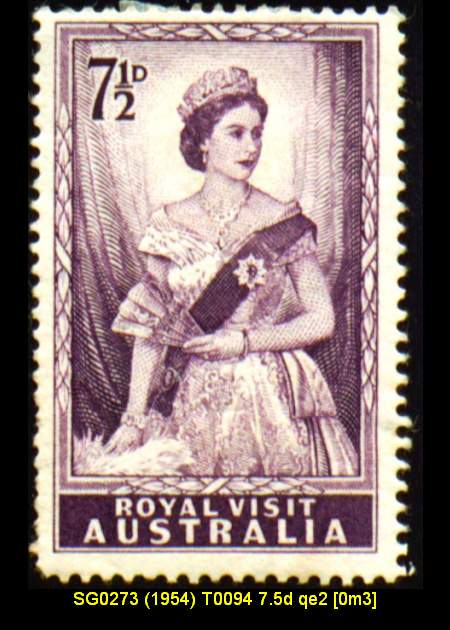
The Queen in Royal Tyrian Purple 1954
(apologies for poor scan)





 Posted 10/21/2010 01:00 am