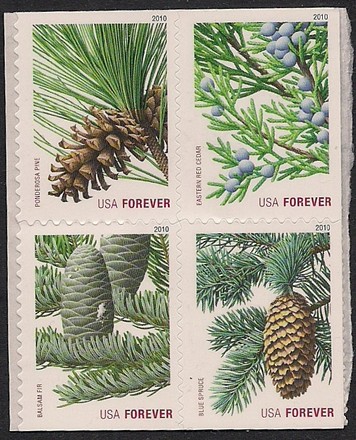
When US Forever stamps were issued a few years ago, someone came up with this summary of how it would be as an investment (not too good) and they were not even taking into account what we stamp collectors know about common stamps often going for a fraction of its face value:
Quote:When Forever Stamps were first introduced, lots of people seemed to think of them as a great investment. A Forever Stamp is sold at the current 1st class postage rate (41 cents when introduced) and is valid 1st class postage forever, regardless of the cost of 1st class stamps in the future.The investment angle works like this: Buy a lot of Forever Stamps at the current rate and then sell them for a price between what you paid and the new rate once stamp prices go up.
Here's the problem…
On a Long Term Basis:
The Postal Accountability and Enhancement Act, signed into law by President Bush in December of 2006, ensures that future price increases in postage will be kept below an inflation-based ceiling. That means that even if stamps cost 10 times what you paid at some point in the distant future, the value of the money you could get for selling them would be less than what it is worth today. Investments that don't keep up with inflation are, by definition, losing you money!
On a Short Term Basis:
While it's true that buying Forever Stamps right before a rate increase will yield a potential gain, the liquidity of stamp value is an issue as well as the small nature of the gain. Selling your stamps at a profit becomes more difficult because of transaction fees, such as those you might find on an auction site like
ebay. In order to make these fees small, relative to your profit, you have to sell A LOT of stamps in a transaction.Let's say you buy 10,000 stamps at $0.41 each before the price goes up to $0.42. You would have to spend $4,100 for your stamps. When the price went up, you'd have to sell it for something less than $4,200. Even if you got $4,199 and didn't have any transaction fees (unlikely), you'd be making less than 2.5% gain. Finding a buyer at that price might be difficult and a lower price would obviously lower your gain. The fact that there are many people who mistakenly think that investing in Forever Stamps is a good idea means that you'd have stiff competition. So you'd likely end up selling for much closer to $0.41 than $0.42 each.Selling in large quantities has a problem of its own.
If a buyer regularly needs a lot of postage, they are probably aware of the increase and buying Forever Stamps for their own use before the increase. If they use low quantities, they may be hesitant to purchase a large amount from you because, as described above, Forever Stamps are a poor long term investment. So unless they were certain that they would use the stamps faster than inflation made the discount moot, they'd be better off not buying from you.
Stocking up on Forever Stamps for your own use before a price increase takes effect is a way to save a little bit of money. Just remember to buy few enough that you can use them before inflation makes it a bad deal for you as well. I would say 6 months worth of stamps is about the limit of what makes sense.





 Posted 11/28/2010 01:04 am