| Author |
 Replies: 19 / Views: 7,049 Replies: 19 / Views: 7,049 |
|
Pillar Of The Community
Australia
2156 Posts |
|
|
I've been researching the KGV 1d reds with a view to establishing the shades of the two examples I own. This is the first: 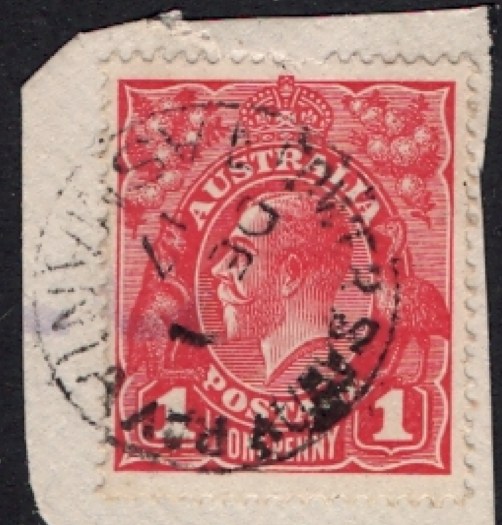 It's a slightly yellowish rose colour, perhaps rosine, but not like the shade of any stamp issued before 1918. However, it was cancelled in December, 1917, so I must be missing something. (It also has a cancel from a town in Tasmania I can't make out. If you know what it is, pls let me know!) And the second: 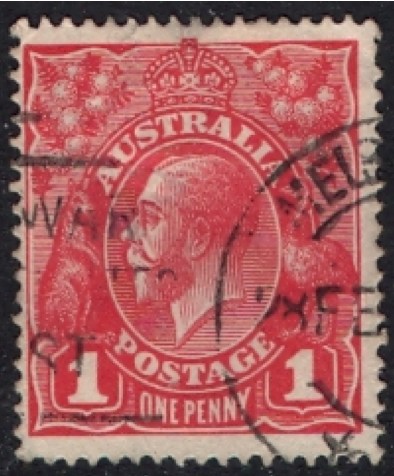 This one is more carmine, I guess. Suggestions welcome! |
|
Send note to Staff
|
|
|
|
|
Bedrock Of The Community
Australia
38679 Posts |
|
|
The postmark is "Lower Sandy Bay"
KG5 has given chapter and verse on the shades of
the KG5 sideface
you should search out his informative posts.
Myself, the best way to judge shades is have them
physically in fron of you, in bulk and
shift shades around in hiearchy.
Obvious shades become apparent.
|
Send note to Staff 
|
|
|
Pillar Of The Community
Australia
2156 Posts |
|
|
rod222, KG5's thread is pages and pages long. It is very informative, but it takes a good while to find the bits that you're interested in at any given time! I think the problem is definitely not having enough examples to go by. I've only got two of the 1d reds, but they don't look the same colour as any of those shown here: http://reviews.ebay.com.au/KGV-1d-R...000002973144Thanks for identifying the Tassie placename! I can see it easily now. |
|
Send note to Staff
|
|
|
Bedrock Of The Community
Australia
38679 Posts |
|
|
Not that I know anything about these, but
Alas!
that is because you are comparing apples to oranges.
Those shades refer to the RECESS printed animal.
Yours is the later typographed sideface.
The recess penny is a seperate animal altogether.
|
|
Send note to Staff
|
|
|
Pillar Of The Community
Australia
2156 Posts |
|
|
Sorry. rod222, I was referring to the whole sequence of articles starting at that URL. He goes through in the entire history of the shades of the 1d red in five webpages. My problem, in a nutshell, is that my stamp - the first one - looks identical in colour to this 'rose red' item being sold on ebay for $7.500 (described as G 102): http://cgi.ebay.com.au/ws/eBayISAPI...guide:2&rd=1Mine is definitely rose red, but the one for sale was printed in 1918. Mine was cancelled in December 1917. So it can't be the valuable rose red. I'm wondering what the difference is between that one and what, I suppose, must be SG 21cd. Last, according to Gibbons, all issues of this stemp were typographed, except for the unwatermarked first issue. Is that incorrect? |
|
Send note to Staff
|
| Edited by jimjamtwo - 02/18/2011 01:13 am |
|
|
Bedrock Of The Community
Australia
38679 Posts |
|
|
No that's right,
the first was reces printed,
with different mixes of ink over the period,
hence the hunt for shades.
Yours can be identified by wmk.
|
|
Send note to Staff
|
|
|
Pillar Of The Community
Australia
3547 Posts |
|
|
There are a couple of points to bear in mind here. First, the ebay stamp has a Drury Certificate - the gold standard for the identification of 1d Red shades. The shades distinguished by the specialists can be very subtle, so you need someone like Drury to pass judgment. Of course, there are also the watermark and paper differences in these stamps as well, which can make a vast difference in value. If you think you're onto something, I'd send it to Drury to be certified. Then you can be quite certain of what you have. Secondly, anyone can ask any price for any old rubbish on ebay ( http://www.stampboards.com/viewtopi...f=21&t=379). The test is whether they sell for the price being asked, and to a genuine buyer. I'm not for a moment suggesting that this particular ebay item is rubbish. I do wonder if it will sell at that price, that's all. More generally, though, beware of ebay asking prices. They aren't necessarily a reliable guide to values. |
|
Send note to Staff
|
|
|
Pillar Of The Community
Australia
2156 Posts |
|
|
Of course you're right there, tonymacg. In this particular case, I was curious because the Gibbons catalogue doesn't list any KGV stamps with CVs anywhere near as high as the one listed on ebay, so it really made me wonder, especially when - as far as you can tell these things through scans - my stamp appeared to be an identical colour. I've done a fair bit of research on the colour issue today and found some really good sources of information, such as this one: http://www.australianstamps.hsservi...data/node/45 and, best of all, this one: http://www.glebecoins.net/kgv/The_K...v_1d_red.htmSo I'm making progress, but I wouldn't seek to have the stamp expertised unless I felt confident that it was one of the rarest shades. Otherwise, why bother? (I'm sure certification isn't cheap!) |
|
Send note to Staff
|
| Edited by jimjamtwo - 02/18/2011 07:55 am |
|
|
Pillar Of The Community
Australia
3547 Posts |
|
|
If you really want to get half-serious about the 1d Reds, you need to beg, borrow or steal the Australian Commonwealth Specialists Catalogue volume for the George V Heads. Then, when you want to get fully serious, there are books devoted to the 1d Red! |
|
Send note to Staff
|
|
|
Pillar Of The Community
Australia
2156 Posts |
|
|
tonymacg, my ambitions are extremely limited - I just want to know which shades my two 1d reds are.
Then I'll worry about the 2d reds and the 1d greens! |
|
Send note to Staff
|
|
|
New Member
Australia
3 Posts |
|
|
jimjam2, take care with matching colours purely from internet photographs, get yourself a set of Stanley Gibbons colours, they will help you sort out the shades.
The colors can be distorted depending upon the settings on your screen and the scanner that took the scan.
|
|
Send note to Staff
|
|
|
Pillar Of The Community
Australia
2156 Posts |
|
|
tonykgv, I appreciate that. But it creates an insurmountable difficulty if the value of a given stamp is determined predominantly by its shade. My stamp is more yellowish than the scan above indicates. It considerably paler than the second stamp in my scan, yet the scan makes it look as though it could even be redder. But it's actually the second stamp that is redder (here it looks pinker!)
We've all heard about the famous 'salmon eosin' variety - but scans of this shade clearly aren't reliable. My stamp looks like one of the scans of this shade I've seen online but not like another.
It's all so very frustrating!
I'm not sure what the alternative to using net resources is, though, for not every owner of a 1d red can afford to ask Michael Drury for a certificate!
This makes me wonder: how does Drury decide what shade a stamp is?
And is he the only person competent to decide? |
|
Send note to Staff
|
| Edited by jimjamtwo - 02/19/2011 02:12 am |
|
|
Pillar Of The Community
Australia
4034 Posts |
|
|
 To our forum family tonykgv. Really like to see kgv in your user name.  Great comment. KGV Hi! jimjamtwo All the best with your penny red shades challenge.  Patience helped me the most in 1d red shades. Happy stamping KGV. |
|
Send note to Staff
|
|
|
Pillar Of The Community
Australia
4034 Posts |
|
|
Will try to do the impossible.
1st stamp.
If it is rough paper it is Rose Red aniline Aug 1917.
If it is smooth paper it could be.
Rose ( pale to bright) Jan 1917
Rose-Carmine ( pale to bright ) Mar 1917
Salmon ( Pinkish to Reddish ) Nov 1917
This is as far as I can go and rest is a guess. Hope it helps. Your date on the 1st stamp makes it Salmon. The 2nd stamp looks as you say Carmine aniline.
Shades are just not that simple. Happy stamping KGV |
|
Send note to Staff
|
| Edited by KGV Collector - 02/19/2011 03:08 am |
|
|
Pillar Of The Community
Australia
2156 Posts |
|
|
Thanks for the try, KGV.
I don't know how to tell rough paper from smooth, but my copies both seem very smooth!
A general question: my first stamp is a kind of yellowish red. Yet I can't find any references to 1917 KGV 1d reds that are yellowish.
Could that be significant? |
|
Send note to Staff
|
|
|
Pillar Of The Community
Australia
4034 Posts |
|
|
Sometimes the owner of the stamps might use them 2 years into the future.
Having pale to bright in the shade description means to me bulk variation in the shade group
There are over 244 named penny red shades.
Fadling and changelings also complicate the whole process.
Happy stamping KGV |
|
Send note to Staff
|
|
|
Replies: 19 / Views: 7,049 |
|




 Posted 02/17/2011 10:39 pm


