Stamp Community Family of Web Sites
Thousands of stamps, consistently graded, competitively priced and hundreds of in-depth blog posts to read


Stamp Community Forum
 
Username:
Password:
Save Password
Forgot your Password?

This page may contain links that result in small commissions to keep this free site up and running.

Welcome Guest! Registering and/or logging in will remove the anchor (bottom) ads. It's Free!

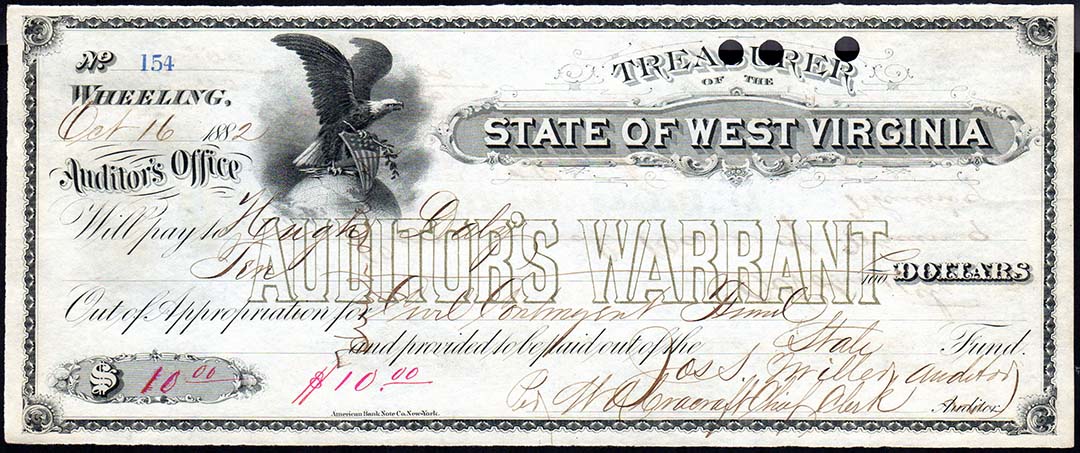
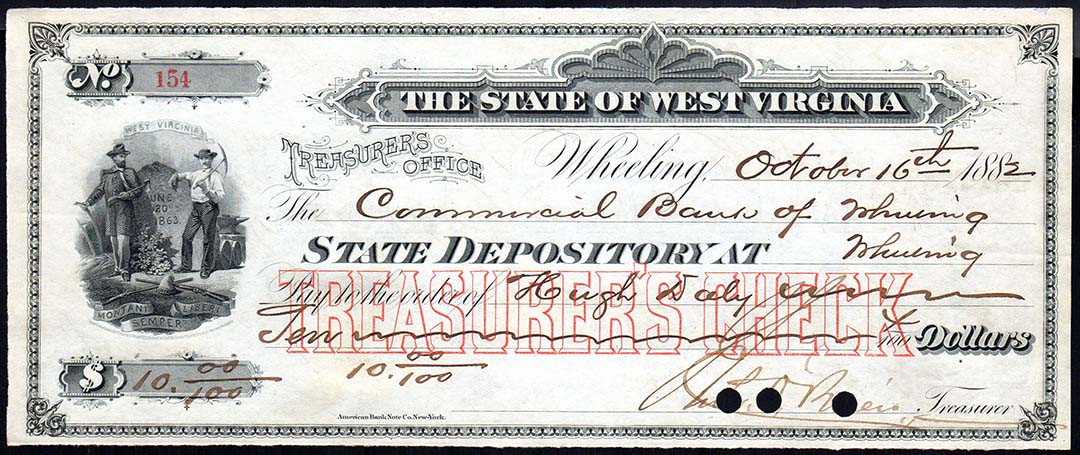
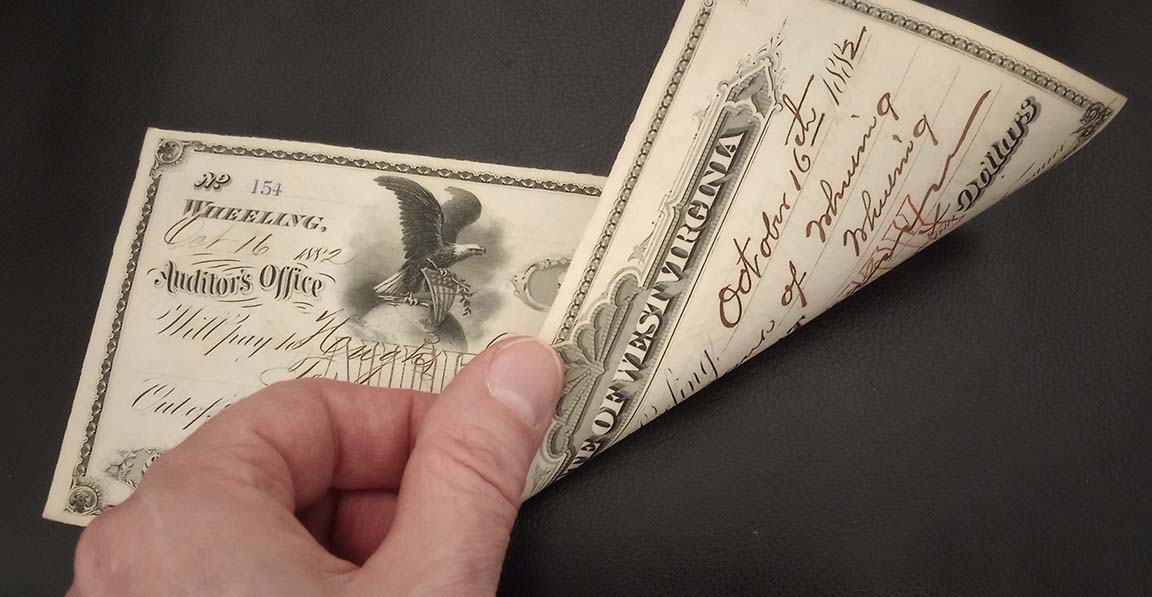
Two-Sided West Virginia Auditor's Warrant 1882

 
To participate in the forum you must log in or register.
Author Previous TopicReplies: 2 / Views: 645Next Topic  
Pillar Of The Community
United States
1804 Posts
Posted 10/08/2025   3:50 pm  Show Profile Bookmark this topic Add GregAlex to your friends list Get a Link to this Message
This is the first time I've seen something like this: a two-sided check! Technically, I think it's a check and a warrant. Maybe someone here can help figure out the accounting on this. It looks like the funds ($10) were paid to the recipient, Hugh Daly, by the state auditor using a warrant, which was then drawn from the State Depository at Wheeling using the Treasurer's Check printed on the flip side. Both sides have the same serial number.

In any case, it's an attractive ABNC engraved piece with twice the bang for my buck.


Send note to Staff

Pillar Of The Community
United States
1847 Posts
Posted 10/09/2025   03:41 am  Show Profile Bookmark this reply Add cjpalermo1964 to your friends list  Get a Link to this Reply
In 1872 West Virginia, auditor's warrants and checks were part of a two-step payment system used for state financial control and accountability.

The auditor's warrant was essentially an authorization to pay, not the payment itself. It served as expenditure control, with the state auditor verifying that funds had been legally appropriated by the legislature for the specified purpose, that the payment to the specified person was legitimate and properly documented, and that sufficient funds existed in the designated appropriation. The warrant also created an accounting record that the state owed this money, and caused accountants to make book entries, reducing the available balance in that appropriation account. Additionally, it gave the state treasurer the legal authority to make the payment from the general fund.

The process worked in two steps. First, the auditor issued the warrant after approving the claim, essentially declaring that the state owed this money and should pay it. The payee, the payee's contract sponsor, or another interested government official would have prepared or requested the warrant. That person then took the warrant to the treasurer. The treasurer then drew a check against the general state fund, which was the state's main bank account, based on the warrant's authorization.

This separation of duties was a key internal control mechanism. The auditor, as a legislative branch officer, verified legitimacy and tracked appropriations, while the treasurer, as an executive branch officer, actually held and disbursed the money. This meant that no single official could both authorize and make payments, which prevented fraud.

The warrant you have is historically significant as evidence of this nineteenth-century governmental accounting practice, showing the financial controls West Virginia used during the Reconstruction era.
Send note to Staff  Go to Top of Page
Edited by cjpalermo1964 - 10/09/2025 03:42 am
Pillar Of The Community
United States
1804 Posts
Posted 10/10/2025   12:44 am  Show Profile Bookmark this reply Add GregAlex to your friends list  Get a Link to this Reply
Terrific explanation! Thanks so much for laying out the process. Now the double-sided financial instrument makes much more sense. It's actually quite practical -- I'm surprised more state governments didn't do this.
Send note to Staff  Go to Top of Page
  Previous TopicReplies: 2 / Views: 645Next Topic  
 
To participate in the forum you must log in or register.

Go to Top of Page

Disclaimer: While a tremendous amount of effort goes into ensuring the accuracy of the information contained in this site, Stamp Community assumes no liability for errors. Copyright 2005 - 2026 Stamp Community Family - All rights reserved worldwide. Use of any images or content on this website without prior written permission of Stamp Community or the original lender is strictly prohibited.
Privacy Policy / Terms of Use    Advertise Here
Stamp Community Forum © 2007 - 2026 Stamp Community Forums
It took 0.11 seconds to lick this stamp. Powered By: Snitz Forums 2000 Version 3.4.05