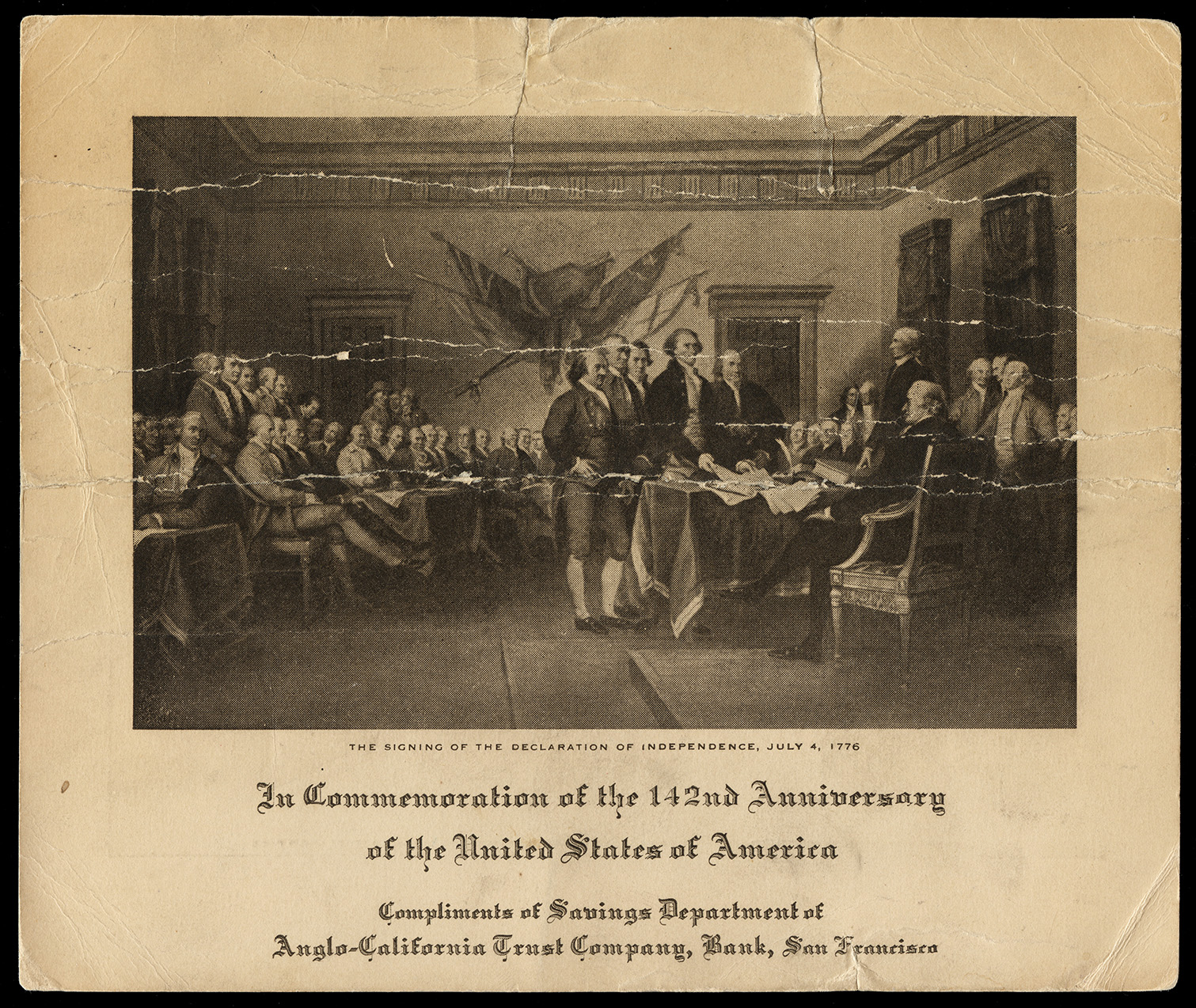
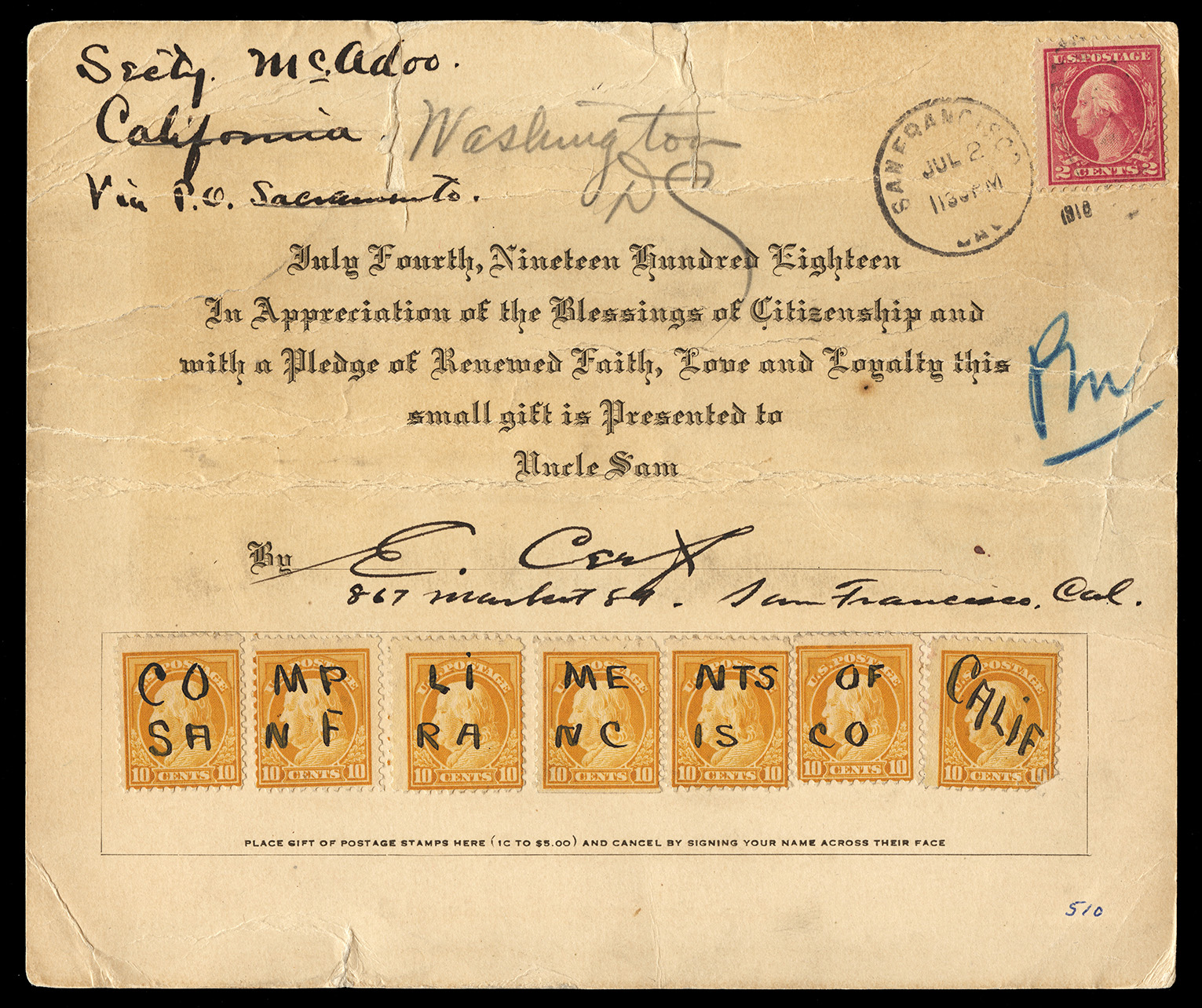
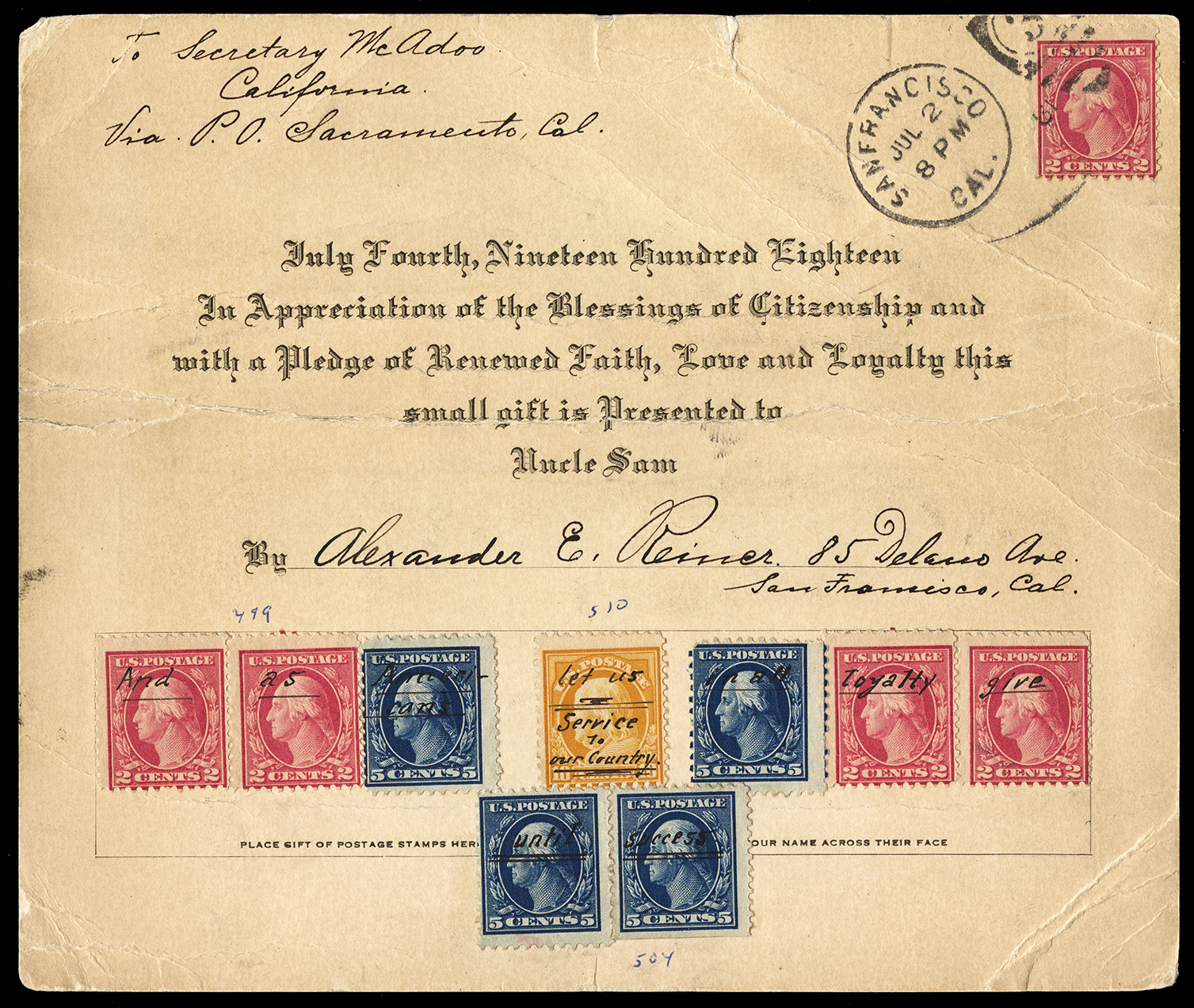
I have had one of these for years. Given the printing layout I did not think it was a one of a kind creation and eventually saw one or two others. My example of course includes parcel post stamps and many dollars of stamps.
Note the date, July 4th, 1918, the heart of WWI. The day was a special day of patriotic activity both domestic and abroad. Thankful US Citizen and legal residents showed their patriotism, these cards being one such way.
Quote:
Celebrating the 4th of July during World War I
The day the Stars and Stripes flew from Victoria tower
By Stuart Irwin
The Fourth of July holiday is an occasion for the United States of America to celebrate and commemorate the birth of the nation. It is interesting to recall how this holiday was celebrated during the years America participated in World War One. The entry of the United States into the war provided a massive boost to the Allied powers and marked a significant moment in the conflict.
Unsurprisingly, therefore, the July 4 holiday excited much interest among the Allied powers. In 1917, The Times newspaper, in London, claimed that '[t]here have been many memorable Fourths of July in the past one hundred and forty-one years, but never one so pregnant with the drama of great events as this'. For example, by the order of the King, the stars and stripes flew from Victoria tower.
The celebrations in France were even more extravagant. The New York Times reported on July 4, 1918 that 'Paris turned out today as almost never in its history to celebrate the Fourth of July. The French capital not only extended a royal welcome to the Americans here, but made a thorough holiday of the day on its own account.' The events included American troops marching through the city, where they were welcomed by '**crowds of people that jammed every available inch of space and every window in the buildings along the line of march, on roofs, and even in trees, cheered themselves hoarse'. Most notably, a ceremony was held to mark the renaming of Avenue du President Wilson.
Such displays of American patriotism highlight the sense of gratitude and unity in purpose that was felt by the Allied powers. Indeed, The Times offered an eloquent narrative of the significance of having America enter the war:
They will have their reward not only in helping to save civilization from its present agony, but in an America ennobled by sacrifice, strengthened by a new consciousness of unity, made more efficient for all the purposes both of war and peace, and broadened by contact with world-wide interests and problems. The political balance of the universe shifted when General Pershing's troops landed in France, and America, in entering the war, has also entered the world – to play in it, we are very sure, side by side with the Allied democracies, a vigorous and inspiring part.
Closer to home, on July 4 1918, President Wilson delivered an address at Mount Vernon, Virginia where he sought to link the endeavours of George Washington and the other Founding Fathers of the United States with the present efforts in the battlefields of Europe. Wilson told his audience the following:
We intend what they intended. We here in America believe our participation in this present war to be only the fruitage of what they planted. Our case differs from theirs only in this, that it is our inestimable privilege to concert with men out of every nation what shall make not only the liberties of America secure but the liberties of every other people as well.
It is fascinating to see how President Wilson used the July 4 holiday as an opportunity to talk about the cause of liberty, and how the values and ideals of America's forefathers remained equally potent in the twentieth century.
**Bracketed [ ] lower case 'c' indicated a change from the original uppercase in the quote activated the censoring mechanism of SCF so I removed the brackets.
See:
https://www.worldwar1centennial.org...ing-wwi.html to view photographs
Quote:
Gifts to the U.S. Government
The Bureau of the Fiscal Service may accept gifts donated to the United States Government to reduce debt held by the public.
The account was established in 1843 to accept gifts, such as bequests, from individuals wishing to express their patriotism to the United States. Money deposited into this account is for general use by the federal government and can be available for budget needs.
These contributions are considered an unconditional gift to the government.
Acting for the Secretary of the Treasury, Fiscal Service may accept a gift of:
• Money, only on the condition that it be used to reduce debt held by the public.
• An outstanding government obligation, only on the condition that the obligation be cashed and the proceeds used to reduce debt held by the public.
• Other intangible personal property only on the condition that the property is sold and the proceeds used to reduce the public debt.
• Gifts to reduce debt held by the public may be inter vivos (from a living person) gifts or testamentary bequests (in a person's will).
In 1918 all profit made by the USPOD, and monies collected by the USPOD as war bonds, saving stamps, the WWI Parcel Taxes and custom clearance fees, were directly forwarded to the US Treasury.
Therefore these purchased but unused, affixed and demonetized by manuscript cancels were a intended as a direct gift to the US Government. By forwarding to Sec. McAdoo, the total of such gifted via the USPOD monies could be recognized and redirected from general USPOD profits.
Here the stamps represent a fiscal action of a direct gift to the US Government in support of the costs of WWI. Unlike war saving stamps and war bonds, this money from common folks did not need to be repaid.
Edited for minor English issues.



 Replies: 4 / Views: 202

 Posted 07/22/2026 11:19 am