Here are four single stamps depicting Russian historic events.
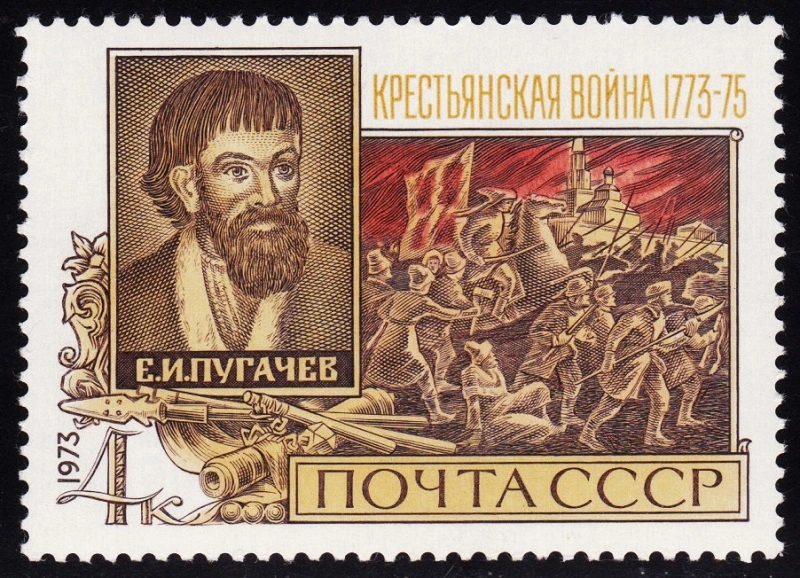
Bicentenary of Peasant War, designed by Valery Pimenov, engraved by Vladimir Smirnov and issued on September 23, 1975.
Yemelyan Pugachev (c. 1742 -1775) was a Don Cossack who led the great Russian Peasants' War of 1773 -1775 against the government of Catherine the Great. Claiming to be the deposed Emperor Peter III, he attracted Cossacks, peasants, serfs and other dissatisfied groups to his cause. The scene on the right of the stamp shows Pugachev's rebel forces advancing during the uprising, symbolizing the large-scale popular revolt that spread across the Volga and Ural regions before being suppressed by the imperial army.
Birth Centenary of S.V. Ivanov (1864-1910), designed by Roman F. Zhitkov, engraved by Ivan Sapronov and Vladimir Smirnov and issued on December 22, 1964. The stamp shows the portrait of the artist based on painting by Osip Emmanuelovich Braz (1873-1936). On the right, detail from the painting "Military Campaign of the Russians in the 16th Century", 1903.

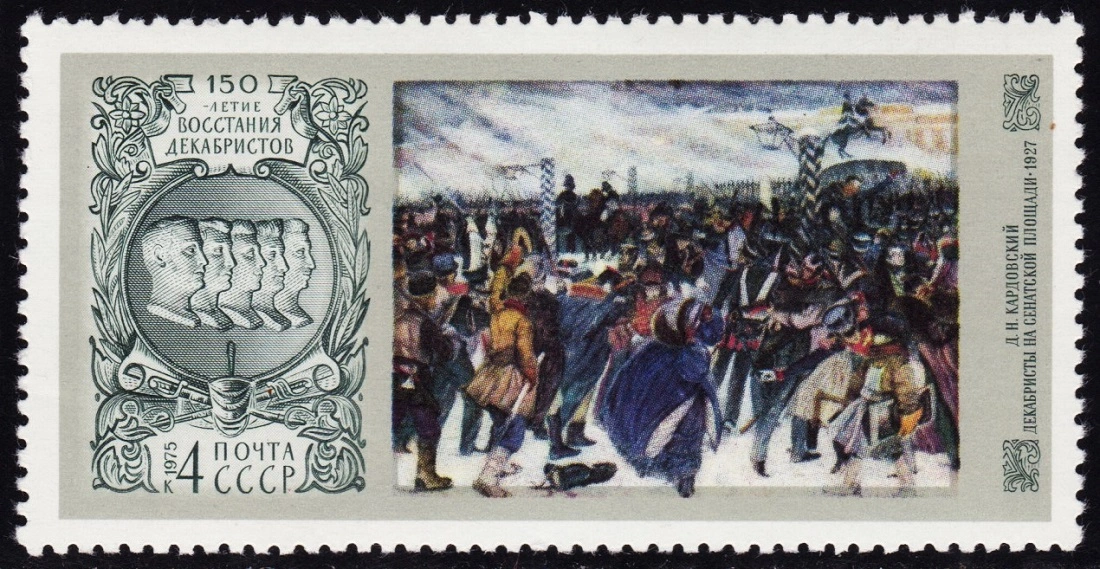
150th Anniversary of Decembrist Uprising, designed by Ivan Martynov | Nikolai Cherkasov, monochrome green frame engraved by Ivan M. Mokrousov and issued on November 12, 1975. The colorful painting is lithography.
The Decembrist Uprising was a failed revolt by liberal Russian army officers in St. Petersburg in December 1825, demanding political reform and opposing the accession of Tsar Nicholas I. The stamp reproduces Dmitry Kardovsky's (1866–1943) painting The Decembrist Revolt at Senate Square, showing the confrontation between the rebels and imperial forces. the small medallion at left shows profiles of five prominent Decembrists.
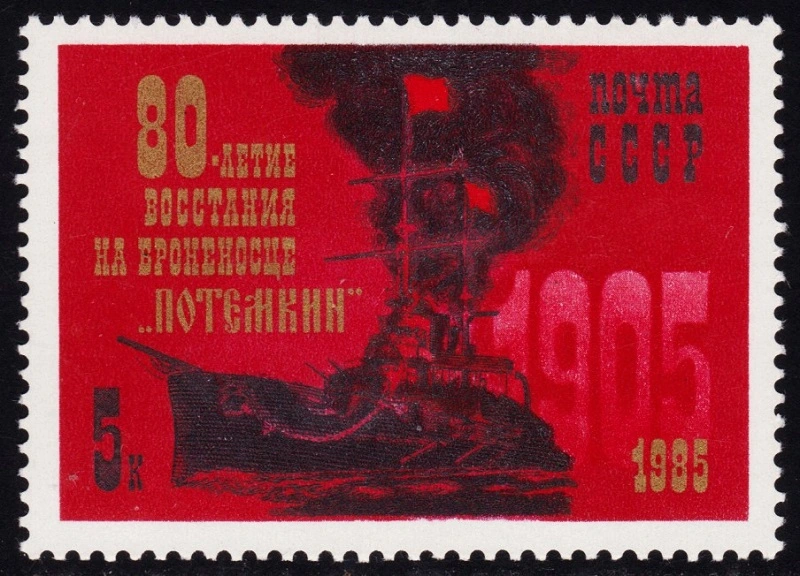
The 80th anniversary of battleship "Potemkin" Rebellion, designed by
Alexander Tolkachev and issued on June 14, 1985. The black color is engraved, Red and gold colors are photogravure.
The Battleship Potemkin mutiny began in June 1905, during the Russian Revolution of 1905, when sailors aboard the Potemkin rebelled against their officers after years of harsh discipline and poor conditions, with spoiled meat triggering the immediate confrontation. The mutineers took control of the ship and sailed to Odessa, where unrest was already underway; although the revolt ultimately failed, it became a powerful symbol of resistance to Tsarist rule. The stamp depicting the battleship under a red revolutionary flag.





 Posted 07/15/2026 10:16 am