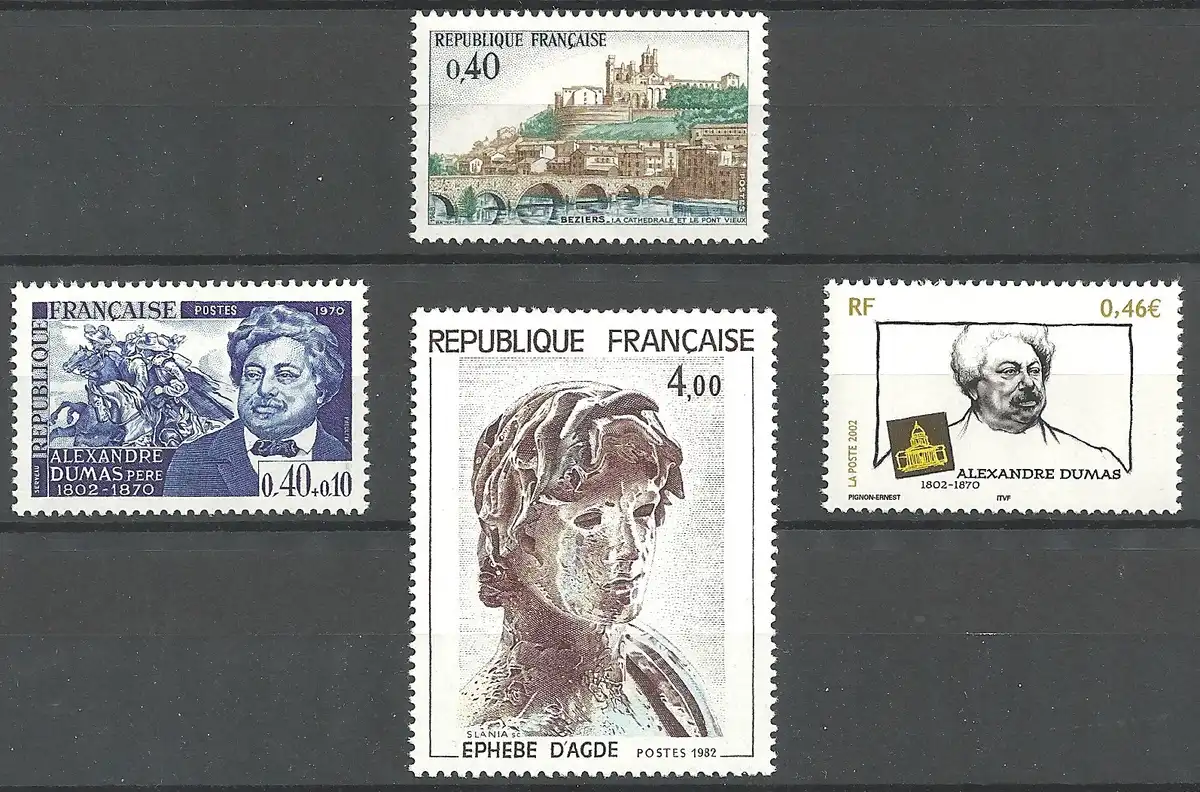
So, let's move further on – along the coast line. There one finds a lot of Étangs, these are more or less from the sea precluded waters with long beaches to the seafront side.
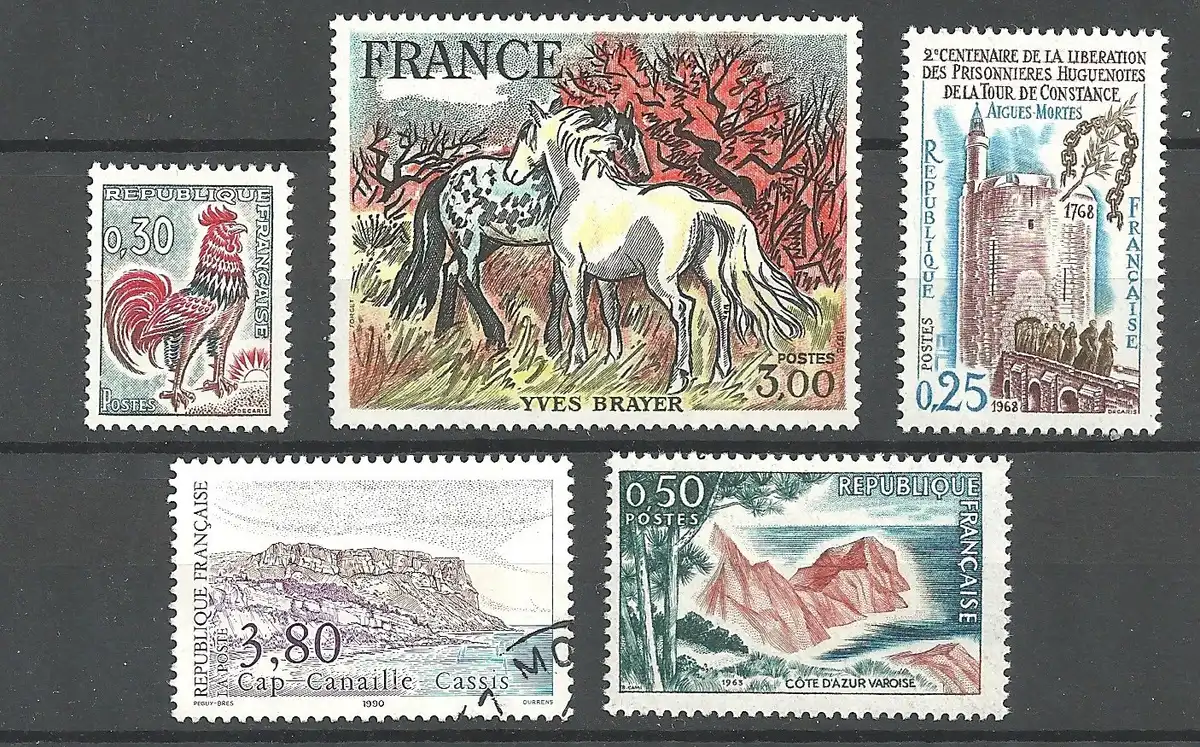
There the German masculine traveller has to proof himself towards his local contender. Those who mean well might find them proud, others would say vain. Now, that the French emblem is the cock (stamp above left), no wonder that one's own comb swells when being confronted with a overdoing bragging rooster. However, I remember such a moment.
Well yes, the German-French antagonism. What does Jacques Rivière (French author, who was 1914 taken prisoner of war for four years in Germany, whose impressions he later described in his essay „L'Allemand") say to that:
• Well, Germans may be supposed to be strong and steadfast, but aren't in the least qualified to be fervent lovers. They lack in wildness and sensuality, thus unable to comprehend live as an adventure.
• As with the French their souls are breathing to swiftly, they jump to conclusions and are willing to accept any kind of injustice, as they might always justify it with claiming to be French and thus being possessed with a unique grade of passion.
I found these thoughts entertaining, so I shared them today. From a philatelic perspective, it's true that Germans are killjoys (stamps in DEM are no longer valid), and the French simply allow more variety (as almost all stamps are still valid for postage – and yes, you will find me harping on this point all the time).
But let's return to the local geography: one passes the village of La Grand Motte (true fact: it was the French answer to the success of the Spanish in regards to organise and attract mass tourism, a short while ago lauded in culture column in my German newspaper). On that day I had no luck in finding an accomodation to stay there, but the tourist information helped me secure a room in a historic inn in nearby Aigues-Mortes (a fantastic little romantic fortified town)—see the stamp in the upper right corner. From time to time you've to have a little luck in life.
And now we advance further through the glowing hot area of the Carmargue, for me it seemed so hot and life hostile that I couldn't take any pleasure in the region. It is famous of its white horses, which are in fact to be found there on the pastures. They have been honoured by the artist Yves Brayer by a famous painting, which was a template for a stamp (above middle).
The next task was to cross the river Rhone, the river delta was an obstacle and I couldn't make out any opportunity to cross it along the coast line. Rather I saw on the map only cul des sac-roads and industrial compounds. Therefore, I decided to go over the stream near Arles und stay a day in the interior. After Salon en Provence I swung in again in direction of the coast and at Cassis hit the seaside again. The beauty of the region has been acknowledged by the French postal administration (stamp down left).
West of Toulon the worth a visit department Var begins (stamp below left, pines and a remarkable coast line are typical of the region). It starts to get posh, and some nice accomodations were to be found alongside the road. One of which stood out by its club-like arrangement which remembered me of the golden era of the 1960ies (during which a in Germany famous heir and playboy Gunter Sachs was on the prowl on his Mammuth-motorcycle).
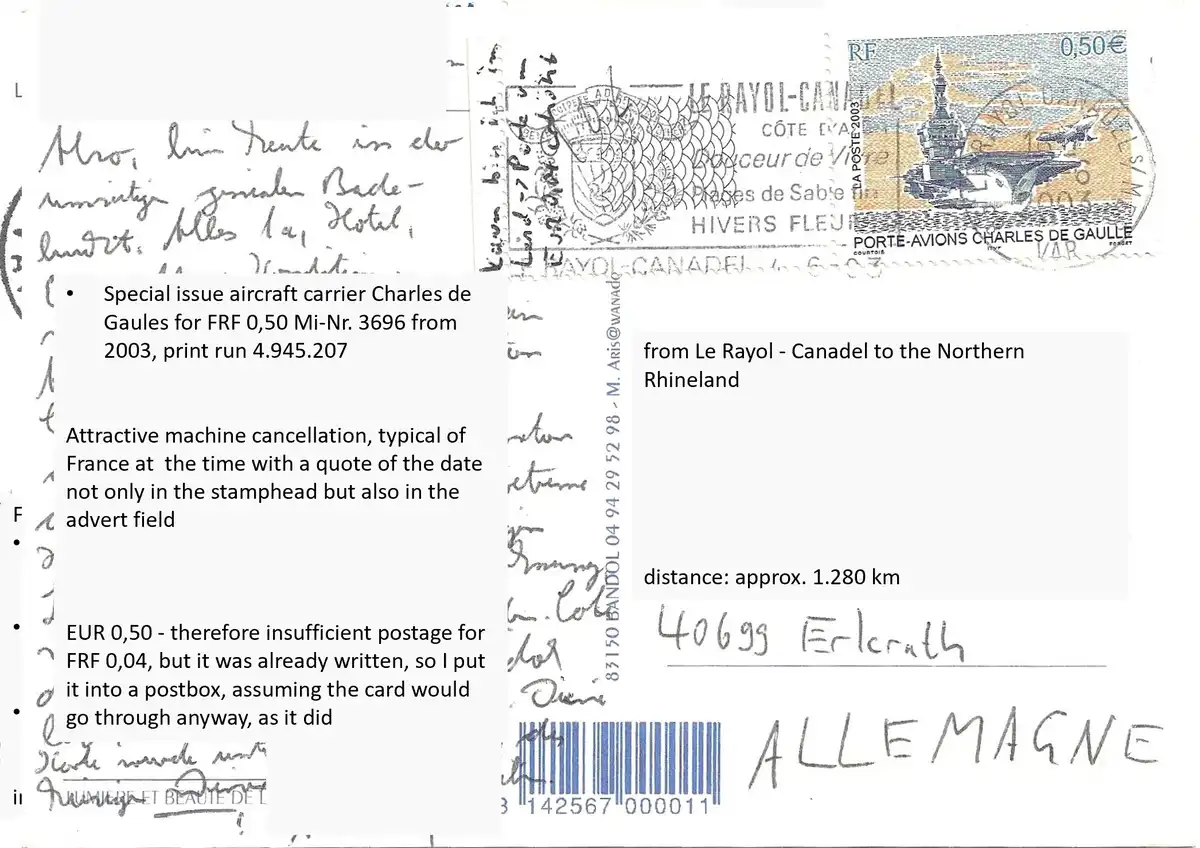
And life is full of surprises: one befell me in La Londe: where I was informed by a charming female postal clerk that the French Post had increased their postage rate by EUR 0,04 to EUR 0,54. And charming lady or not, I had to buy and put on extra postage on the already prepared postcard.
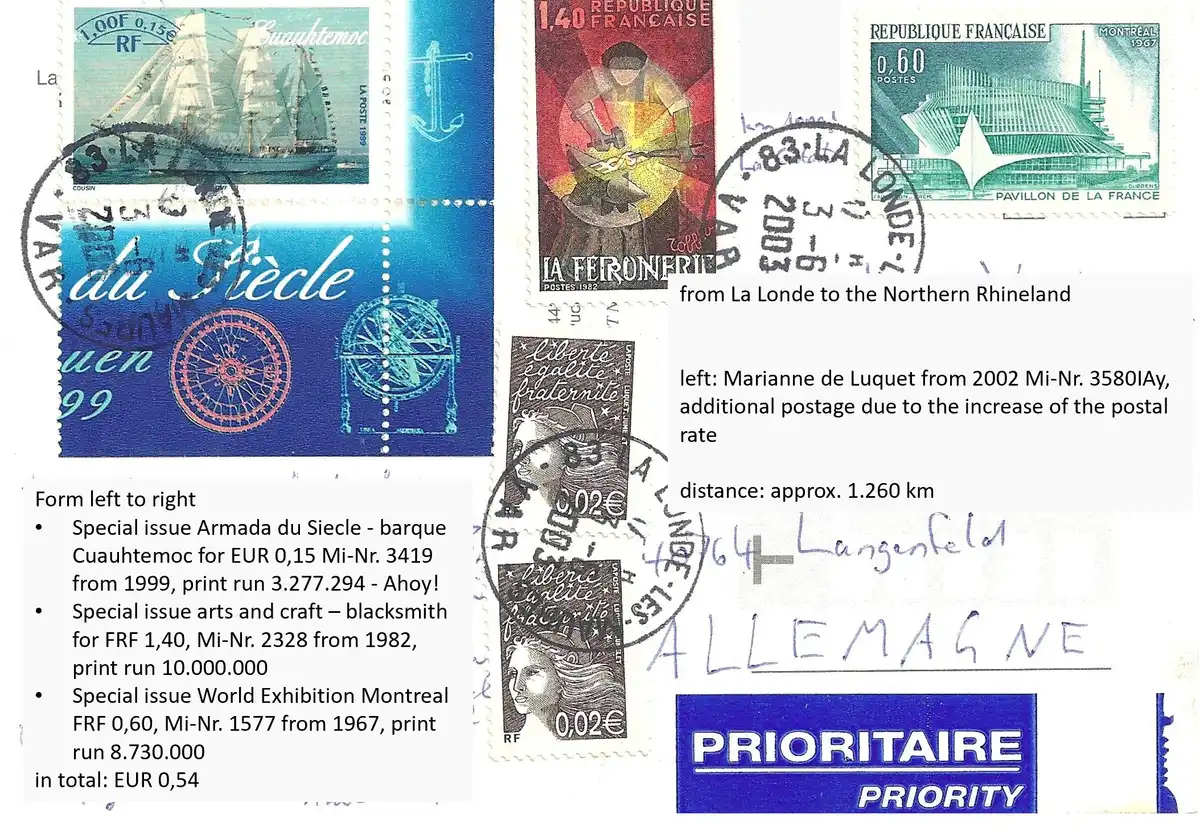
From Rayol Canadel I sent another card to Germany (but put that in the post box to dogde the EUR 0,04 surcharge, that worked) before entering a beautiful scenic road which led to St. Tropez. I recommend to visit the charming harbour area. I found it interesting to see that all the impressive yachts showed the colours of some tax evasion-destination with Union Jack-quotes on their flags, not one had the French tricolore at the stern.
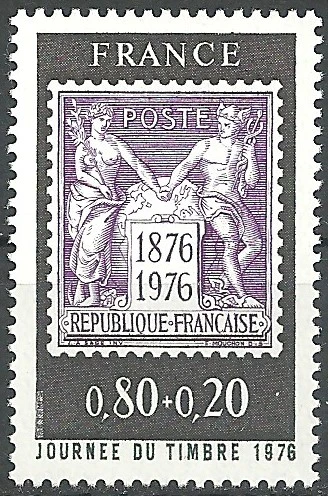
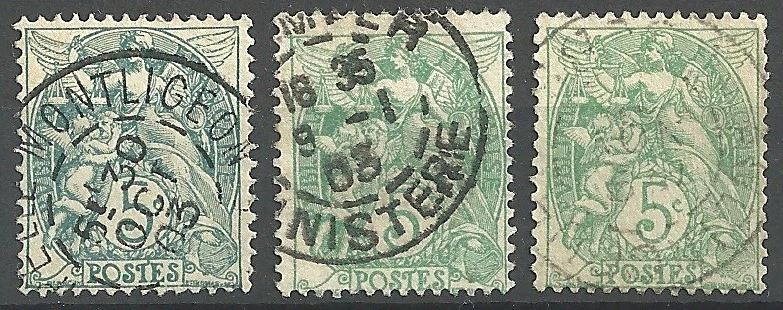
Anything missing?. Oh – yes, women. Right, I have something for you here. The issues as per type Blanc from 1900, that was the template for the small amount issues (below Francs 0,10) of that era.
Displayed we find a female goddess of liberty, with a phyrgian cap on, the left breast uncovered (as with the famous picture by Delacroix showing the ambush on the Bastille). A pair of scales in the right hand stands for equality, the embracing puttos for fraternity.
And I caught another detail, that is a mirror in the hand of Lady liberty. The mirror is known as an attribute of the goddess Aphrodite, who is the goddess of love and beauty. On the stamp Lady Liberty holds as well a branch of laurel in her left hand.
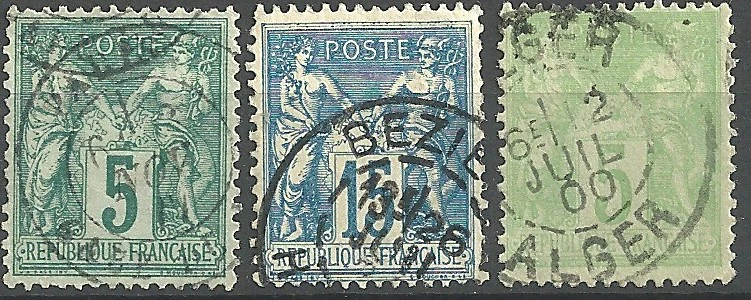
Type Blanc was in circulation until 1932, I find it interesting to see how many different hues can be discovered, it's my pleasure to show some examples.
So much for today for all friends of practised philately.



 Replies: 78 / Views: 12,391

 Posted 08/16/2026 01:15 am