| Author |
 Replies: 25 / Views: 729 Replies: 25 / Views: 729 |
|
|
|
Moderator

United States
5108 Posts |
|
|
Makes perfect sense to me, as long as the 25% incentive results in at least 25% more buyers due to that incentive. Anything less than 25% new buyers is a loss, and anything more is a gain.
I guess the long term effect could be that buyers now know that an incentive will be offered in the last quarter and will hold back their purchases until that quarter, resulting in a net loss overall. It's kind of like watching my spouse wait until that one special day at Kohl's when the prices dramatically drop, you get double coupons, and lots of other incentives. Any other day we shop there, she says, "Nobody pays those normal prices. They always wait until the sale days." |
Send note to Staff 
|
|
|
Bedrock Of The Community
12777 Posts |
|
|
Quote:
I guess the long term effect could be that buyers now know that an incentive will be offered in the last quarter and will hold back their purchases until that quarter, resulting in a net loss overall. It's kind of like watching my spouse wait until that one special day at Kohl's when the prices dramatically drop, you get double coupons, and lots of other incentives. Any other day we shop there, she says, "Nobody pays those normal prices. They always wait until the sale days." Exactly this. |
|
Send note to Staff
|
|
|
Pillar Of The Community
United States
6470 Posts |
|
|
Quote:
Back to the membership, now imagine you offer a 30-day discount to incentivize sales. So you offer $11.25 off the product you sell. Now, in a given month, you sell 100 memberships, but with a discount, you sell 150.
You "spent" $562.50 on advertising (as evidenced by this thread, etc.) in lost revenue, and in exchange, you generate an extra 50 memberships. So instead of $4,500 in membership dues, you generate $6,750 in membership dues. History tells us that 2/3rds of the people who sign up for a membership above $25 will renew year over year. To be fair, that isn't the entire picture, as those additional 50 memberships aren't pure profit. There is a cost associated with those 50 memberships: the 50 copies of The American Philatelist and their associated printing and (likely the biggest component) the mailing costs. I agree with your general premise, but it's not pure gain. |
|
Send note to Staff
|
|
| Edited by revenuecollector - Yesterday 5:40 pm |
|
|
Valued Member
United States
291 Posts |
|
|
Quote:
To be fair, that isn't the entire picture, as those additional 50 memberships aren't pure profit. There is a cost associated with those 50 memberships: the 50 copies of The American Philatelist and their associated printing and (likely the biggest component) the mailing costs. And if 100 percent of The American Philatelist was paid for by membership dues this would, theoretically, be a significant cost. So we'll earmark the $15 of the $45 that is the annual support for the AP from dues and the loss might come from another service. While members did help underwrite major items (the digital library, Stamp SCHOOL are 100 percent donor financed). The business operations still exist and pay for the rest. Though Roger Albanese, who contributed $2.2 million to debt retirement was never an APS member and the last $1 million of the debt was paid off by APS surpluses accumulated over a five year period (some commenter here has been told that before but ignores it). I am struggling to reconcile why a discount is so problematic. If the APS spent $15,000 advertising membership, people would hail the genius of it. But discounting the membership and letting the grassroots push it out is effectively another aspect of the same activity. But somehow, it's not viewed the same way. It is a business expense much the same. |
|
Send note to Staff
|
|
|
Pillar Of The Community
United States
1874 Posts |
|
|
It's just because any time-limited discount devalues the MSRP of the product and makes prospective customers wonder what the real cost and value of the product are, and why they should ever pay full price as opposed to waiting for another discount. It makes them wonder why the organization can't permanently reduce the price. It also makes people who just paid the full price feel like chumps. |
|
Send note to Staff
|
|
|
Pillar Of The Community
United States
4520 Posts |
|
|
I went to a daytime luncheon (cannot believe alcohol was served) for the 50th anniversary of the Triangle Stamp Club that meets south of Chapel Hill, NC. Kirk Gills, APS Executive Director, gave an APS update and there was a presentation by James P. Mazepa. Gillis references the "Silver Tsunami" as the target for APS membership growth given the increasing numbers of seniors. It will not be by done by placing ads but trying to connect via other interests. He stated an ad in the AARP magazine was $150,000. I did ask about StampEd and he said it was halted given it was not affordable to print. The new website will be launched in January. There will be a new e-commerce platform will launched in 2027 so stampstore is coming back too. A draft of a new education course is available You https://360.articulate.com/review/c...9d0ba/reviewSee more here in the APS newsletter. https://aps.cvtrk.io/cv/viewemail/3...6D1EC68C9D2E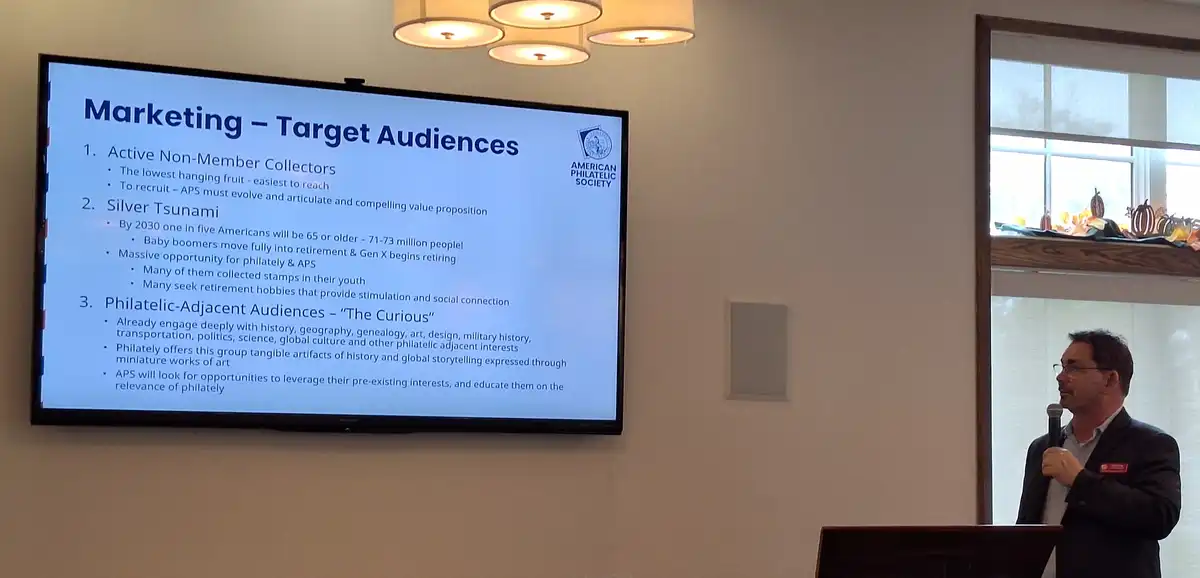 |
|
Send note to Staff
|
Al |
| Edited by angore - Today 3 Hrs 45 Min ago |
|
|
Pillar Of The Community
United States
4186 Posts |
|
|
I'm sorry, but the "silver tsunami" is hardly a new revelation. Also, we have already passed the peak number of boomers retiring each year and the oldest boomers are now already 80 and if they haven't joined yet, they are unlikely to.
I do like the idea of targeting history buffs, although I don't know how they will approach them. |
|
Send note to Staff
|
|
|
Pillar Of The Community
United States
4520 Posts |
|
|
Nothing new about it except it may be a statement they are not targeting young ones specifically but going after people that may have the time and interests to get in involved in stamps. APS is hiring a PR firm to find something that the usual methods. |
|
Send note to Staff
|
Al |
| Edited by angore - Today 2 Hrs 1 Min ago |
|
|
Pillar Of The Community
1322 Posts |
|
|
Quote:
Membership dues are not the primary revenue………...
…………….As the guy who balanced the budget Ill ask again, so what was considered primary revenue during your tenure? Just curious. Tks - wm. |
|
Send note to Staff
|
All the best… |
|
|
Valued Member
United States
291 Posts |
|
|
Quote:
Ill ask again, so what was considered primary revenue during your tenure? Just curious. Tks - wm. I did not consider anything "primary revenue." I outlined why I believed diversifying revenue was critical to financial sustainability. The enterprise programs (sales and expertizing) had to become more self-sustaining; newsletter and AP advertising increased, sales of donated materials increased, and they underwrote education operations. If membership had been or should be primary revenue, we would have increased it during the ten years I was there. Instead, annual dues have been $45 since 2008, the longest single period dues have remained the same. Membership is meant to get people in the door and supported, but it should not force everyone to underwrite every activity the APS provides and it doesn't. |
|
Send note to Staff
|
|
|
Replies: 25 / Views: 729 |
|




 Posted Yesterday 11:39 am





