|
This page may contain links that result in small commissions to keep this free site up and running.

Welcome Guest! Registering and/or logging in will remove the anchor (bottom) ads. It's Free!
To participate in the forum you must log in or register.
| Author |
 Replies: 7 / Views: 445  |
|
|
Valued Member

United Kingdom
245 Posts |
|
|
Hello, wise and helpful experts! I've been compiling a table of phosphor cylinders used for GB Machin definitives printed by Harrison and Sons from 1971 onwards. My only source for this compilation is Stanley Gibbons - sadly, Deegam has no information, nor do the online chapters of the Connoisseur Catalogue. As you can see in my table (attached below), cylinders 13A and 14A are included by Gibbons in their useful introductory list of all phosphor cylinders, but their detailed lists of individual stamps contain only one use each of cylinders 13 and 14 (probably in 1973 only), and no use at all of cylinders 13A and 14A. It occurred to me that cylinder numbers 13A and 14A might have been used on the dot panes while 13 and 14 were used on the no-dot panes, but the cylinder blocks from my collection refute this hypothesis. It also occurred to me that these cylinders might have been used only for regional issues, like cylinders 10, 11, 12, P19 etc (which are not included in my table yet), but both the regional cylinder blocks I own and the Gibbons listings refute this hypothesis too. So do phosphor cylinders 13A and 14A exist or not? Or am I stupidly missing something obvious? 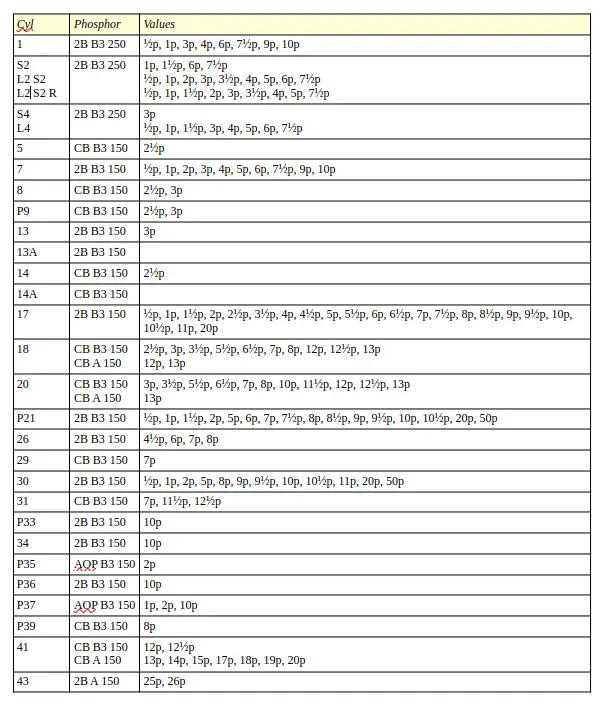 In the "cylinder numbers" column, S stands for small, L for large, and R for re-engraved. In the phosphor column, 2B, CB and AOP stand for two bars, centre bar and all-over phosphor; B3 and A represent different phosphor inks; and 150 or 250 are the photogravure screens measured in lines per inch. These details are irrelevant to my question, but may be of interest. N.B. My table is a draft, not a finished publication, and hasn't been checked carefully for mistakes. |
|
Send note to Staff
|
| Edited by pjr - 08/09/2026 2:14 pm |
|
|
|
|
New Member
United States
1 Posts |
|
|
While searching dealer stock, I found what appear to be examples of both missing phosphor cylinders:
• 1971 2½p Pale Magenta FCP(H)/PVAI Cylinder 13A (-) dot cylinder block (Deegam DG25.4, SG Specialised U87)
• 1981 4p Turquoise PCP(H)/DEX Cylinder 14A 11B no-dot cylinder block (Deegam DG40.7, SG Specialised UG13)
Assuming the attributions are correct, that seems to confirm that both 13A and 14A genuinely existed, although it still leaves the question of why they're absent from the detailed SG listings.
(Obviously I'm brand new and not sure if links are allowed; I found these at a site called Jerwood Philatelics. Also, sorry if this isn't as helpful as I was hoping it might be!) |
Send note to Staff 
|
|
|
Pillar Of The Community
Netherlands
6667 Posts |
|
|
As presented above: 13A (-) would mean colour cylinder 13A, no phosphor cylinder. 13 and 13A were used for the inverted sheet printing DG 25.4.5 released April 1972.
14A 11B would be colour cylinder 14A, phosphor cylinder 11B. However, the 4 p was printed by Waddington that used two lithographic plates. In that case, you get DG 14.7.1 that was issued in 1984 and printed from plates 13A and 11B, 14A and 11B and 15A 11B. So, here, also, 11B is a colour plate, not a phosphor cylinder.
If I understand the OP correctly, the question is whether phosphor cylinders 13A and 14A were used. |
|
Send note to Staff
|
| Edited by NSK - 08/10/2026 01:43 am |
|
|
Pillar Of The Community
Netherlands
6667 Posts |
|
|
@pjr, I would not be surprised if SG has been a bit careless and that 13A was used for the 3p and 14A for the 2 1/2p printings together with the A variants of the colour cylinders. They may have forgotten the A of the phosphor cylinders but not those of the colour cylinders. |
|
Send note to Staff
|
| Edited by NSK - 08/10/2026 04:39 am |
|
|
Valued Member
United Kingdom
245 Posts |
|
|
mechanika1: Welcome! It's a delight to read a first post from a new member who offers help instead of asking for help, and I hope you'll stay here for a long time and do much more of the same. But NSK is right: In the Jerwood Philatelics listing, 13A is an ink cylinder, not a phosphor cylinder, and 14A and 11B are ink plates, not phosphor plates. In fact, neither Jerwood Philatelics nor Hampstead Castle, both of whom are competent specialist dealers, lists phosphor cylinders 13A or 14A.
NSK: For the 2½p (SG U87, DG 25.4.5), I have both no-dot and dot cylinder blocks of ink cylinders 13 and 13A, and they both have phosphor cylinder 14, not 14A. For the 3p (SG U103, DG 30.4.5), I have both no-dot and dot cylinder blocks of ink cylinders 12 and 12A, and they both have phosphor cylinder 13, not 13A. Unless somebody somewhere can confirm that blocks showing phosphor cylinder numbers 13A and 14A exist, I'm going to assume that SG has indeed been careless, and that the carelessness amounts to accidentally inventing non-existent phosphor cylinders by analogy.
Incidentally, phosphor cylinders 13A and 14A are listed as if they existed in SG Specialised Vol 4, 5th edition (1988) and 10th edition (2008, reprinted 2010), and it seems amazing to me that nobody noticed the mistake (if it's a mistake) in twenty years.
Huge thanks to mechanika1 and NSK. |
|
Send note to Staff
|
|
|
Pillar Of The Community
Netherlands
6667 Posts |
|
|
I have my doubts about SG making up cylinders. SG also remarks that the colour cylinders that would be candidates did not always show the phosphor cylinder. It, also, may be that they were never used.
Have you contacted the editor? |
|
Send note to Staff
|
|
|
Valued Member
United Kingdom
245 Posts |
|
|
Thanks again for the reply, NSK.
For the 3p, the likely colour cylinder candidates are 12 and 12A, both of which are listed in 2010 with phosphor cylinder 13 only. For the 2½p the colour cylinder candidates are 13 and 13A, both of which are listed in 2010 with phosphor cylinder 14 in two states, and also with phosphor cylinder "11" displaced to row 11. But comparison with the 1988 edition shows that 11 is a misprint for 14. (Phosphor cylinder 11 was used only for Regionals. So here we have SG "making up cylinders". Another example would be the Isle of Man 3p (XM14) listed in 2010 as printed from colour cylinder 4, which never existed: again the 1988 edition shows that it was really colour cylinder 1, with phosphor cylinder 4.)
But in this case 1988 and 2010 editions agree, so it's not just the kind of mistake that creeps in when re-typing text. And since we have colour cylinders 12A and 13A alongside 12 and 13, it would not be surprising to find phosphor cylinders 13A and 14A alongside 13 and 14. But I've seen no evidence that they existed. Perhaps they were manufactured but not used?
I've thought about contacting the SG catalogue editor, but there's so little likelihood of a new edition that it hardly seems worth it. I'll wait a while in case you or anybody else has anything to add here, and then I'll probably go to the Modern British Philatelic Circle. |
|
Send note to Staff
|
|
|
Valued Member
United Kingdom
245 Posts |
|
|
Update with new information:
In 1972, presumably as a result of high demand, Harrison & Sons briefly used their "Woods" press for 2½p and 3p definitive printings. The "Woods" press could accommodate ten cylinders, and could therefore print nine colours plus phosphor, so using it for definitives that required only two of its units wasn't usually appropriate.
The cylinders made for this printing differed from all previous definitive cylinders by having twice the usual circumference. This meant that every revolution of the gigantic cylinder printed four counter sheets instead of two. These, therefore, had four distinguishing numbers engraved on the colour cylinders instead of two, viz. 12 or 13 no dot, 12 or 13 dot, 12A or 13A no dot, and 12A or 13A dot. But the phosphor cylinders had neither dots nor A's engraved on them, so we have the following combinations of cylinder numbers on each set of four counter sheets:
2½p, colour cylinder 13
top left: colour 13 no dot, phosphor 14 no dot
top right: colour 13 dot, phosphor 14 no dot
bottom left: colour 13A no dot, phosphor 14 no dot
bottom right: colour 13A dot, phosphor 14 no dot
3p, colour cylinder 12
top left: colour 12 no dot, phosphor 13 no dot
top right: colour 12 dot, phosphor 13 no dot
bottom left: colour 12A no dot, phosphor 13 no dot
bottom right: colour 12A dot, phosphor 13 no dot
Is your head spinning? Mine certainly is. But there are further complications! On early "Woods" printings of the 2½p the phosphor cylinder number wasn't engraved on any of the four panes, and not even the box that ought to have contained the number was engraved on the bottom right pane. And on the 3p printings the phosphor cylinder number is sometimes displaced upwards by 20mm or 39mm.
I conclude that there are no such things as phosphor cylinders 13A and 14A, but also that there are no such things as colour cylinders 12A and 13A. The A's are merely supplementary markings on the colour cylinders necessitated by Harrison's exceptional use of the "Woods" press. Does everybody agree?
(The "Woods" press was gradually superseded by the famous "Jumelle" press, and seems to have been scrapped after printing some of the 1973 Christmas stamps. I can find little information about it, and no photographs or diagrams online.)
None of this is original research. My principal sources of information are two publications of the British Decimal Stamp Study Circle:
Guidec 105: Presses used for Machin definitives - An Introduction (Ian de la Rue Browne, 1983, updated 2012)
Guidec 112: Phosphor cylinders used by Harrison for low value sheet definitives (J M Dutton, 1984)
|
|
Send note to Staff
|
| Edited by pjr - Today 11 Min ago |
|
| |
Replies: 7 / Views: 445 |
|
|
To participate in the forum you must log in or register. | |
Disclaimer: While a tremendous amount of effort goes into ensuring the accuracy of the information contained in this site, Stamp Community assumes no liability for errors. Copyright 2005 - 2026 Stamp Community Family - All rights reserved worldwide. Use of any images or content on this website without prior written permission of Stamp Community or the original lender is strictly prohibited.
Privacy Policy / Terms of Use Advertise Here |
| Stamp Community Forum |
© 2007 - 2026 Stamp Community Forums |
| It took 0.18 seconds to lick this stamp. |
 |
|
|
|


 Posted 08/09/2026 2:10 pm


