| Author |
 Replies: 615 / Views: 74,570 Replies: 615 / Views: 74,570 |
|
|
|
Pillar Of The Community
United States
1817 Posts |
|
|
Widget, I too have found that the right side of the bottom recut on Plate 1 Late stamps is often difficult to perceive, especially on non-worn-plate copies. The good news is that this particular feature is almost never needed to plate a particular stamp.
Regarding the identification of double transfers, they can of course show up in many ways, but one obvious one is the encroachment of the horizontal lines of shading surrounding Franklin's bust into the white oval defining the rim of the central medallion. In the two copies of 86L1L that you show this is clearly evident on the left side of the oval. |
Send note to Staff 
|
|
|
Valued Member
United States
38 Posts |
|
|
Dudley, I totally agree, the easiest double transfers to identify are the ones with the encroachment, 86L being an excellent example. The harder ones for me are where the double transfer shows in the ornaments or some times the lettering in the banners. For example, 21L1L identified as a double transfer, but for the life of me I don't see it. I know as I do this more, the subtlety of some double transfers will become more apparent. But man I have spent some frustrating hours trying to Plate some stamps where knowing if it was a double transfer would have definitely helped me narrow the search. Regardless, I still enjoy the chase and the challenge. 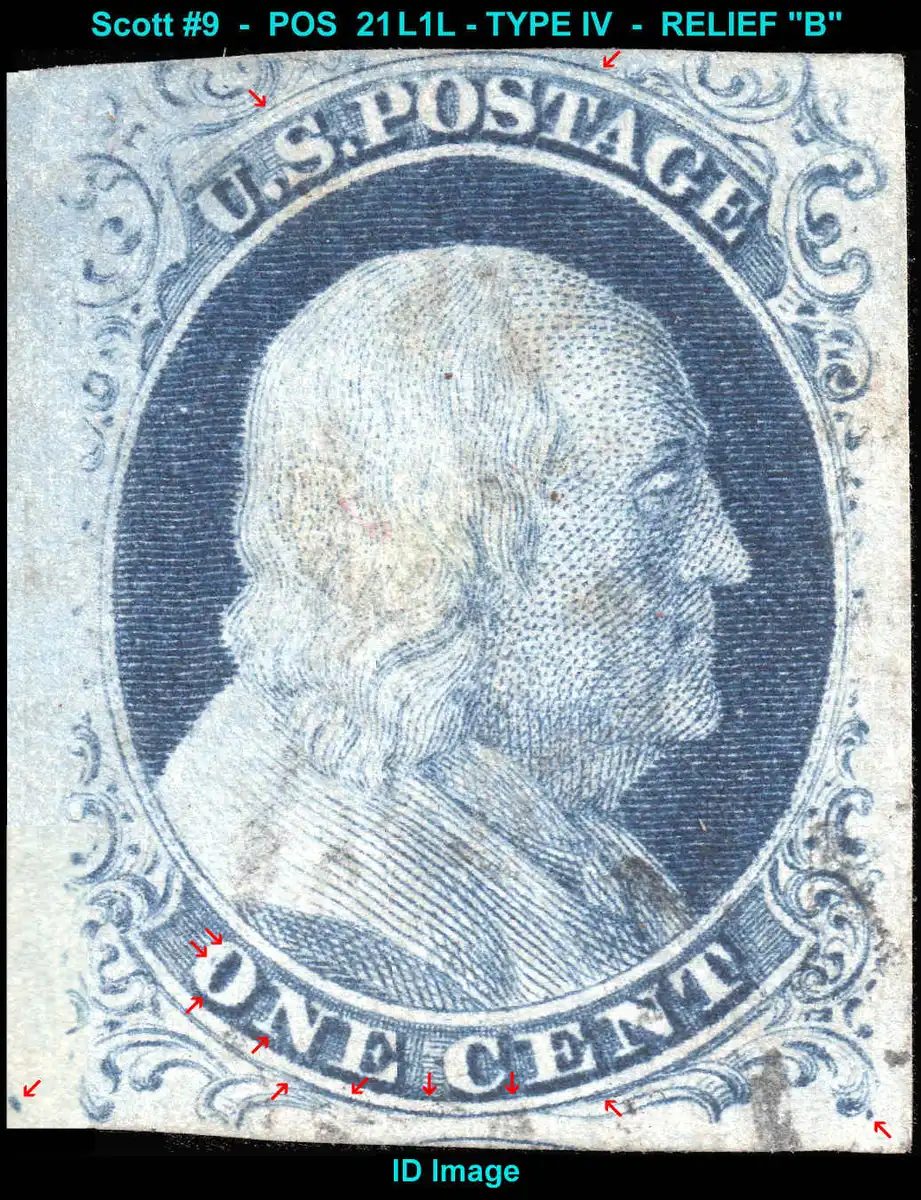 |
|
Send note to Staff
|
|
|
Valued Member
United States
38 Posts |
|
|
Added a nice horizontal strip of 3 to the collection (25R-27R1L). They are cut tight on the bottom so the Guide dots are not visible - otherwise, nice clear images with a distinctive red cancel2. The cover even includes the old wax seal and original letter - a letter from a wife to her husband. Dated August 3rd, 1855 or 1865 (date is not written clearly). 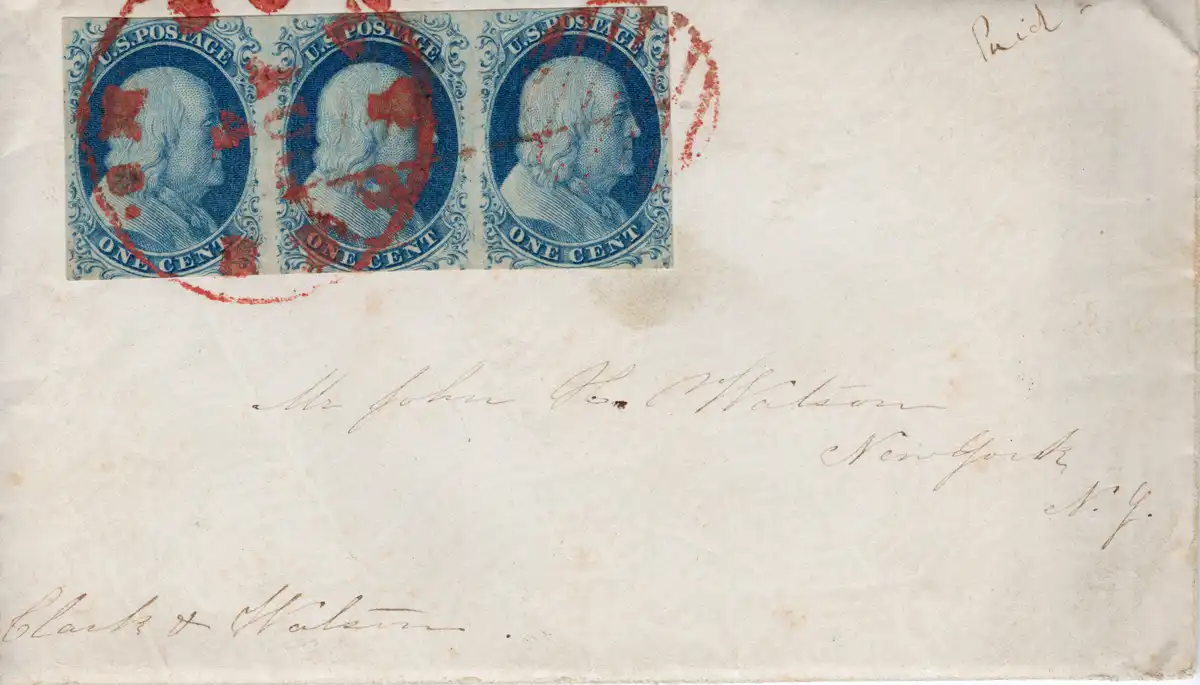 |
|
Send note to Staff
|
|
|
Pillar Of The Community
United States
3520 Posts |
|
|
Given a choice between 1865 and 1855 its clearly 1855, as 1865 is just too far out of period and super unlikely.
Pretty datestamp. I didn't try to decipher the town, but its a nice item. |
|
Send note to Staff
|
|
|
Bedrock Of The Community
United States
10824 Posts |
|
|
Far and away the easiest double transfer to see on any one cent 1851 is on number 5. It's both unique and very large. There is an O in between the P and O of POSTAGE that is impossible to miss. The whole upper right corner is also doubled, but that extra O is pretty obvious. |
|
Send note to Staff
|
|
|
Valued Member
United States
38 Posts |
|
|
txstamp, the cert that came with the stamp indicated the date cancel is for Holyoak, Mississippi. I did research and could find no historical record of an incorporated town of Holyoak, Miss., but there were several incorporated areas named Holyoak. I also wonder if it is actually Holyoke, Mass. Regardless, the letter provided no clue other than the wife refer to the hot weather (which would lean in favor of Mississippi). |
|
Send note to Staff
|
|
|
Bedrock Of The Community
United States
10824 Posts |
|
|
Mass is much more likely. At the time, Miss. would have been used for Mississippi rather then MS, which is a much more modern abbreviation. |
|
Send note to Staff
|
|
|
Pillar Of The Community

United States
1122 Posts |
|
|
Likely Massachusetts then. I have a #24 with an 1861 cancel from the state of "Ms" and I got excited that it was a Mississippi Confederate usage, but alas, that city's name was only known from Massachusetts and Google says that Ms was an early abbreviation for Massachusetts before standardization.
Regarding weather, have you been to Boston in August? It can get pretty hot there too.
Still a very nice cover. Who is the certificate from? |
|
Send note to Staff
|
|
|
Valued Member
United States
38 Posts |
|
|
That makes sense ZebraMan. Looking at the cancel and the cert, it states cancel from "Holyoak, Ms." Although there is no Holyoak, Mass. there is definitely a Holyoke, close to mount Holyoke near Amerherst. In looking at the cancellation, I could see how someone could read it either way. Here's the Cert. 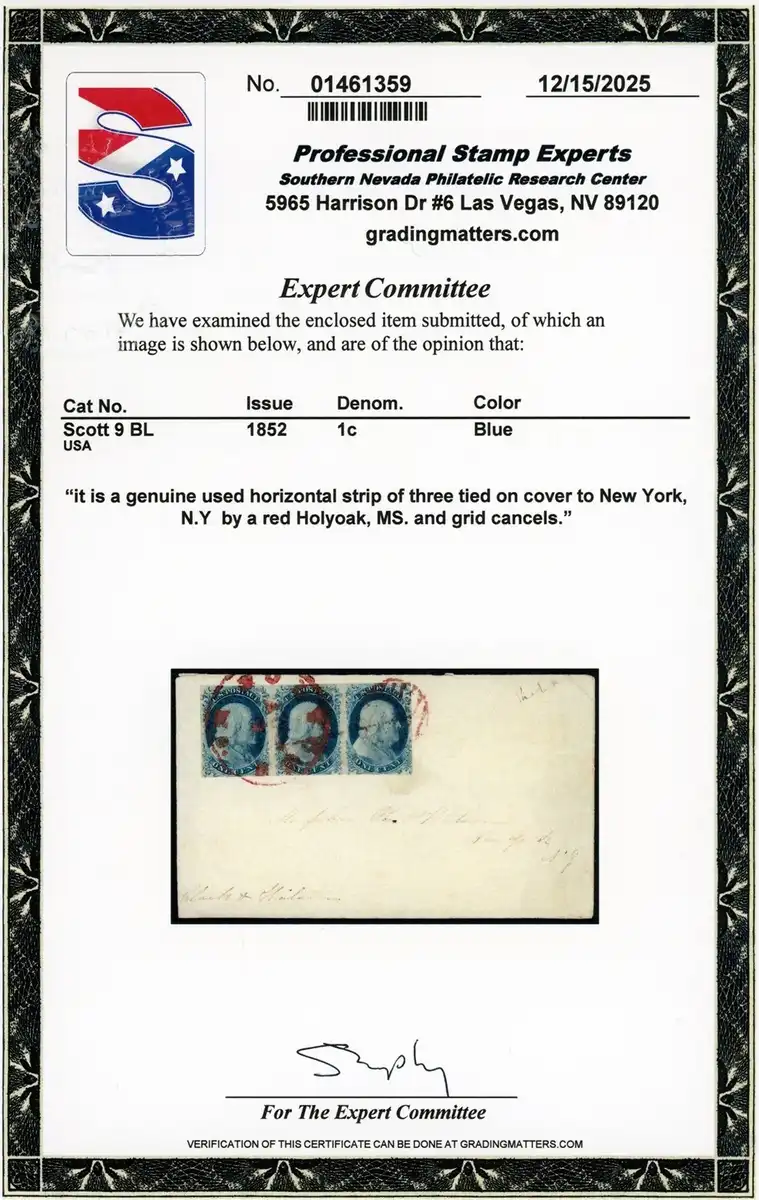 |
|
Send note to Staff
|
|
|
Valued Member
United States
38 Posts |
|
|
I could use some help confirming a plate position. I picked this stamp up during the last Kelleher Auctions. Nice borders, but scissor cut a little tight on the top. I believe this is a 37R1L. It shows the split topline on the left just above the left side of the "P" in "Postage." I also think I can make out a small plate mark on the left side of the "O" in "Postage" Any help in confirming would be appreciated. 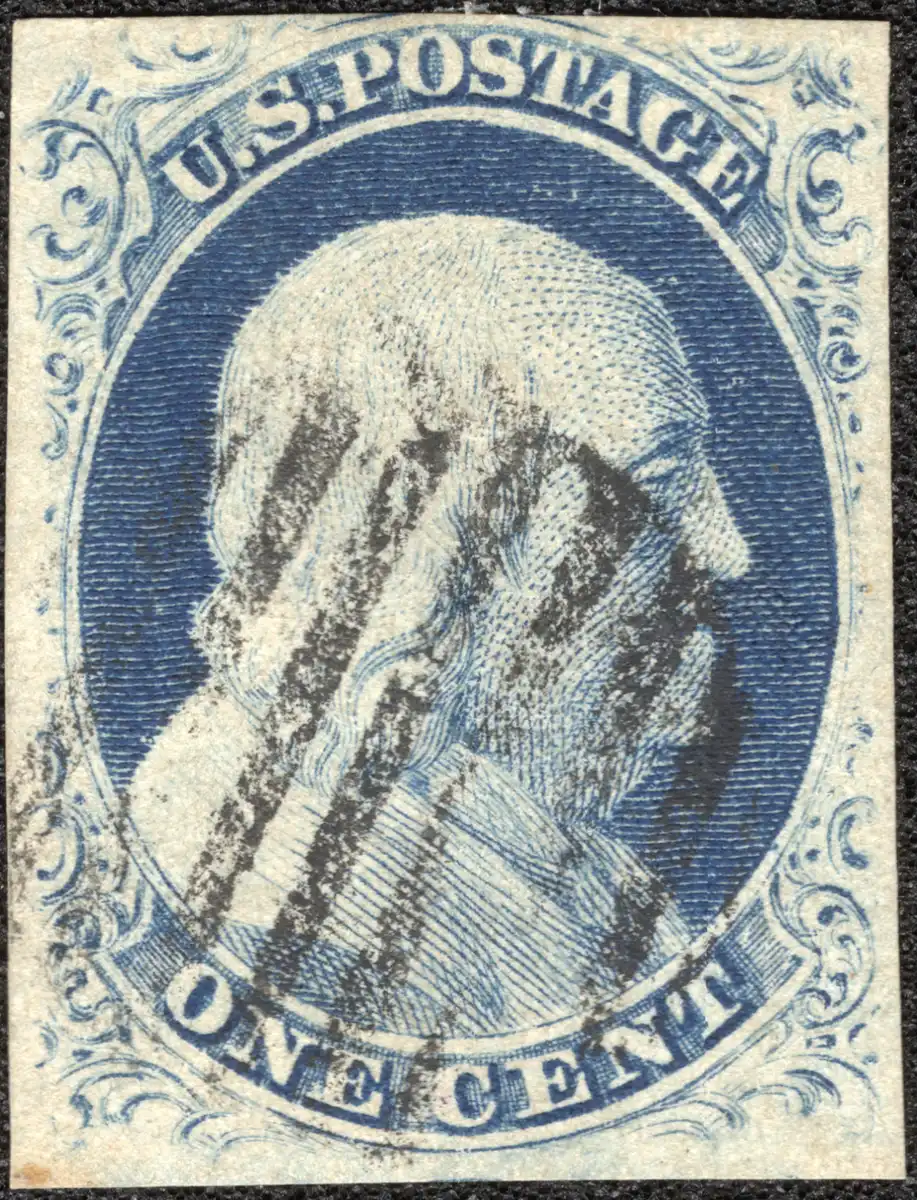 |
|
Send note to Staff
|
|
|
Valued Member
Norway
451 Posts |
|
|
widget1- I agree. Your stamp looks like a good match for 37R1L. It's also a nice example of a split topline. |
|
Send note to Staff
|
|
|
Valued Member
United States
38 Posts |
|
|
In the Plating Initiative Database at StampSmarter, there are comments that indicate "double transfer" or "SHIFT". What is the difference between a stamp where a "Shift" is indicated vs. a stamp with a double transfer? |
|
Send note to Staff
|
|
|
Bedrock Of The Community
United States
10824 Posts |
|
|
Semantics, in my opinion. Double transfers essentially have three reasons. 1) The transfer roll slips north south a bit and produces a double transfer, usually at the top of the upper lettering and the bottom of the lower lettering. 2) The transfer roll twists a bit during the process and produces some kind of east-west double transfer. 3) The siderographer started to enter the position in the wrong location, and did not burnish out the extra lines. Transfer rolls had multiple stamps on them, and some foreign entries were formed because of this, when the transfer roll was rocked too far. And since plate steel was difficult to obtain, plates were reused, and not always burnished out completely, and this created foreign entries at times as well. |
|
Send note to Staff
|
|
|
Pillar Of The Community
United States
1817 Posts |
|
|
Strictly speaking, a double transfer is revcollector's third example above, while shifted transfers are examples 1 and 2. In the end the result is similar in all cases. |
|
Send note to Staff
|
|
|
Pillar Of The Community
United States
636 Posts |
|
|
Extracted from Chase's book on the 3c issue -- but applies the same to the 1c blues...
**********
SHIFTED TRANSFERS:
It is an odd fact that perhaps no one variety has had so many names attached to it as have shifted transfers, these being also known as re-entries, shifts, misplaced transfers, double transfers, fresh entries, double entries, mis-strikes, and shifted dies, this last term being obviously incorrect. Personally I prefer the term, shifted transfer as perhaps the most descriptive.
First, what they are, and how they are caused on line-engraved plates. A shifted transfer is a re-duplication of part, or sometimes nearly all of the design on a stamp plate, this re-duplication being close to the real stamp impression. It necessarily shows on the printed stamp in color, where normally no color appears. There are several ways in which they may occur:
First, while making a plate the roll may be taken up and put down on the plate again, slightly out of place as regards the impression which is being made. Obviously this will cause reduplication of certain parts of the design.
Second, the design may be more or less completely entered on a plate out of the desired position. This may be corrected by turning the plate over and hammering out the design from the back of the plate until the displaced metal is nearly flush with the normal surface of the plate. The area is then burnished in an attempt to remove such fine lines or depressions as remain. Often, though, certain of the deeper parts of the wrong design are not entirely cleared away, thus giving our shifted transfer. If only a very light impression out of position had been rocked on the plate it might be removed largely or entirely by burnishing only.
Third, it is evident that, should either the transfer roll or the plate move slightly while the design is being transferred, a doubling will result; but the plate makers at the Bureau of Engraving and Printing at Washington with whom I have discussed this matter tell me that at the present time and with the present methods, at any rate, it is hardly possible for this to happen.
Fourth, and most commonly on these stamps, shifted transfers result from an attempt to strengthen the design on a plate which shows more or less wear, some time after the plate was made. Ordinarily this process is known as "re-entry". These shifted transfers really occurred in much the same manner as that first described, the second application of the transfer roll not registering directly over the original impression . Strictly speaking line engravers call these first three accidents " fresh entries" and reserve the term " re-entry" for my fourth class.
********** |
|
Send note to Staff
|
|
|
Replies: 615 / Views: 74,570 |
|




 Posted 04/04/2026 10:19 am


