Part 6PERFORATION AND OTHER VARIETIESThere are numerous occurrences of horizontal pairs that are imperforate between the stamps. These are set out in the table below.

The 1d brownish red is listed in the Stanley Gibbons catalogue but not mentioned in Basset Hull or Hutson. The White collection had an example postmarked the 12th January 1871 at Sydney.
The 2d pale blue is not listed by Gibbons but is mentioned in Basset Hull and Hutson. I have not seen an example of this variety.
In the small crown over NSW group, the 1d in dull red perforated 13 is known imperforate vertically (horizontal pair) and the 1/- black perforated 13 is known imperforate horizontally (vertical pair).
Hutson notes that the Royal Collection contains a 2d Prussian blue perforated 13 strip of four with the middle two stamps imperforate between. He also notes a variety of the same stamp imperforate between (vertical pair).
Gibbons notes that the Royal Collection contains a 2d Prussian blue used horizontal pair imperforate vertically. Is this the strip of four that Hutson alludes to? The 2d in pale blue perforated 13 is known with a second impression of the words TWO PENCE behind the Queen's head.
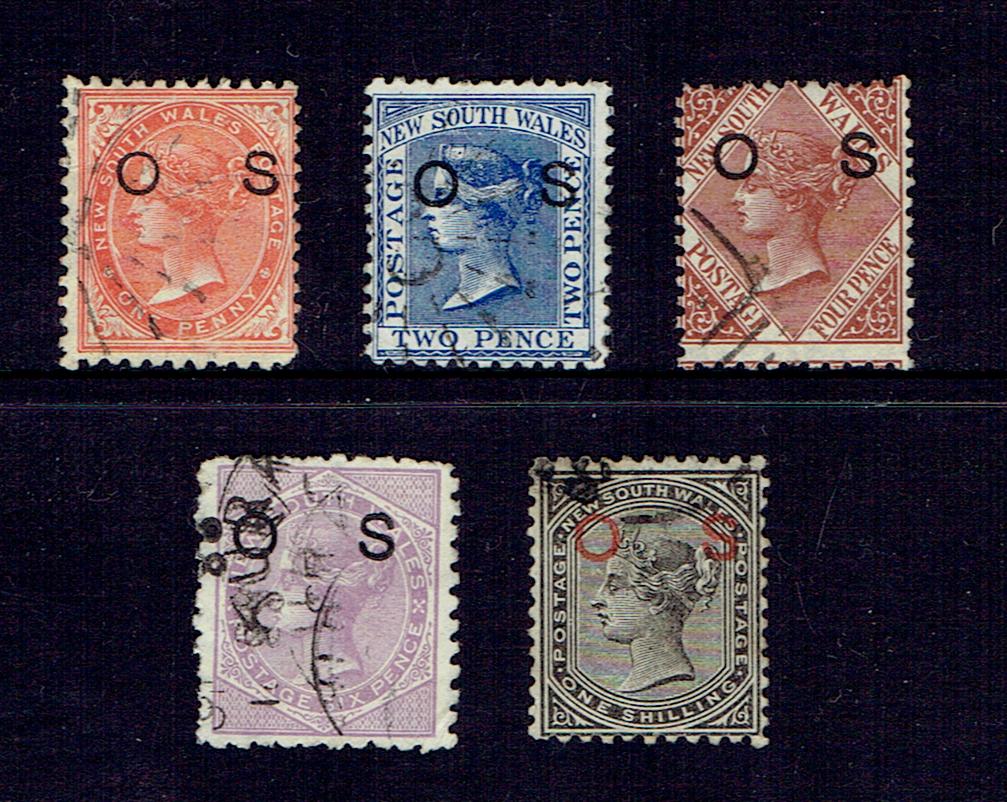
The 9d perforated 11 is known with the surcharge doubled, one in black and one in blue.
Basset Hull mentions the existence of imperforate vertical pairs of the 1/- but perforated 13 on the left or right side only, as well as examples imperforate all round. The latter variety would have to exist in pairs as definitive proof of its existence, but I am not aware of any such variety.
The Hutson collection contained an imperforate vertical pair of the 1/- that was perforated 13 on the left side only. He also notes the Royal Collection has a vertical pair perforated 13 all round but imperforate between and also imperforate at the base where it is described as cut close.
In the large crown over NSW group, the Carrington collection had two of the four known examples of the 1d in orange, perforated 13, which would suggest the earlier salmon shade with the same perforation does not exist. The salmon is unpriced by Gibbons and Hutson stated he had not seen an example.
Hutson had a 1d stamp perforated 12 all round, the top and bottom perforations being faked, with the original 11 gauge from the comb machine being removed.
The 2d Prussian blue is known printed double. An example imperforate on three sides, being the left stamp in a horizontal pair, is also known.
Two stamps, the 1d brick red from plate 2, watermarked single-lined 1 and perforated 13 and the 2d pale blue watermarked small crown, perforated 13, can be found printed on highly surfaced paper.
The 2d printed on the NSW watermarked paper is known imperforate but of course should be collected in pairs.
In the John Bell collection, auctioned by Prestige Philately in May 2013, two items in lot 1118 were highlighted. They are both watermarked large crown.
The first was a block of nine of the 2d perforated 11x12, which must be assumed to be line perforated, otherwise there would've been no reason to mention the block.
The other was a 1/- perforated 10 on the top and sides, but perforated 12 at the bottom. Hutson had an example of the 1/- stamp perforated 12 at the top and right and 10 at the bottom and left, but stated the 12s were faked.
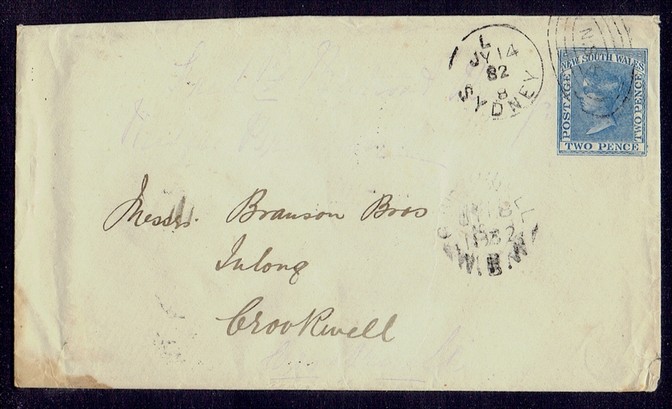
Hutson mentions a 2d bisected on cover dated 28th April 1887. Another cover with a 2d bisect is known from 1877, on an OHMS cover posted from Gunnedah to Cassilis.
The 1884 plate of the 1d developed many plate flaws and scratches towards the end of its life and these are well worth studying.
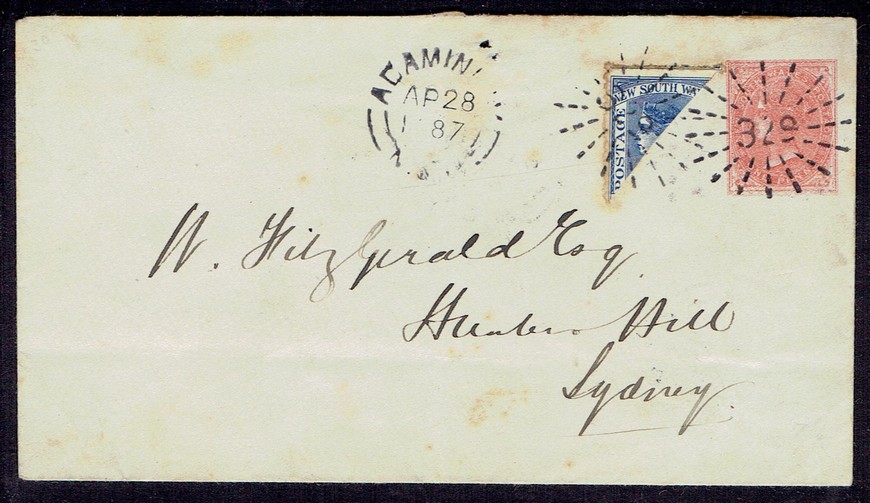 The 1887 bisect cover, a 1d envelope with a 2d bisected diagonally,
posted from Adaminaby to SydneyThere is a note in the Scott catalogue at the beginning of the New South Wales listings, regarding stamps with perforations clear of the design. This note is absent from the Stanley Gibbons catalogue. It is very relevant to the De La Rue issues.
Due to the narrow spacing of the stamps on each plate, finding examples where the perforations are clear of the design is somewhat difficult. The 6d value is relatively easier to find than the other values, due to the wider spacing of the stamps on the plate.
This situation has given rise to fakery, as can be seen by the two examples below, which have had their perforations trimmed off. Might the 1/- be an example of the variety alluded to in Basset Hull?

In addition to the above varieties, I have seen a 2d watermarked double-lined 5 imperforate at right and bottom, a 6d mauve (watermark unknown) with part side inscription apparently imperforate at right and a 1/- with an 1879 postmark imperforate all round.
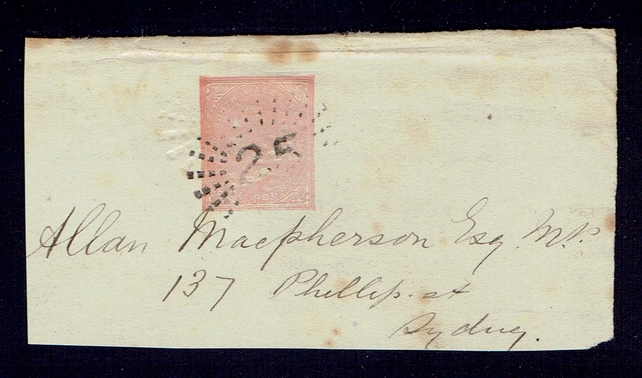
I have also seen an imperforate 2d stamp, without watermark, dated 22nd December 1865. There are fragments of the adjoining stamps on the left, bottom, and bottom left.





 Posted 04/14/2021 07:27 am