Hi Serace,
Although I see you've not logged-on in over 3 months.
As you have figured out, there are several look-alikes of this stamp type varying by sheet, coil, and booklet; as well as flat vs rotary printings; and lastly by several perforation rates.
The first reply to your thread included:
Quote:
1. The first image shows nothing.
2. The third image shows nothing.
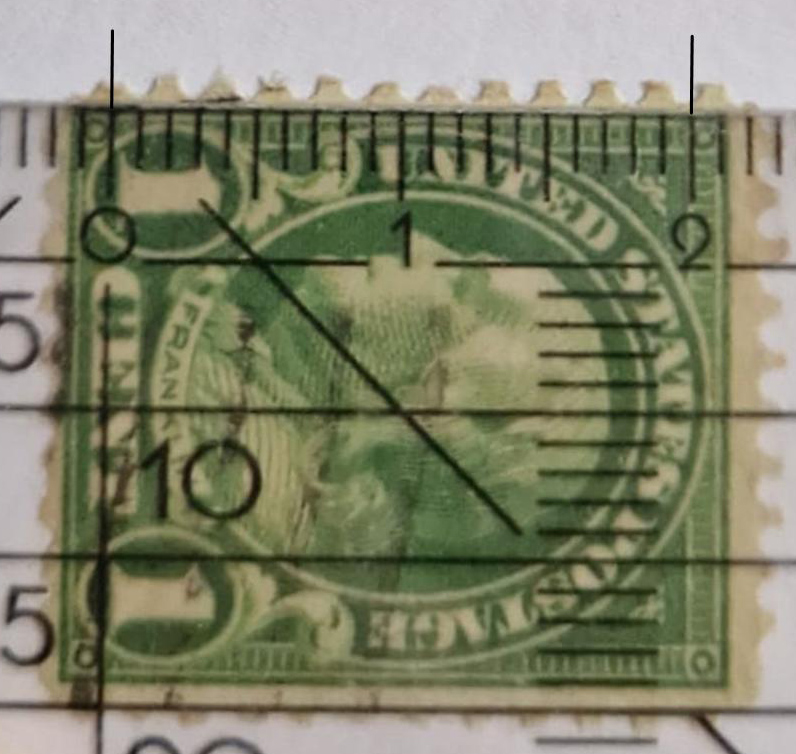
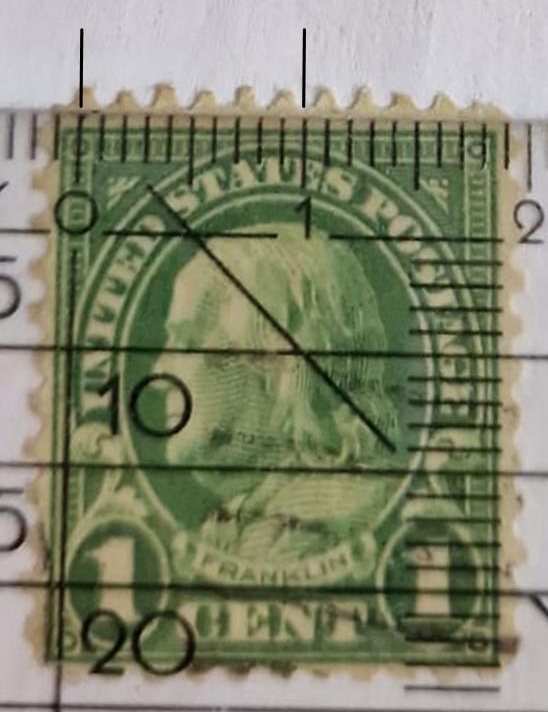
However, these 2 images provide exactly the information needed to positively identify your stamp. Specifically, the rate of perforation is the number of perforations per 20mm or 2cm.
If the lines for 0 and 2cm are extended to emphasize them, one can easily see there are 10-1/2 tooth/hole cycles in this length:
The top is a bit more tricky since it is narrower than 2cm, but when the 0 and 1 cm lines are extended for emphasis, there are exactly 5-1/2 perf/hole cycles in the this length, which must be doubled to obtain 11 for the entire 2cm length.
A formal perforartion gauge will make this much easier in the future, but your illustrations are more than satisfactory here today.
Thus by catalog convention of listing the perforation rate at the top first, then the sides, your stamp is perf 11x10.5 which can only be Scott 632. The rarer varieties we all hope for have a different perforation rate, sorry!
edit: to correct a minor typo.





 Posted 05/16/2025 1:57 pm


