| Author |
 Replies: 17 / Views: 3,456 Replies: 17 / Views: 3,456 |
|
Valued Member
United States
45 Posts |
|
|
This is an RPPC of the SS Normandie that I purchased at the GASPEX show in Atlanta, GA, this past weekend. The stamp is France #290. The postmark is New York Au Havre with a c at the bottom. The postmark suggests to me that it was posted on board the ship. Making it a paquebot mark. There is another purple postal mark across the stamp. That reads (DIRECTORY SEARCHER NO*). I have no idea what that means. All help, thoughts, and other observations about this card would be greatly appreciated.  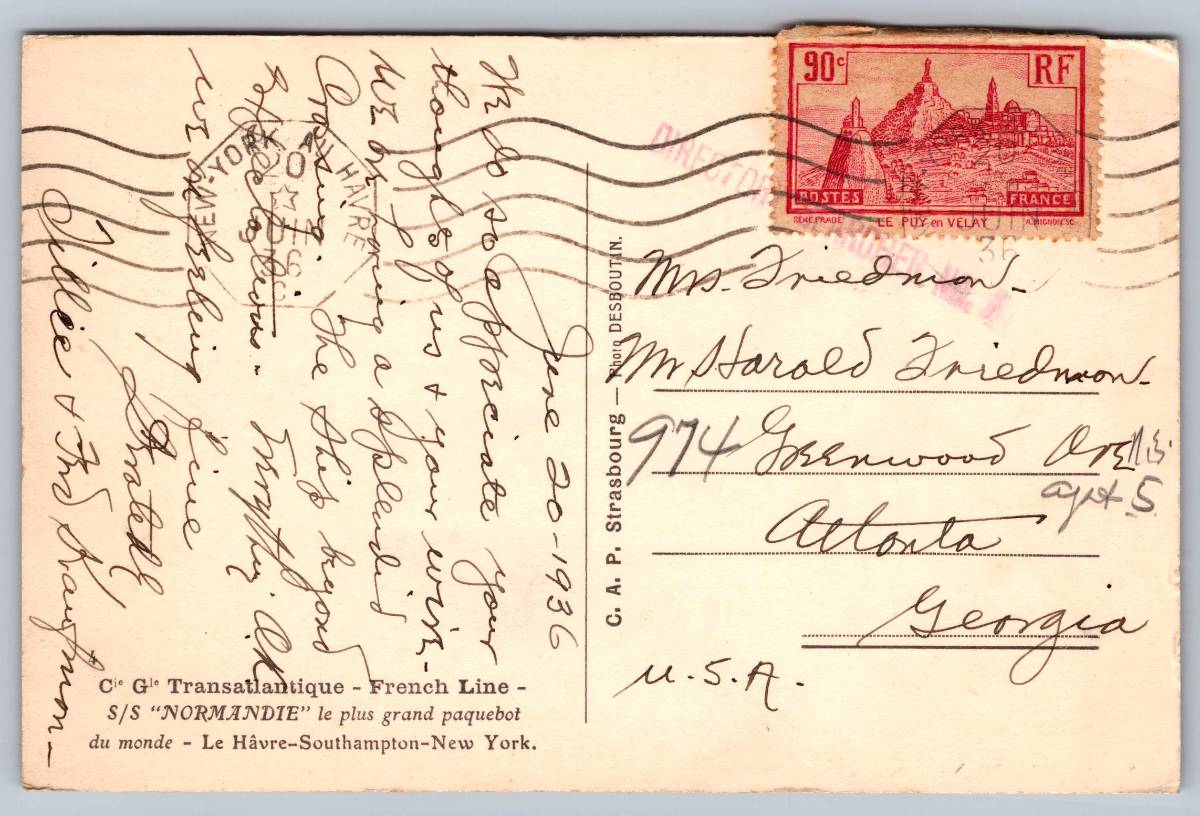 |
|
Send note to Staff
|
|
|
|
|
Pillar Of The Community
United Kingdom
8636 Posts |
|
|
This isn't a RPPC - it's a standard commercial production. RPPCs are real photographs printed on blank postcard slips, usually by small, local photographers. |
Send note to Staff 
|
|
|
Pillar Of The Community
6366 Posts |
|
|
It is clearly a real photo, thus qualifies as a RPPC. The quantity does not disquality it, nor its paper.
Directory searcher: The card had an incomplete address and a postal employee searched their directories and added the apartment number. |
|
Send note to Staff
|
| Edited by John Becker - 08/24/2025 3:39 pm |
|
|
Pillar Of The Community
Canada
5821 Posts |
|
|
Quote:
It is clearly a real photo, thus qualifies as a RPPC. I looked up RPPC and found it stands for Real Photo Post Card
A real photo postcard (RPPC) is a continuous-tone photographic image printed on postcard stock. The term recognizes a distinction between the real photo process and the lithographic or offset printing processes employed in the manufacture of most postcard images.
As per wikipediaSo the printing has to be via photogravure not offset litho not whether it is a real photo |
|
Send note to Staff
|
|
|
Valued Member
United States
45 Posts |
|
|
Thanks for all the help. Clearly, I need to learn more about all the different printing techniques. There are so many. It's almost a specialty on its own.
|
|
Send note to Staff
|
|
|
Pillar Of The Community
United Kingdom
8636 Posts |
|
|
Valued Member
United States
81 Posts |
|
|
I can't claim to be an expert on deltiology, but I have researched the postcards I have in my exhibit, and I'll have to disagree with some of the comments in this thread. Gazillions of "real photos" have been printed onto postcards, but if the process involves lithography, photogravure, collotype or any other type of printing, they are nor RPPCs. RPPCs are made using special paper stock which has photographic paper on the front and standard postcard paper on the back. As GeoffHa's article mentions, there were a limited number of companies that made this postcard thickness photographic paper. The postcards were developed, not printed, by exposing them to a photographic negative. Thus you don't see the dots or "worms" (collotype) of other postcards with photos on them - just smooth continuous tones. In the OP image, we can't check for dots or not, but I don't see the typical silvering sheen in dark areas (though maybe it doesn't have the right lighting). But most importantly, the printer on the back is C.A.P. Strasbourg and it doesn't specify if it is "real photo" paper. They apparently did so on RPPCs that they developed. 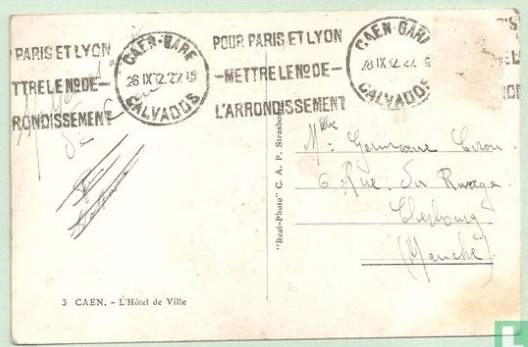 |
|
Send note to Staff
|
|
|
Valued Member
United Kingdom
391 Posts |
|
|
It's sepia-toned if it is a real photo- that might prevent any silvering. There's some kind of damage in the top right corner which kind of suggests that it is an RPC. |
|
Send note to Staff
|
|
|
Pillar Of The Community
6366 Posts |
|
|
RPPC or not, does it really matter?
Let's get back to answering the OP's question about the postal markings. |
|
Send note to Staff
|
|
|
Pillar Of The Community
United Kingdom
8636 Posts |
|
|
Well, you thought it mattered enough to make inaccurate comments on the subject. |
|
Send note to Staff
|
|
|
Pillar Of The Community
6366 Posts |
|
|
You take issue with my initial reply which was very brief and thus not detailed. My grandfather made real photo postcards with negatives and contact print frames onto photo sensitive paper. They weren't printed, they were exposed and developed. I stil have several of the wood frames. And I could go on, but again, it does not really address the OP's questions about the postal markiings. Just saying. |
|
Send note to Staff
|
| Edited by John Becker - 08/25/2025 5:21 pm |
|
|
Pillar Of The Community
United Kingdom
8636 Posts |
|
|
Your initial reply was plain wrong in ignoring the accepted definition of a real photo postcard. |
|
Send note to Staff
|
|
|
Pillar Of The Community
6366 Posts |
|
|
Then please explain exactly HOW the OP's card was produced. Printed vs exposed, the glossy surface, is there a patent or trademark name to this specific card, etc. When you tell me I am wrong, I insist that I know the exact details. Again, this is all distracting from the OP's questions.
I would also add there is no official "accepted definition" clearing house in the hobby, particlarly when there are often subtle differences in word translations and in different countries/continents. Many philatelic "definitions" have evolved over the years to such an extent that they do not take into account the broader context outside the hobby - or to be inclusive of one-off items and mass production by the same process. Another example is defining "overprint", which has been debated here. I am happy to agree to disagree and move on. |
|
Send note to Staff
|
| Edited by John Becker - 08/25/2025 6:32 pm |
|
|
Bedrock Of The Community
United States
10870 Posts |
|
|
Nice auxiliary marking. One wonders whether the sender was on their way to the Olympics later that summer. |
|
Send note to Staff
|
|
|
Valued Member
United States
81 Posts |
|
|
This is what chat gpt has to say about the cancellation:
This is an octagonal New York exchange office postmark, used on incoming and outgoing transatlantic mail. The marking in your image reads:
"NEW-YORK / HAVRE LINE" with a date inside, and a small letter "C" at the bottom.
Here's what each part means:
Octagonal shape – These distinctive marks were applied by the New York Foreign Mail Exchange Office. They are closely associated with the packet lines that carried mail across the Atlantic, especially in the 1850s–1870s.
HAVRE LINE – Refers to the French Line (Compagnie Générale Transatlantique), commonly called the Havre Line, which operated steamers between New York and Le Havre, France.
Star inside – Often used as a control device in these markings.
Letter at the bottom ("C") – This is an exchange clerk's marking. Each clerk at the Foreign Mail Exchange Office was assigned a letter (A, B, C, D, etc.) that they placed in the postmark. The letter allowed the Post Office to track which clerk handled the mail. "C" simply indicates it was processed by clerk C on that date.
These marks are collectible because they can identify not just the route (Havre Line) but also the handling clerk. Different letters appear in different strikes, and specialists sometimes collect them by letter.
And here is what chat gpt says about the handstamp "directory searcher no 1":
Great eye — that pink marking "DIRECTORY SEARCHER No. 1" is actually a U.S. auxiliary marking used by the post office.
Here's what it means:
Directory Section – In large U.S. cities (especially New York, Chicago, etc.), the Post Office had a Directory Section that handled undeliverable mail. If an address was incomplete, illegible, or the addressee had moved, the item was routed to the Directory Section.
"Searcher" – Clerks there were called Directory Searchers. They would consult city directories, forwarding records, and change-of-address notices to try to find the correct recipient.
"No. 1" – This number refers to the particular clerk or sometimes the sub-office/desk within the Directory Section who worked on the piece of mail. So "No. 1" means it was handled by Searcher No. 1.
On your 1936 postcard – This marking shows that when the card arrived in the U.S., the address couldn't be delivered as written. A directory searcher attempted to identify the recipient before the card was either delivered (if a match was found) or returned to sender.
So in short:
#128073; "Directory searcher no. 1" = auxiliary marking from the U.S. Post Office Directory Section, applied when mail required address correction or identification before delivery.
The postcard couldn't be delivered as written because there was no street or apt number I'm guessing. The "searcher" presumably determined it was "974" and "Apt 5" and added those in in pencil. I somehow doubt the post office would go to this much trouble now. |
|
Send note to Staff
|
|
|
Pillar Of The Community
United States
4465 Posts |
|
|
Chat gpt is about as reliable as Wikipedia but Wikipedia has the backbone to state that it is not to be used as a reference, only a starting point. Posting unverified drivel from Chat gpt is not helpful but rather harmful to long term knowledge. For example just last week I looked at the AI generated response at the top of a google search which placed two cities in Marin County Ca rather than Santa Clara County. One town was Sunnyvale, CA which is in the heart of Silicon Valley and among other computer enterprises, the current AI push. Quote:
DIRECTORY SEARCHER NO* Some clerk or other postal employee looks up address in the local city directory as stated by John Becker. However, in larger cities there can be more than one employee doing the directory service and they each are numbered. So the intend is after the printed "NO>" a number identifying the searcher would be entered by manuscript. Edited for English |
|
Send note to Staff
|
| Edited by Parcelpostguy - 08/26/2025 12:31 pm |
|
|
Replies: 17 / Views: 3,456 |
|




 Posted 08/24/2025 3:24 pm


