| Author |
 Replies: 623 / Views: 85,463 Replies: 623 / Views: 85,463 |
|
|
|
Pillar Of The Community
Netherlands
6641 Posts |
|
|
Moderator

United States
5106 Posts |
|
|
Pillar Of The Community
United Kingdom
895 Posts |
|
|
Slogan postmark (two styles): "Use up your non-barcoded stamps by 31 January 2023. Or swap them out for new barcoded ones."  |
Send note to Staff 
|
|
|
Pillar Of The Community
Netherlands
6641 Posts |
|
|
Very little attention has been given to the large-format parcel-rate stamps. Until 1977, the higher values covering parcel rates had been printed in a slightly larger format than the other Machin stamps. This had been done using the intaglio printing process. As this became too expensive, new parcel-rate stamps were issued that were printed in photogravure. Initially, a £1, a £2, and £5 stamp were issued. The Perpetua fount used for the intaglio £1 was also used for these stamps. The size of these 'high value' stamps was increased to the standard size used for special stamps. Until 1983, the stamps did not cover a specific parcel rate and a mixture of stamps would be required. An exception was the local delivery rate of £1 that was in force between 1 February 1982 and 5 April 1983. 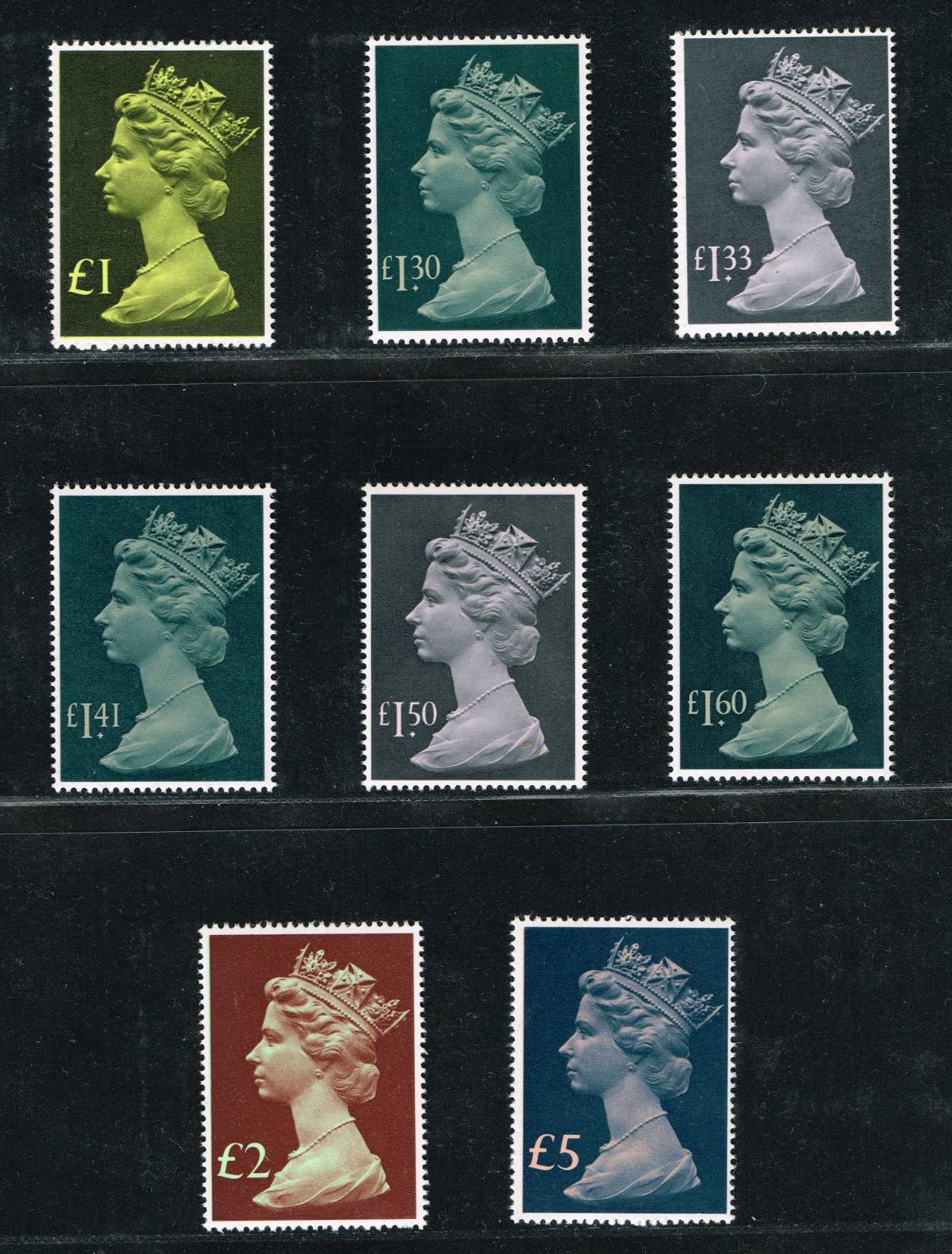 On 5 April 1983, the inland rate for a parcel weighing up to one kilogramme was raised from £1.20 to £1.30. Coincidentally, the £2 would cover the local delivery rate for parcels weighing between 2 and 3 kilogrammes. On 3 September 1984, it was raised to £1.33. Further increases took effect on 2 September 1985 (£1.41), 1 September 1986 (£1.50), and 7 September 1987 (£1.60) when the local delivery rate was abolished. The local delivery rate had not been available in London from 7 June 1976. On each of these occasions, a parcel-rate stamp was issued for the basic inland rate. The £1, £2, and £5 that were in used from 1977 have listed 'shade' varieties. They, also, have listed perforation varieties, existing with comb and rotary perforations. |
|
Send note to Staff
|
|
|
Pillar Of The Community
Netherlands
6641 Posts |
|
|
The stamps were printed in double-pane sheets of 100 stamps. Each pane in the sheet consisted of 5 x 10 stamps. The panes were separated by a vertical gutter margin with perforations between the margin and adjoining stamps. This gave rise to the popular 'gutter pair' format. 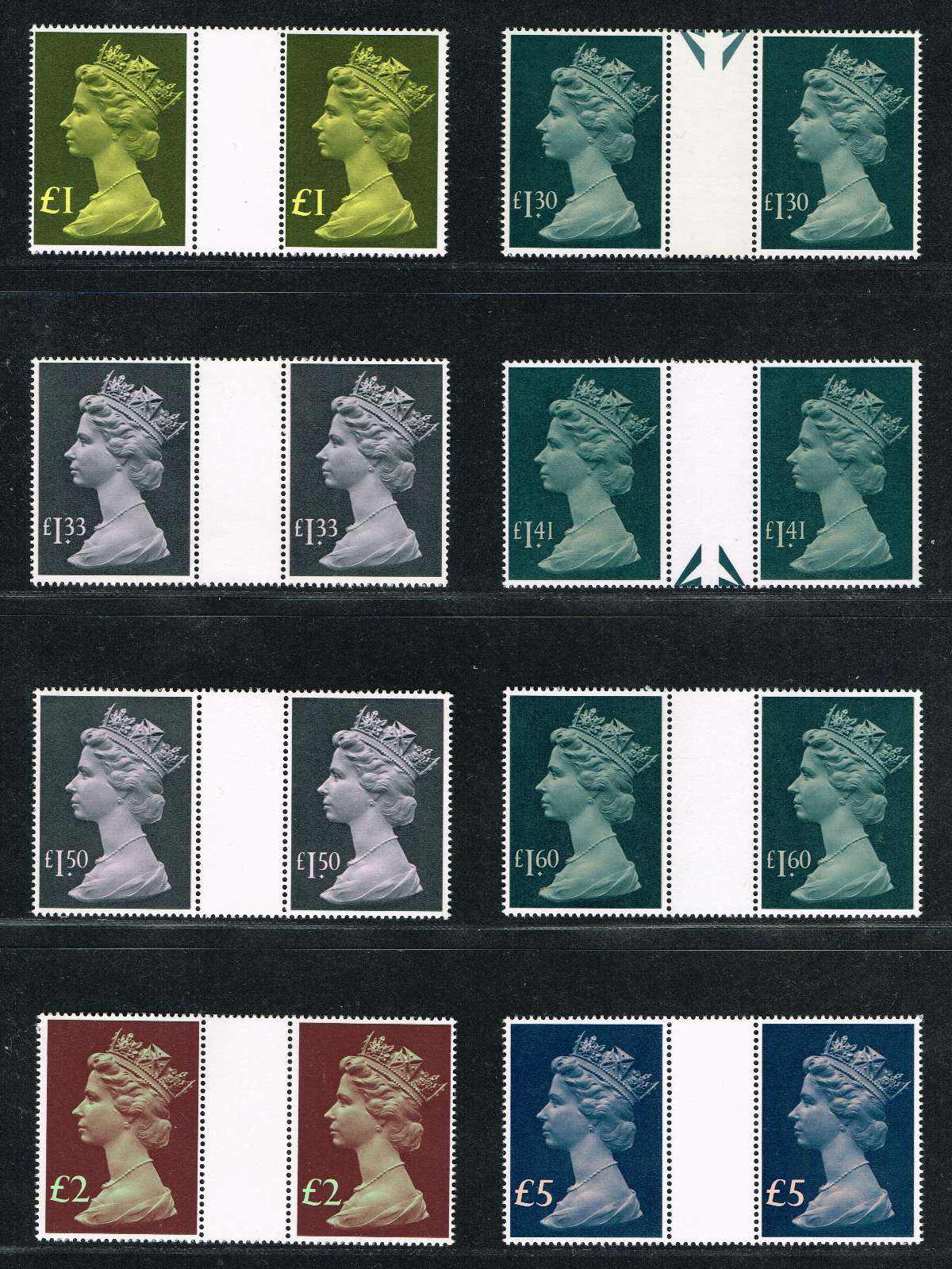 The half 'arrows' at the top of the gutter margin of the £1.30 stamps and at the bottom of it of the £1.41 stamps identify these gutter pairs as being from rows 1 and 10, respectively. The lighter background colour of the £1-stamp compared to the single in the previous post is an actual 'shade' difference. |
|
Send note to Staff
|
|
|
Pillar Of The Community
Netherlands
6641 Posts |
|
|
Among the markings printed in the margins were the cylinder numbers and a box with dots in the colours in which the stamps were printed. All were printed in two colours. In the period during which these stamps were issued, Harrison and Sons printed such a box with colour dots in the gutter margin of the second row of stamps. For obvious reasons, these boxes are known to collectors as 'traffic lights.' The traffic light, in reverse order, also appeared in the bottom margin below each pane. 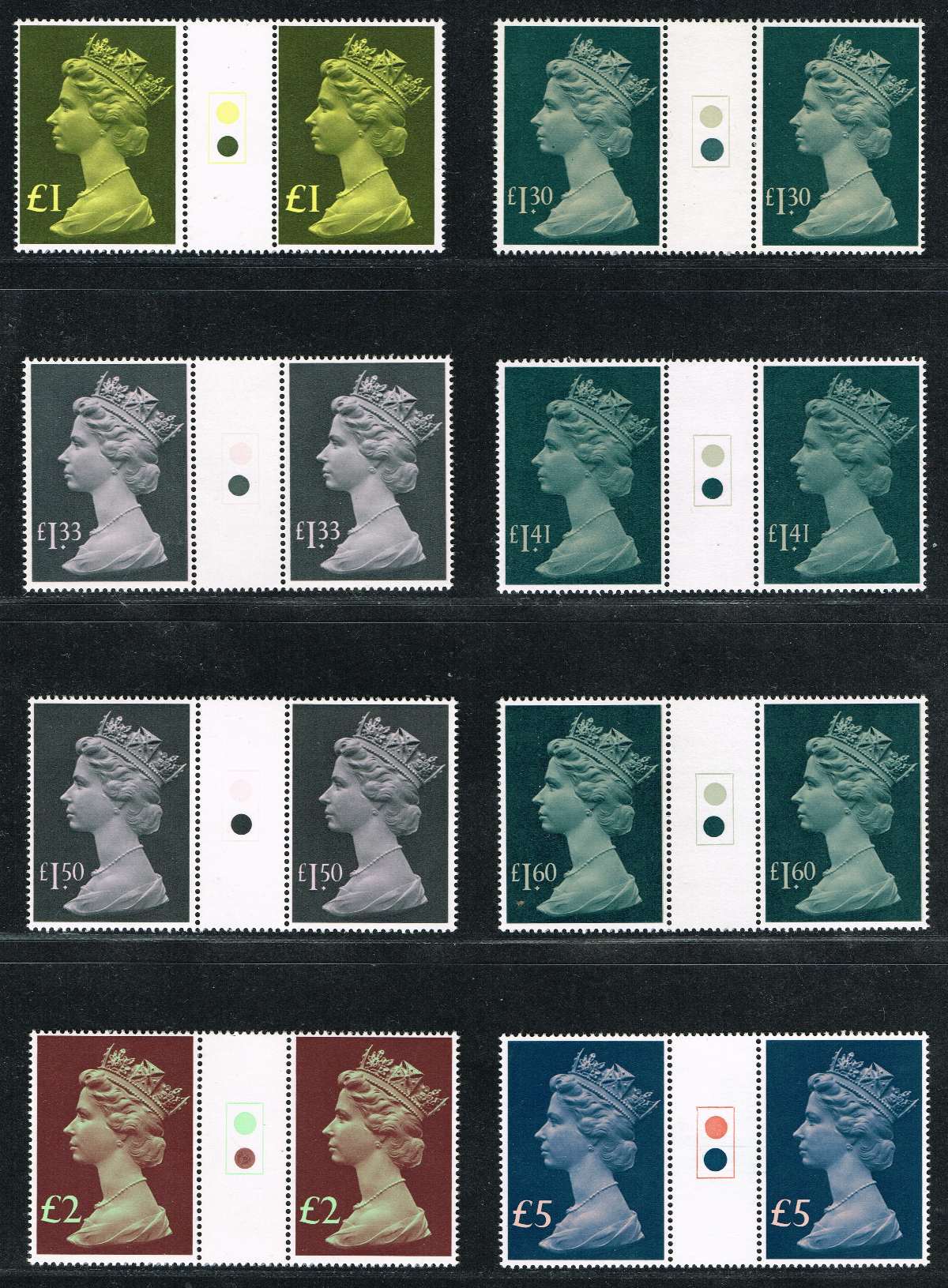 |
|
Send note to Staff
|
|
|
Pillar Of The Community
Netherlands
6641 Posts |
|
|
Pillar Of The Community
Netherlands
6641 Posts |
|
|
Page 26 Quote:
1)
There is a stamp in the Connoisseur catalogue in chapter 2, number P70:
7P deep reddish brown, CB, thin numeral, head B1, cyl. 8, experimental coating PCP
It has a high value, so I wonder which of is characteristics is responsible for it?
Does anbody know this stamp? Quote:1) 7p deep reddish brown - this is the stamp also described as brick red: https://www.adminware.ca/machin/m007r.htm (the earlier 7p brown from 1974 doesn't exist with the narrow value.) It appears to only exist with narrow value and one centre band, and one head type - so everything's pointing to that experimental coating. Sorry, I don't know what it means, but it sounds like a trial was done on some sheets, and experts have identified the difference. This is the 1974 red-brown stamp. Connoisseur P70 is a 'Phosphor Coated Paper' or 'PCP' stamp. The catalogue mentions it is from cylinder 8 no dot, a sheet cylinder, likely released in June 1977. I think, this is the stamp that the Deegam Machin Handbook lists as DG 70.2.1b with description 'AOP + CB.' Ot gives a release date of 10 July 1977 and printed from cylinder 8. The Deegam handbook provides no further details. The Deegam handbook does not discern between dot and no-dot panes. Cylinder eight was used for double-pane printing. The normal stamp is listed in the Connoisseur Catalogue as CC 152 (Fluorescent Coated Paper, Polyvinyl alcohol gum and a centre phosphor bar). The question is which listing is correct. Did Harrison use half a cylinder to print stamps on paper that had phosphor mixed into the paper coating? This is what the Connoisseur Catalogue suggests. The alternative is that there was a phosphor wash when printing the stamp, causing the whole stamp to be covered with the phosphor ink? The CB remains distinct. In March 1977, something similar happened with the 50p stamp on the same paper with two phosphor bars (DG 500.1.1a, CC 228AOPa/b). First to answer the original question. The reason it is quoted at a high price (CC £ 1,250, Deegam - rather outdated - rarity class 7) is its rarity. What is special about it is that the stamp has a centre phosphor bar, whilst the whole stamp shows phosphorescence. I cannot say for sure which listing is correct. My guess is that Deegam is correct. Harrison was experimenting with PCP. However, both sources date the release of ordinary and 'experimental' stamps to about the same period. Would Harrison have changed the cylinder to print only a single pane and change its paper source so quickly after inaugurating the cylinder? Also, a few months earlier, the AOP wash occurred during the printing of another stamp. |
|
Send note to Staff
|
|
|
Pillar Of The Community
Netherlands
6641 Posts |
|
|
This is SG U426a, CC 228AOPa, DG 500.1.1a. It is the 50p stamp issued 2 February 1977 with two phosphor bars. The phosphor bars are clearly showing on either side of the stamp. The area between the phosphor bars, and particularly the top half of it, also shows strong violet afterglow. 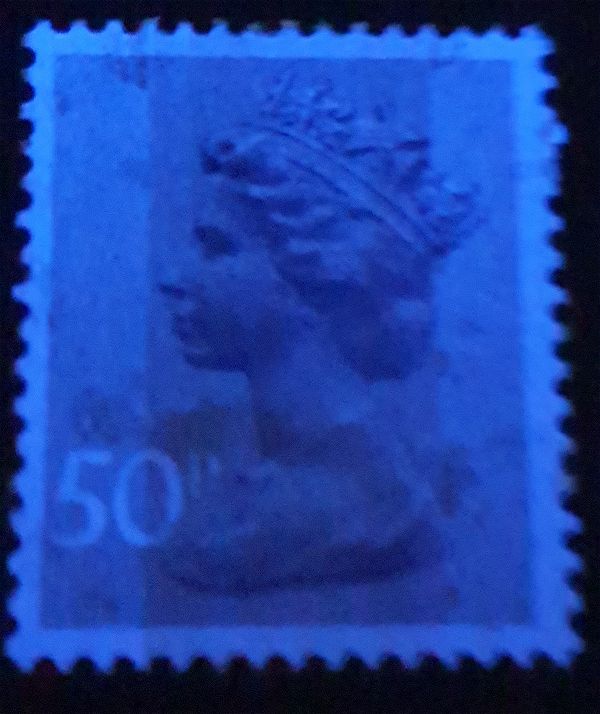 This is an example of 'All Over Phosphor' (AOP) wash. The phosphor was not intentionally applied over the whole surface has happened with the 1p, 2p, and 10p stamps. The experimental coating has a similar reaction. However, since the phosphor was mixed into the coating, it will be more equally distributed over the stamp surface. In addition, phosphor bars were applied to make sure the automatic letter facing machines would read the phosphor signals. |
|
Send note to Staff
|
|
|
Pillar Of The Community
Netherlands
6641 Posts |
|
|
In the same post on page 26: Quote:
2)
Has anybody an example of an uncoated stamp (or a link) where you can see how obvious this uncoated paper is? Sometimes uncoated paper is also smooth, so how do you distinguish coated and uncoated paper in the Machins? The fibres of uncoated papers show under magnification. Normally, the coating hides the paper fibres. Unfortunately, my new microscope arrived this weekend with its driver on a CD-rom. Although my laptop is a few years old, it is one of those that no longer have a CD-rom drive. They are not the standard equipment anymore. So, my phone will have to do. Its camera cannot magnify the stamps enough. 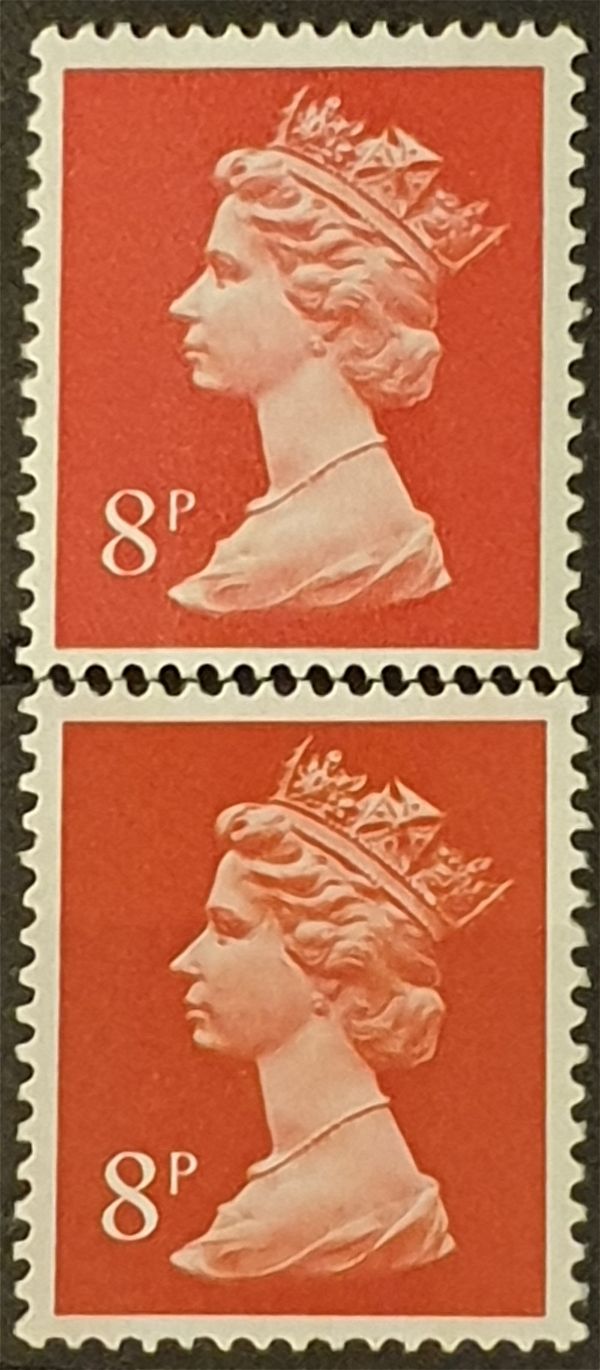 These are the fluorescent coated paper 8p stamps with two phosphor bars, issued 24 October 1973 (DG 80.1.1, CC 161). One has the fluorescent coating, the other has not, i.e., it is uncoated. The fluorescent coated paper is called such because the coating has an optical brightening agent (OBA) mixed into the coating. This makes the stamp appear bright under longwave ultraviolet light. Clearly, the uncoated paper cannot have this OBA as the coating is missing. A stamp printed on uncoated paper, therefore, must lack the fluorescent reaction of an ordinary stamp. Below picture shows which of the two stamps in above picture was printed on uncoated paper. 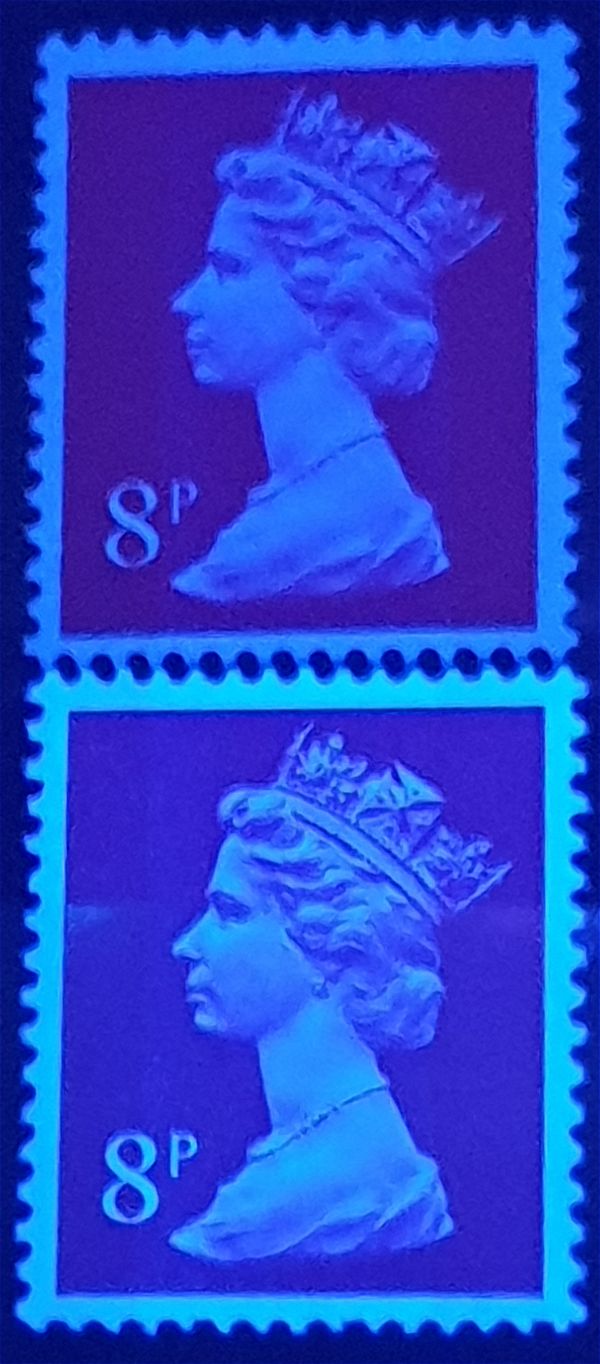 There is a caveat. Some stamps were printed on coated paper that had the OBA omitted or 'low OBA.' Here are the same stamps again, with the 15 1/2p on PCP1 paper with fluorescent brightener (OBA) omitted (DG 155.1.1a, CC P155FBO). 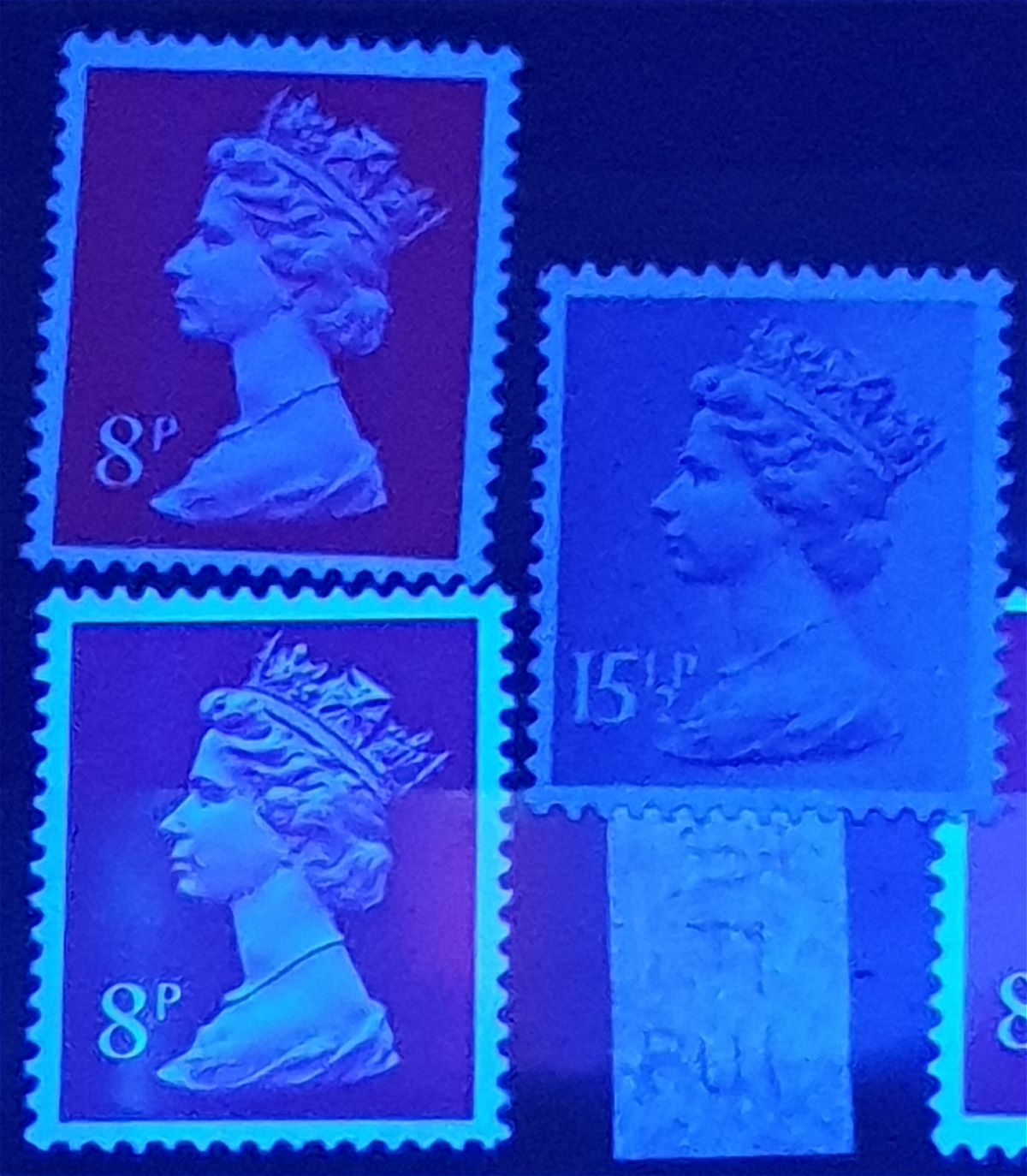 The 8p is not known with the OBA omitted. So, the top one was printed on uncoated paper. |
|
Send note to Staff
|
|
|
Pillar Of The Community
Netherlands
6641 Posts |
|
|
Well, you got what you asked for. They stopped issuing Machins. |
|
Send note to Staff
|
| Edited by NSK - 08/30/2023 03:39 am |
|
|
Pillar Of The Community
United States
4505 Posts |
|
|
Given the end of Machins, maybe Gibbons could spin off the not very up to date Specialized Machin section and create a final Machin Specialized. |
|
Send note to Staff
|
Al |
|
|
Pillar Of The Community
Netherlands
6641 Posts |
|
|
@angore,
I am not sure what you are trying to say.
Since they also have specialised Queen Victoria, Four Kings, and pre-decimal Queen Elizabeth II catalogues, I wonder how the end of an era would be a reason to discontinue an existing specialised volume and replace it by another catalogue.
Also, I do not see how such a new catalogue will be 'final.' No doubt new discoveries will be made in the next decade. Even Deegam still lists new finds from booklets issued almost fifty years ago.
Any such new catalogue, likely, builds on the current catalogue. A new edition of the existing specialised volume looks like a more viable option.
I would agree it is a good reason to, finally, update the current outdated specialised volume dedicated to decimal Machins. And they may not update that for a very long time. |
|
Send note to Staff
|
|
|
Pillar Of The Community
United States
4505 Posts |
|
|
It would be more "final" that the book today but then I recall Hugh Jeffries stating they had no interest in updating the specialized catalog (personal interest or resources). |
|
Send note to Staff
|
Al |
|
|
Pillar Of The Community
United Kingdom
895 Posts |
|
|
I agree there is scope for trying to define the set, now no more are appearing. New discoveries will be the realm of the deep specialist - most collectors I think aren't that interested in technicalities which require equipment to detect. I also think there would be scope now for pre-printed albums for collecting the "complete" set. |
|
Send note to Staff
|
|
|
Replies: 623 / Views: 85,463 |
|




 Posted 12/28/2022 2:29 pm