| Author |
 Replies: 181 / Views: 24,865 Replies: 181 / Views: 24,865 |
|
|
|
Pillar Of The Community
United States
7239 Posts |
|
|
Thanks Rod. I cannot recall having seen those pages before. Here are some provisional Estonian cancellations from 1918-20 as listed and shown in the Estonia Philately and Postal History Handbook/Catalogue by Vambola Hurt and Elmar Ojaste. Provisional markings are listed for 164 towns + 9 unknown post offices. There are as many as seven different markings/town, but usually there is only one per town. Not all markings are illustrated. Here is the opening statement for this section of the Handbook: "The lack of cancellers in Estonia was one of the more prominent problems when the Estonian GPO commenced its activities in November 1918. No general instructions were issued by the GPO and the re-opened P.O.s had to use all available means and "make-dos". The old Russian stamps (cancellers) were to be sent to the GPO for re-engraving and only to some of the P.O.s centrally made rubber stamps were provided."    |
Send note to Staff 
|
|
|
Pillar Of The Community
United States
7239 Posts |
|
|
Bedrock Of The Community
Australia
38679 Posts |
|
|
Pillar Of The Community
United States
2830 Posts |
|
|
I love the coat of arms issue of 1928-40 but have yet to add it to my definitives collection. Very hard to find mint stamps in good condition, but this thread inspires me to look deeper. |
|
Send note to Staff
|
|
|
Pillar Of The Community
United States
7239 Posts |
|
|
This posting focuses on the 2 Mk overprint of 1920. Hurt and Ojaste's Estonia Handbook mentions the faultiness of both the underlying 70 p stamp and the overprint: "The print is transparent and often faulty", and "The OPT is often faulty and strongly shifted." The overprint consists of 2 strike lines and the "2 Mk." printing plus 2 dots. One dot is approx. 1.5 mm below the beginning of the second strike line, and the second, larger dot is 5 mm below the "2". First scan shows several overprint varieties as described in the Estonia Handbook. There is the very shortened left leg of the "M", listed by the authors as E:4. Broken overprint lines are listed as E:5, and shifted overprint is listed as E:6. Note that the overprint on the third stamp is shifted and tilted. Second and third scans show an unlisted plate flaw of the underlying printing. It is a dot between the two seagulls. The Estonia Handbook describes these stamps as follows, "The overprinting was made on the 70 penni value of the Seagull issue." I take this to mean that there was not a new printing done for the overprinted stamps. I have not found this plate flaw on my accumulation of unoverprinted 70 p stamps. Of course, the flaw could have occurred late in the printing, so that the flaw occurs only within the remaining stock used for the overprinted stamps.    |
|
Send note to Staff
|
|
|
Bedrock Of The Community
Australia
38679 Posts |
|
|
Fascinating Bob. Dots on my Sc#55, #56 and #58 The greyer stamps are not mine, examples I found when I was looking.  On Sc# 55 and #56  |
|
Send note to Staff
|
|
|
Pillar Of The Community
United States
7239 Posts |
|
|
Estonia Handbook, "The overprinted issued was made to provide stamps for the increase of Postal Tariffs from July 1, 1920. The 1 Mark value was intended for domestic postcards and the 2 Marka for domestic letters."
The sheets of these three unoverprinted stamps were printed as four panes of 100 (2 x 2). The overprints were applied to the full sheets of 400 stamps.
Regarding the two, "1 Mk." overprint stamps, Estonia Handbook says, "The black OPT - 1 Mk. and two control period markings - was typographed by the A/S Uhiselu in Tallinn and applied to the whole printing sheet of 400 stamps. The same plate was used for both values. Due to wear and tear the OPT is often faulty and numerous printing errors have been recorded. The OPT is also often strongly shifted."
The positions of the "1 Mk." plate flaw "print varieties" as listed by the Estonia Handbook are identified, whereas there is no identification for the plate flaw positions on the "2 Mk." stamp.
For example, the 1 Mk. print variety E:9 "short left foot of the M" is pane II, pos.96. Of course, the PF and position is the same for both 1 Mk. stamps. |
|
Send note to Staff
|
| Edited by bookbndrbob - 05/12/2020 11:02 am |
|
|
Pillar Of The Community
United Kingdom
1255 Posts |
|
|
Bob, the only variety of the 2m on 70p you are likely to come across is a major shift in the surcharge, either upwards or downwards so that the bars are clear of the original value, or the "short foot to 2". I've seen very few others. The 1m on 15p or 35p can, however, be pretty shocking and is worth picking up as large multiples. Mind you, it was a post-war provisional so it needs to be put in context. |
|
Send note to Staff
|
|
|
Pillar Of The Community
United States
7239 Posts |
|
|
Thanks Timm H. Searching for plate flaws has always been "hit or miss" for me; sometimes lucky and sometimes not. I have never knowingly bought a large accumulation of used stamps from a specialist dealer or collector. I have had limited success with the Estonia stamps, so I surmise that the material I have been looking at has been through "knowledgeable" hands at some point. Here is a plate flaw on the un-overprinted 70 p Seagull definitive. It is E:6 "Right 7 and 0 joined" in the Estonia Handbook. These three stamps were in one lot, as I recall.   |
|
Send note to Staff
|
|
|
Pillar Of The Community
United Kingdom
1255 Posts |
|
|
Bob, this is my experience too. I will sift through hundreds if I find them at a stamp fair or a dealer. Oddly, it's the flaws on the "3 lions" definitives which are the hardest to find. I must get round to posting some of my collection. |
|
Send note to Staff
|
|
|
Pillar Of The Community
United States
7239 Posts |
|
|
Pillar Of The Community
United Kingdom
1255 Posts |
|
|
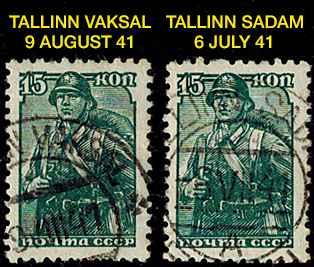
The Tallinn Vaksal cancel raises a nice issue of "loan words" in language. Vaksal means railway station, and is identical to the Russian word. It gets its origins from the 1840s when Russia was starting to build her railway network. Legend has it that distinguished Russian visitors to the UK were taken on a railway journey around London in order to give them the heavy sales pitch on railways and how to build them. They had to pass through Vauxhall Station, which was the major hub of its time in London (and still is). They were deeply impressed, and thought that Vauxhall was the generic name for "railway station", so the word entered the Russian vocabulary. Karandash is the Russian word for "pencil" for example, borrowed from the French, and there are many more examples.
Estonia was part of the Russian Empire before gaining her independence in the war of 1919-1921, split between the provinces of Estland and Lifland. |
|
Send note to Staff
|
|
|
Bedrock Of The Community
Australia
38679 Posts |
|
|
Fascinating, Tim.
No idea Vauxhall was a location.
When I was a kid the Vauxhall E Type Wyvern, was my dream car.
Big chrome strips down the bonnet...cool!
|
|
Send note to Staff
|
|
|
Pillar Of The Community
United Kingdom
1255 Posts |
|
|
When I was at school, some of our 6th form used to get summer jobs at the Vauxhall car plant in Luton, driving cars from the finishing line to the main parking lots. I remember that they earned good money. |
|
Send note to Staff
|
|
|
Pillar Of The Community
United States
7239 Posts |
|
|
Replies: 181 / Views: 24,865 |
|




 Posted 04/25/2020 7:10 pm