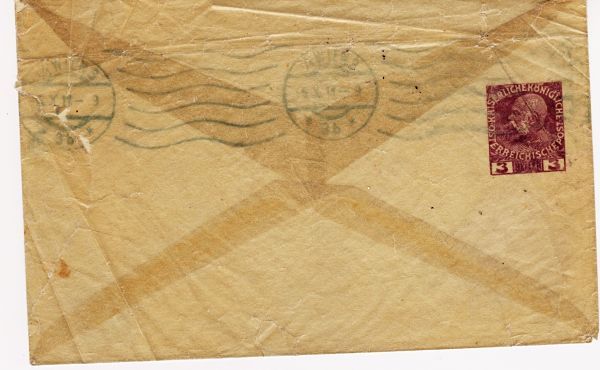
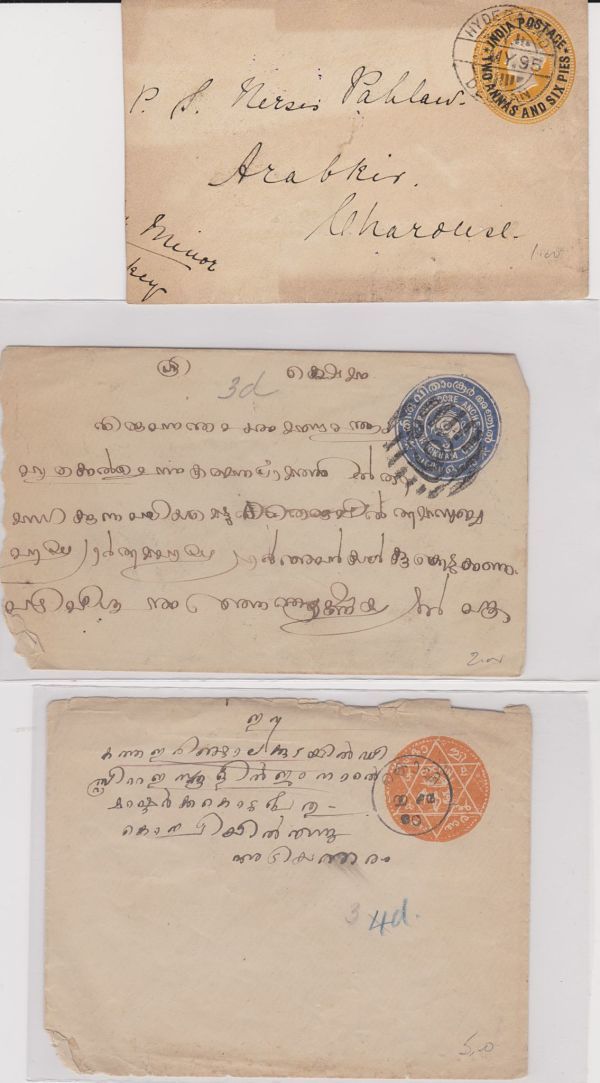
This ½ Anna postal stationery cover from Indore (Deschl E1)

was the only envelope issued by Indore; it's quite common, as these things go.
However, it has a nice strike of the Indore State post office at Ujjain, an important and very holy city in the neighbouring State of Gwalior. This was a unique arrangement between the Indore and Gwalior States, which allowed an Indore post office to operate on Gwalior soil. There was nothing identical anywhere else in India.
Another little point of interest about the cover is the address. It begins (enclosed by two sets of parallel lines) with the famous curse of 74 on anyone delaying or interfering with the letter. Frits Staal explained the curse this way:
"Envelopes even more than single stamps are often marked with scribbles, lines, dots, or other symbols that are supposed to prevent them from being taken away or opened by unauthorized outsiders. A similar practice adopted by Hindus in Jammu and Kashmir, Indore, Jaipur, and so on is to write: //74// at the beginning of the address to insure safe delivery of the letter. ... Professor Bruce Pray has drawn my attention to a story translated from the Hindi in Linguistic Survey of India, vol. VI, pp48-49 about the miraculous powers of song. The singer Tan-sen sang with such force that all the lamps at the court of Emperor Akbar lit themselves, and Tan-sen himself burst into flames and fell down dead. Earlier, he had warned that if such a thing would happen, he could be brought to life only by Queen Kamla of Chittaur. The Emperor therefore attacked Chittaur and a terrible battle ensued. Seventy-four and a half maunds (one maund being equal to approximately 80 lbs.) of sacred threads were collected from the corpses of the slain. Queen Kamla was taken prisoner, and when ordered to sing, she sang with such force that her soul burst its way through her skull and went to heaven, leaving the audience with their mouths open in astonishment. The number 74½ is still written on letters as the strongest of seals, for "the sin of the slaughter of Chittaur" is thereby incurred by all who violate the letter."
Frits Staal, The Stamps of Jammu & Kashmir, pp124-125





 Posted 06/24/2014 09:52 am