|
This page may contain links that result in small commissions to keep this free site up and running.

Welcome Guest! Registering and/or logging in will remove the anchor (bottom) ads. It's Free!
To participate in the forum you must log in or register.
| Author |
 Replies: 339 / Views: 84,926 Replies: 339 / Views: 84,926 |
|
|
|
Valued Member
Denmark
445 Posts |
|
|
Geoff,
SG will release a new version of the Imperial album this year.
This time it will not be fastbound. |
Send note to Staff 
|
|
|
|
Pillar Of The Community
Finland
753 Posts |
|
|
Quote:
Scb... 718,000! Is this through 2014? They just provide the latest numbers, not a detailed list what's within. My hunch is that big countries are there but lesser ones are more or less short. Quote:
I found a great book called The Philatelic Almanac from 1936 by Lindquist that summarizes by decade the number of stamps through 1934. I've posted this before (at least on my blog;you should really hang out there more often, LOL), but here it comes again... This is from a 1950/60s Finnish stamp bible, but the data itself is likely based on some German resource:  (the blacked areas are simply to provide translations to non-Finnish readers) Like they say there are lies, damned lies, and statistics... Quote:
Area 66 hits on a major dilemma, binders falling apart. I can say this about Scott International, empty binders are fairly easy to find. All binders eventually fail. Stock books are not isolated case neither... The thicker they are, the more likely the spine will fall apart on the long run. That's why I use mostly 16 and 32 pagers these days, as they seem to last just about anything. In addition, the thinner volumes make it easier to add new books in between when required. And the ones with black pages + transparent strips. Don't use them either (the gum on the strips will fail sooner or later, and then the stamps start falling out of pages)  ... On the other good old fashioned stock books with white pages + glassine strips seem to last forever  -k- |
|
Send note to Staff
|
|
| Edited by scb - 03/20/2015 04:13 am |
|
|
Pillar Of The Community
United States
8571 Posts |
|
|
That number of 718,000 sounds realistic . The stamp collecting community looks at about 75,000 different stamps as a large collection . It is not that uncommon to see collections of 100,000 to 140,000 different stamps up for auction . The magic cutoff number that very few collectors ever achieve is the 200,000 different worldwide collections .Now that magic number of 200,000 today is easier to get to .
|
|
Send note to Staff
|
|
|
Pillar Of The Community
Finland
753 Posts |
|
|
Getting huge quantities of stamps is not an issue, as anybody with deep pockets can buy as many stamps/collections as they like. The real difficulty is to find the time to work/study/research/organize all those stamps. I think most collectors stop at around 200K simply because they, or more precisely their life runs out of time.But for those of us who have started early/at young age, going beyond should not be 'hard'... It's bit of the same as in investing. Start early and repeat, and you can achieve great things even on modest budget. |
|
Send note to Staff
|
|
| Edited by scb - 03/20/2015 08:38 am |
|
|
Pillar Of The Community
Norway
1661 Posts |
|
|
landoquakes Quote:
Blaamand, your Sweden homemade page is very striking Thanks!  keijo - That's an interessant article on number of issues. As you say it's impossible to get any correct answer on this, it's all down to interpretation. My system lists as follows: 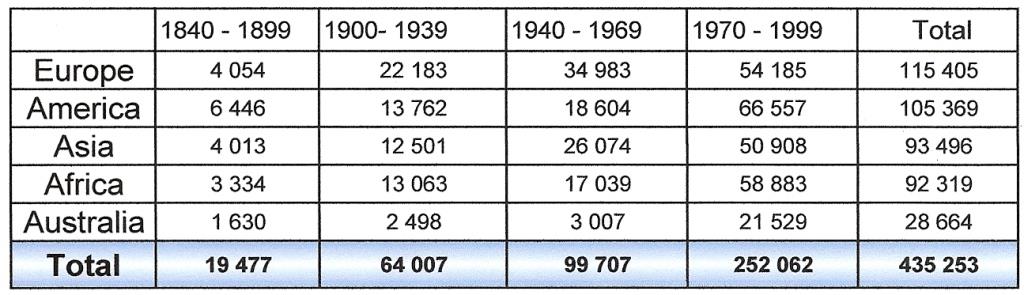 Total 26 237 from Europe until 1940, which is almost identical to the numbers from your 'Finnish stamp bible'. However my total numbers for the world is a few thousands of, must differ on the other continents. This is all only numbers, the main thing is to have some joy collecting them, disregarding numbers. Floortrader I agree that 200k seems like a magic target  Regarding definition of 'large', I can hardly understand how to define that and who is in a position to do so.  Whoever is collecting stamps, and see their collection growing day by day, would be entitled to think their collection is getting larger every day, hence they have a 'large' collection compared to what they had before  That would be my goal, disregading any number or comparison to others, but first of all the joy of it |
|
Send note to Staff
|
|
|
Pillar Of The Community
United States
2830 Posts |
|
|
Great stuff! Love it. In terms of adding to a collection slowly, and I mean in the sense of mounting stamps into your collection, if you mounted 50 stamps a day for 6 days a week (everyone takes a day off!) for 50 weeks a year (don't forget vacations!), you'd be mounting 15,000 stamps a year. So for the kinds of numbers Floortrader and Blaamand are talking about, at this pace it would take 5 years to get to 75,000. 125,000 takes 8 years 4 months, and the magic number of 200,000 would take more than 13 years!
Another way to look at this is if you get 20 stamps on each page (meaning 40 stamps on 2 sides of a page) it would take 3,125 2-sided pages to store a collection of 125,000 stamps. A collection of 200,000 would take 5,000 album pages fully loaded on both sides!
I think I'd want my family to bury those albums with me when I go! |
|
Send note to Staff
|
|
|
Pillar Of The Community
United Kingdom
8624 Posts |
|
|
Shermae
Careful! I dimly recall reading - in the 60s - a book by a stamp dealer. One of his customers told him of his intention of being buried with his collection. A few months after said collector died, a chap came into the dealer's shop with a number of familiar, but now rather musty, volumes ...
Geoff |
|
Send note to Staff
|
|
|
Pillar Of The Community
United States
2830 Posts |
|
|
Pillar Of The Community
Norway
1661 Posts |
|
|
Pillar Of The Community
Norway
1661 Posts |
|
|
Shermae Quote:
So for the kinds of numbers (..) Blaamand are talking about English is not my first language, so you might have misunderstood what I was trying to say in my poor language...  I never wanted this discussion to be about numbers collected and comparison of whether a collection is large or not .. I was trying to say the straight opposite. Number of stamps issued is more interesting for me. And having fun while at it  |
|
Send note to Staff
|
|
|
Pillar Of The Community
1448 Posts |
|
|
I appreciate the stamp numbers stats by decades that both Keijo and Jon posted. Lots of good information!  Just to add to the stat information, I counted all the major numbers in Scott Classic Specialized 1840-1940 catalogue, and came up with 83,262. If you would like to look at the specific breakdown by country, the count is in the first left hand column on my blogsite at... http://bigblue1840-1940.blogspot.co...lection.htmlKeijo's stats show 76,790 through 1940, while Jon's stats show 83,484 through 1939. (Obviously, different catalogues are going to give different counts.) My count of 83,262 is in the same ball park, considering that the Scott 1840-1940 catalogue , despite the name, lists some stamps of a country up to 1952- specifically the British Commonwealth area. The other part that I can use with Keijo's and Jon's stats is the demonstrated increase by decade(s) in stamp production. Why? I'm thinking about expanding the collection year for WW to 1950 or 1960, so I would need to know how bad the shelf/album space requirements would be.  Jon's data shows the number of (major number?) stamps released for 1840-1939 to be 83,484: for the 1940-69 era- 99,707; and for the 1970-99 era - 252,062. The other stat that is helpful for me is Keijo's 25,263 count for 1941-50. It looks like collecting to 1960 would about double the shelf space/page requirements I now have.  Hmmmm, the cutoff date may have to be 1950.  |
|
Send note to Staff
|
|
|
|
Pillar Of The Community
United States
526 Posts |
|
|
Floortrader noted that 75,000 is the threshold for a "large collection," which makes sense to me if one is talking about worldwide to the present or even only to 2000. At 90,000 Keijo has a large collection and Floortrader has a massive one. The 200,000 fatigue factor threshold sounds reasonable to me too. Seventy-five thousand would be, what, 10-15% of the total number of stamps issued 1840-2000?
But I would point out that for us 1840-1940 or 1840-1950/60 collectors a "large collection" would be much smaller. Twenty thousand 1840-1940 would be 25% of the possible stamps. Twenty-five thousand 1840-1950 would be the same. If the bulk of the 20,000 or 25,000 were from the later decades, say, 1900-1940/1950, this need not be hugely expensive but still would cost more than a 75,000-stamp 1840-2000 collection. (Of course variable mint and used ratios will make a huge difference in cost.) On the other hand, if a 25,000 stamp 1840-1950 collection contained stronger 19th-century representation, its cost (and value) would rise significantly, depending, of course, on condition and mint/used.
So, might one say that even as few as 15,000 stamps 1840-1940 would be equivalent to 75,000 stamps from 1840-2000???
Jkjblue's 35,000-40,000 collection (forgive me, Jim, I don't remember exactly), which is largely 1840-1940 but with 1940s, would then be a huge collection (40% or so of the available 83,000). It would be comparable to 250,000 or 300,000 in 1840-2000 stamps unless my math is wrong (which it very well might be).
Jkjblue agonized about how much shelf-space would be needed to extend from 1940 to 1960 as compared to extending from 1940 to 1950. My suggestion: just permit yourself a ragged cutoff.
My theory is this: I'm interested in the world that existed from 1840 to about 1960 when everything changed rapidly--the colonial empires were abandoned. The earliest independences came in the 1950s, then the real turning point was in the 1960s. So I collect British Commonwealth past 1952 and French colonies into the 1950s as I happen on to material rather than obsessively filling spaces. Ditto for Portuguese and Spanish colonies. The transition to independence was itself a process. I collect what I can in that late-colonial period but I don't feel pressured to fill in all the blank spaces. And I only print my Steiner pages as far into the 1950s as I have stamps for.
Might save a few inches of shelf-space. And as a bonus I get to gaze at those interesting colonial pictorials, no longer limited to heads of monarchs, from the 1950s but before the former colonies started issuing thousands of paintings from the Prado or the Louvre or movie stars, footballers, classic automobiles, Elvis Presley, comic book characters, bird species, mindblowing varieties of centipedes, and Princess Diana.
On the other hand, I cut Russia and the Soviet bloc off at 1945. I'm not interested in Hungary or Czechosolovakia under Communism. Yes, there are some really interesting stamps there, but that's a cutoff point I don't mind. (Because I'm a Germanophile, I make an exception for the whole German area, all four zones, to 1949 or 1950).
And cutting the whole (future) Warsaw Pact area off at 1945 would save a LOT of shelfspace. Same with China or Japan or Latin America--collect the 1940s but not particularly the 1950s, whereas for the colonial powers, collect into the 1950s as I am able.
Just let it be ragged like that and enjoy.
|
|
Send note to Staff
|
|
|
Pillar Of The Community
1448 Posts |
|
|
Quote:
Just let it be ragged like that and enjoy. Makes sense. I like the early QE II colonial issues (1950s), while a natural cut-off for China would be 1949. (Note: 1000 post.  ) |
|
Send note to Staff
|
|
| Edited by Jkjblue - 03/20/2015 5:22 pm |
|
|
Pillar Of The Community
United Kingdom
8624 Posts |
|
|
Hieronymus
Each to his own, but, by ignoring post-1945 Czechoslovakia, you're missing what are, taken as a whole, probably the best stamps produced anywhere since the 2nd World War. The GB and US efforts over the same period pale in comparison. Probably only France is in the same league in terms of quality. You're also missing a fascinating political narrative. And they're cheap!
Fully agree on the endless large, art stamps from Latin America etc, however.
Geoff |
|
Send note to Staff
|
|
|
Valued Member
Canada
77 Posts |
|
|
I find Hieronymus' analysis very useful. My cutoff is 1949 in general, but I go to 1952 for British Colonies, the very early 50s for China due to the significant changes in that country at that time, and other exceptions where history warrants, hence I use somewhat of a ragged cut-off. My collection is in the very large range, using the Hieronymus scale. |
|
Send note to Staff
|
|
|
Replies: 339 / Views: 84,926 |
|
|
To participate in the forum you must log in or register. | |
Disclaimer: While a tremendous amount of effort goes into ensuring the accuracy of the information contained in this site, Stamp Community assumes no liability for errors. Copyright 2005 - 2026 Stamp Community Family - All rights reserved worldwide. Use of any images or content on this website without prior written permission of Stamp Community or the original lender is strictly prohibited.
Privacy Policy / Terms of Use Advertise Here |
| Stamp Community Forum |
© 2007 - 2026 Stamp Community Forums |
| It took 0.43 seconds to lick this stamp. |
 |
|
|
|


 Posted 03/20/2015 02:20 am


