When it comes to the Zeppelin covers, there is definitely a high ceiling that far exceeds what I'm able to spend for a single cover. Fortunately, there are a lot of great flight covers that aren't worth much, and often they are also the ones that people might get more excited about due to their better known historical connections. For instance, the first North American flight of the Hindenburg to the US, or its Olympic stadium fly over.
But I can tell there's also a ton of knowledge to be absorbed on the subject of Zep covers & markings, and the potential to find something more valuable for a good price because the seller or other potential buyers may not appreciate the full significance of the piece. So even if you can't afford a particular piece offered at its full value, there's still hope of acquiring it at auction. Personally, I'm attracted by the sheer volume of knowledge to be absorbed... that interests me even more than actually acquiring anything tangible.
I have picked up a few Zep covers that I just really, really liked, visually as well as for their historical connections.
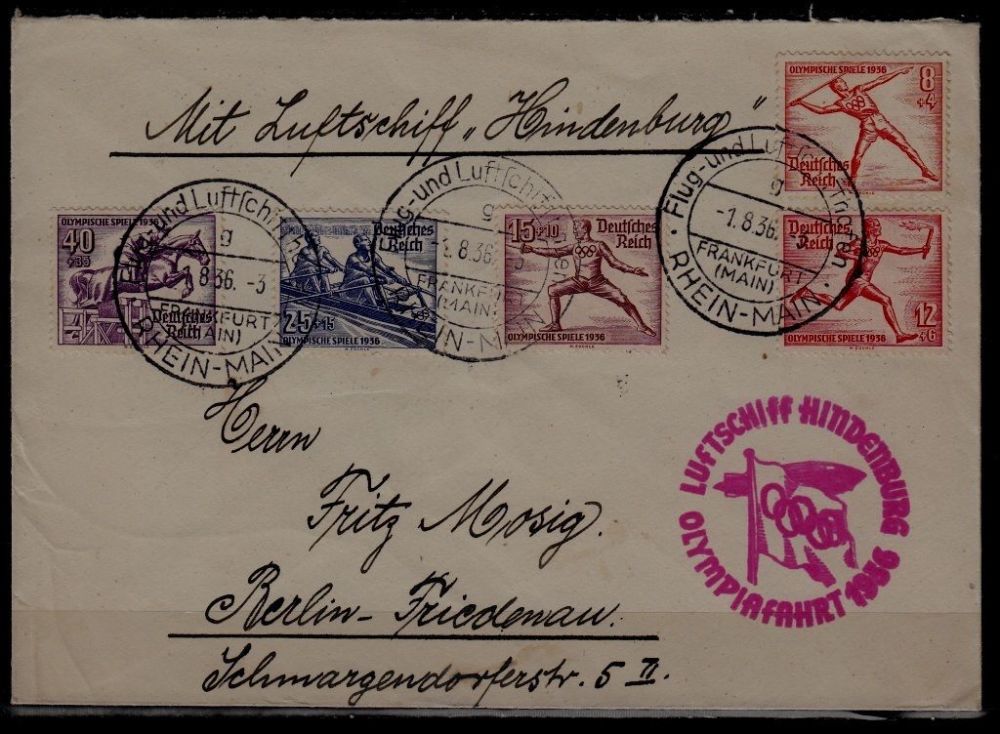
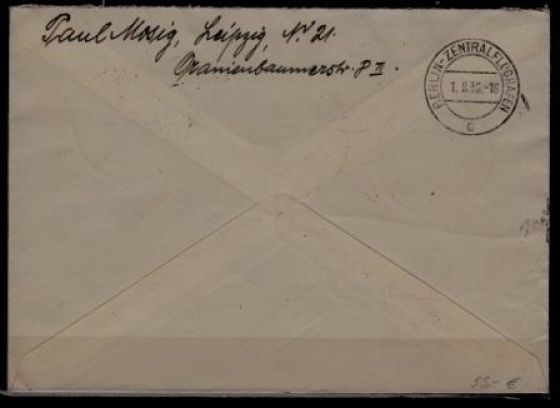
Here's one I just picked up... still not in hand yet... but I wonder how it fits into the whole 'contrived' issue. It was really a propaganda flight, the sender was obviously aware the letter would fly on the Hindenburg, and stamp - cancel placement is visually pleasing and thoughtfully put together. But it actually looks less contrived than many others I've seen, has no connections to dealers that I am aware of, and appears to have been cut opened, so not likely a strictly philatelic item.
This is called the Olympic Games Flight. It is listed in the American Air Mail Catalog as Z-415 and is a common Zeppelin cover with a modest catalog value. I think covers from this flight are very attractive since most of the ones I have seen have multiples of the colorful Olympics stamps such as yours has. I see from the photo that yours has a roughly opened top edge and some small wrinkles at the bottom left which will detract from the already modest commercial value, but overall it is an attractive cover and would look great in a collection.
As for whether it is philatelic or non-philatelic my thought is that it is completely philatelic as are most Zeppelin flight covers. As you point out this one is not addressed to a dealer (at least not a major dealer) but a great many Zeppelin flight covers were prepared by individual collectors back in the day. There is little reason other than philatelic for it to have this particular franking or for it to have had to wait to go on the Zeppelin when there was regular and immediate airmail service between these cities.
There are non-philatelic Zeppelin flight covers, but they are mostly the ones from later year flights that had no special flight cachets and can only be distinguished from regular German airmail by the exact dates of the cancellations and receiving backstamps. They also normally have either mundane, every day postage or are cancelled by meters and are addressed to a location where the use of the Zeppelin would have been the fastest method for delivery. Overall they are not especially attractive.
If you are interested in collecting Zeppelins, or trying to find a gem from among the ordinary and less expensive ones, you really should buy some good reference books to learn what is rare and what is common. I think the best catalog is the "Zeppelin Post Katalog: 22. Auflage" by Hermann E. Sieger. As you can guess by the title, it is written in German so if you do not read German, you can use one of the on line translators to help you decipher what the various words and phrases mean. Eventually you will be able to make out what it is saying as you build up your vocabulary. The next most complete listing is the American Air Mail Catalog. This is entirely in English so it is what is used by many English speaking collectors who do not wish to take the time to learn enough German to use the Sieger catalog. Sieger's last edition was in 2001 and the AAMS last Zeppelin listing was in their 1974 edition with the 1990 pricing update. Neither of these catalogs' edition dates is an issue, though, in terms of identification and relative rarity of Zeppeling flight covers since there haven't been any new Zeppelin flight covers since 1939. The prices in both are out of date, but the relative pricing and rarity are fairly set and all one needs to do is watch some current completed auctions on ebay or in stamp auctions (ignore any ebay auction where the item did not actually sell) to get a current fix on today's commercial values which can then be extrapolated across pretty much all of the other catalog listings.
Thanks for the great info Kimo. That's exactly the sort of info I am looking for. I have the Sieger Catalog coming in the mail already, and will look into the other you mentioned as well.
The modest values of the better known and more contrived Zep covers are precisely what I wanted to illustrate with my picture. I can't afford anything exotic at the moment. My wife is very ill and recently had to 'retire'. So between a lower income and medical expenses, selling another collection and spending modestly is my only choice at the moment. But there's so much to learn; its a fantastic area. A great distraction from other things.
My goal with the Zeppelin covers is to start with the Hindenburg, collect one or two different cover/post cards from each of its more well known or marker flights (first NA trip, first NA return, first SA, etc - for which the covers are generally cheaper and easier to find) then move on to another Zeppelin doing the same. That way I'm enhancing my 'flight topical' collection nicely and not spending heavily on any single cover. If I find some gem along the way, great. If not, the possibility is exciting in any case.
Since I enjoy sharing my collection finds with friend and family, my main focus is finding something historically interesting that others can relate to, and visually appealing. It also has to do something for me personally. I love taking my collection out and examining the covers, and their many details. I'm not one to tuck stuff away and never actually enjoy it.
I should add that although the zep covers are mainly philatelic, the trans-Atlantic flights were faster by a couple of days than ships (in actual travel time), so there were apparently more 'commercial' items sent than what probably would have been sent across Germany. Another factor is that ships carry more weight, and mail containers wait longer in port before departing. Even today, mail containers for ships can easily wait a month in port filling up. So sometimes when you send something to Europe via surface mail, it can take 6-7 weeks, but if your timing is better, it can be 2-3 weeks. At least that's speaking for the Canadian postal system.
Transatlantic mail was not necessarily faster by Zeppelin for two reasons. First, there were not very many Zeppelin flights each year in the early years and if you did not time your commercial mail exactly to go on the Zeppelin without waiting then your cover would sit around a post office for weeks or sometimes months waiting for the next Zeppelin flight. Then in the middle to later years of Zeppelin mail, transatlantic mail could be sent by airmail at first using a combination of the ship with the ship launching an aircraft from a catapult on the upper deck when it came close enough to for the aircraft to reach land on its internal fuel tanks. Later in the time of Zeppelins there were transatlantic flights of regular aircraft - mainly flying boats and seaplanes that were faster than the slow Zeppelins and they were much more regular and frequent so commercial mail would more often go by one of these faster and more frequent airmail methods rather than on a Zeppelin.
I have also found that even when a Zeppelin cover from the earlier days up to the middle of the time of the Zeppelins looks very much like a non-philatelic cover that they can still be either fully or partially philatelic if you can find one with the contents still in it where the sender will often say something like "I am sending this to you by the Zeppelin so your should keep it for a souvenir" or "please keep this envelope for me so I can put it in my collection since I am sending it on the Zeppelin" or things to that effect.
Collecting one of each of the main flights of the Hindenburg might wind up being rather expensive since some of them are rare and go for a fair amount of money. However if you stick to the common ones there will be many to buy and you will not go into the poor house doing it. Another thought might be to try to collect one of each of the Graf Zeppelin II covers. This second Zeppelin with the name Graf Zeppelin was launched in 1938 and flew between 1938 and 1939. It had 13 flights and all but one are very modestly priced. Some of the other Zeppelin categories might be rather expensive and difficult including the Italian Zeppelins or the American Zeppelins or the pre-WW I German Zeppelins, or the WW I war time German Zeppelins, or the British Zeppelins, etc.
Transatlantic airmail in a practical sense (mass) by airplanes didn't come until the very end of the decade, which effectively put the nail in the coffin for airships. Up until that time airships could still carry large loads at speeds that were still fairly impressive. 80mph is slow by todays' standards, but if you watch them in old video, they weren't slow by any means. Ships took a week more or less, generally more, compared to 2-3 days crossing time for airships. But I believe airship postage was also more expensive. 17 transatlantic round trips for the Hindenburg in its first partial year (1936), 10 to NA and 7 SA I believe. I think I recall that one of the SA trips (first?) wasn't even advertised, but still included a mail delivery.
North Atlantic catapult mail began in 1929 and South Atlantic began in 1934. For example, the North Atlantic route began in 1929 with 7 flights, then in 1930 was up to 22 flights, in 1931 it was up to 30 flights and in 1931 it was 35 flights. In 1934, the DHL seaplane transatlantic flight schedule to South America was once every other week and by 1935 was up to every week. And this was just the Germans. France began experimental transatlantic airmail flights in 1930 but took until 1936 to get to weekly airmail by regular aircraft.
My point is not that there was no commercial mail on the German Zeppelins, there certainly was, but rather the relatively infrequent flights - and in my thinking once a month is not terribly frequent when you want a letter to be delivered quickly and it potentially winds up sitting in a post office for 1, 2, 3, or even up to 4 weeks before it goes, make it difficult to count on Zeppelin mail to be the fastest method of delivery, especially when either catapult airmail or regular airmail flights are leaving every week.
That's great info Kimo, thank you. There's certainly a lot of great history involved with flight & mail. Lots of opportunity for learning and collecting.
Does anyone know if the Martin Mars transports/bombers were ever used to carry mail when they were carrying troops? For a few years I have had the privilege of having the last two parked in a nearby lake. Such wonderful aircraft to watch.
I'm not aware that they ever carried troops or mail during the war. The first flight of the prototype was in June 1942 but it had many problems that took until the end of the war to iron out. Finally after the war ended they started regular production but instead of the original order of 20 of them they only bought 5 since they were fairly outdated by that point given the performance of land planes by then. After the war the 5 production Mars aircraft were used to ferry cargo and sometimes passengers between San Francisco, Hawaii and some other Pacific islands for a few years. One was lost to a fire that started in one of its engines during that time. In 1959 the remaining 4 were sold to a forest fire fighting company. Most of the transatlantic mail during the war was initially flown on Pan Am's Martin M-130 and Boeing 314 flying boats in the first year or so and then on land planes afterwards. Pan Am was under contract to the Army until October, 1942 and then was forced to become part of the Army Air Force for the rest of the war.
Quote: Pan Am was under contract to the Army until October, 1942 and then was forced to become part of the Army Air Force for the rest of the war.
A bit of lesser known history about that. While Juan Trippe usually gets all the glory for the rise of Pan Am, it was actually created by Hap Arnold and three other US military men as a way to stop the Germans from getting the contract for mail service from Havana to Miami. But Arnold's creation was on paper only, and they didn't have aircraft to actually carry the mail at the time. Meanwhile, Trippe formed the Aviation Corporation of the Americas and got the landing rights for Havana, and then acquired Pan Am to get the mail contract. Later, when as commanding general of the Army Air Corps, Arnold ordered the "takeover" of Pan Am in Africa, I've wondered if Trippe thought Arnold was getting back at him in some way.
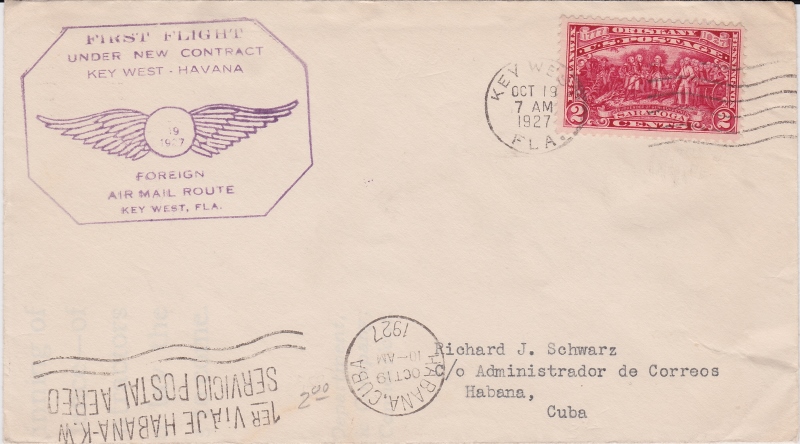
Below: A first Flight Cover for the October 19, 1927 "Inaugural" flight of Pan Am Airways (AAMC FAM 4-2).
"I'm not aware that they ever carried troops or mail during the war. The first flight of the prototype was in June 1942 but it had many problems that took until the end of the war to iron out."
The Martin Mars prototype was used extensively for the last two years of the war, transporting supplies & personnel between California and Hawaii. It makes sense to me that those flights could include mail. However, I don't know enough about how military personnel's mail would have been processed or transported. For instance, did the military collect and transport military related mail they might want censored? Or did they just censor it then turn it over to the mail carriers to transport & deliver?
Btw.. I'm sure many will know this... Hawaii Mars (II) & Philippines Mars are still flying. They are amazing to see.
Here's a good reference link:
Y22F9O3A0EM
*** Edited by Staff to add YouTube tags. Please use them in the future. We prefer embedded video. ***
According to Thomas Boyle's Airmail Operations During World War II:
Quote: Late in 1943, NATS received the first of the JRM-1 Martin Mars flying boats, a very large four-engine aircraft, larger than any other military flying boat used by the U.S. Navy. These aircraft were also assigned to the Alameda to Hawaii route to carry mail and supplies. A Martin Mars flying boat assigned to NAS set a record on 10 March 1944 when it carried 23,864 pounds of air mail from Pearl Harbor to San Francisco.
An air mail cover from a serviceman stationed at a U.S. Navy Aviation repair facility at NAS Kaneohe in Oahu, Hawii, is sown in Figure 69. This cover, mailed in June 1945, was carried by NATS from Hawaii to San Francisco, possibly in one of the new Martin JRM-1 flying boats.
Page 128
Most of this would have been mail carried on the original "The Old Lady" designated XPB2M-1R. Hawaii Mars 1, the first JRM-1, went into service in June 1945, and may have carried mail. It crashed and sank in August 1945 in Chesapeake Bay. The remaining four JRM-1's, latter converted to JRM-3 with larger engines, did not begin to enter service until 1946, and by then mail service had probably reverted to civilian transport, though that's just a guess on my part.
Nice info find Basil! So there was some mail carried by the 'old lady' at least. I wonder if such mail transports would have processed in a similar fashion to civilian mail, with some sort of marking or stamp that would identify its transport between CA & HI. Flying boats are kind of a novel thing, but maybe the military didn't go in for special rubber stamp cachets and that sort of thing?
No, you'll not find much in the way of wartime mail carried my the military air transports having rubber stamp cachets and the like. But before the war, a lot of first flight covers across the Pacific and Atlantic were certainly marked that way. Wartime mail was mostly to and from service personnel and a lot of that is collected, for one reason or another. I have some for my Hap Arnold exhibit from locations related to his activities, such as mail from Tinian when the B-29's were getting started on the bombing of Japan, or from Casablanca around the time of the wartime conference there between Roosevelt and Churchill. Besides learning how to "decode" the APO or FPO numbers, the senders themselves turn out to be people of some interest in terms of their wartime experiences. I've known philatelists to create collections of such mail from the various locations in the South and Central Pacific during WWII and use them to illustrate the advance of the US military toward Japan during WW2. But this is strictly "commercial" mail, mail actually sent to and from service personnel stationed throughout the Pacific. Trying to figure out the routes that the mail would have taken is also interesting to some. Same with the wartime mail on the other side of the world. Just another of the many and varied facets of philately.
Disclaimer: While a tremendous amount of effort goes into ensuring the accuracy of the information contained in this site, Stamp Community assumes no liability for errors. Copyright 2005 - 2026 Stamp Community Family - All rights reserved worldwide. Use of any images or content on this website without prior written permission of Stamp Community or the original lender is strictly prohibited. Privacy Policy / Terms of UseAdvertise Here





 Posted 03/06/2016 11:22 am