| Author |
 Replies: 16 / Views: 3,994 Replies: 16 / Views: 3,994 |
|
Pillar Of The Community
3865 Posts |
|
|
|
Some time after 1932, the British American Banknote Company (BABN) started to print some of its stamps by rotary press web fed dry printing on pre-gummed paper such as Canada 195d when before this Stickney rotary press web fed stamps were only printed by wet printing in that the gum was applied after printing such as Canada 169 and 195.
This was also different than the usual sheet fed flat plate dry printed stamps such as Canada 169a. Thus, describing this stamp as a flat plate printing is a misnomer since it is a rotary press dry printing. This innovation was short lived since BABN lost its contract in 1935.
BABN should be congratulated and recognized for coming up in the 1930's between late 1932 and early 1935 with the (Stickney) rotary press web fed dry printing of Canadian stamps.
This was very much different that the regular (Stickney) rotary press web fed wet printing and the flat plate sheet fed dry printing that was being used by BABN and others at that time.
The Canadian stamp that was mostly rotary press web fed dry printed on pregummed paper is Scott/Unitrade # 195d which is a variety of the 1 cent green Canada Medallion stamp
Scott/Unitrade # 195 which is the regular rotary press web fed wet printed stamp that was gummed after printing. This rotary press web fed dry printed stamp was ahead of its time.
I hope that this achievement in printing is given its proper due by the philatelic community in its current press and others as something that was innovative and creative for its time.
|
|
Send note to Staff
|
| Edited by jogil - 03/07/2016 11:11 am |
|
|
|
|
Pillar Of The Community
Canada
5821 Posts |
|
|
Good article jogil, thanks.
Do you know when the BEP started dry printing on their
Stickney rotary web fed presses ? |
Send note to Staff 
|
|
|
Pillar Of The Community
3865 Posts |
|
|
lithograving: The BEP mostly started this in the mid 1950's. |
|
Send note to Staff
|
| Edited by jogil - 03/07/2016 4:00 pm |
|
|
Pillar Of The Community
Canada
5821 Posts |
|
|
Pillar Of The Community
3865 Posts |
|
|
The BEP supplied BABN with a regular large web fed Stickney rotary press around 1930 that wet printed postage stamps and gummed them after printing them. At some point later between 1933 to 1935, BABN managed to get it to dry print postage stamps on web fed pregummed rolls of paper. |
|
Send note to Staff
|
| Edited by jogil - 03/07/2016 6:09 pm |
|
|
Pillar Of The Community
3865 Posts |
|
|
Here is some more information comparing wet printed web fed rotary press to dry printed sheet fed flat plate press and wet printed web fed rotary press to dry printed web fed rotary press. Also, dry printed sheet fed flat plate press can be compared to dry printed web fed rotary press: 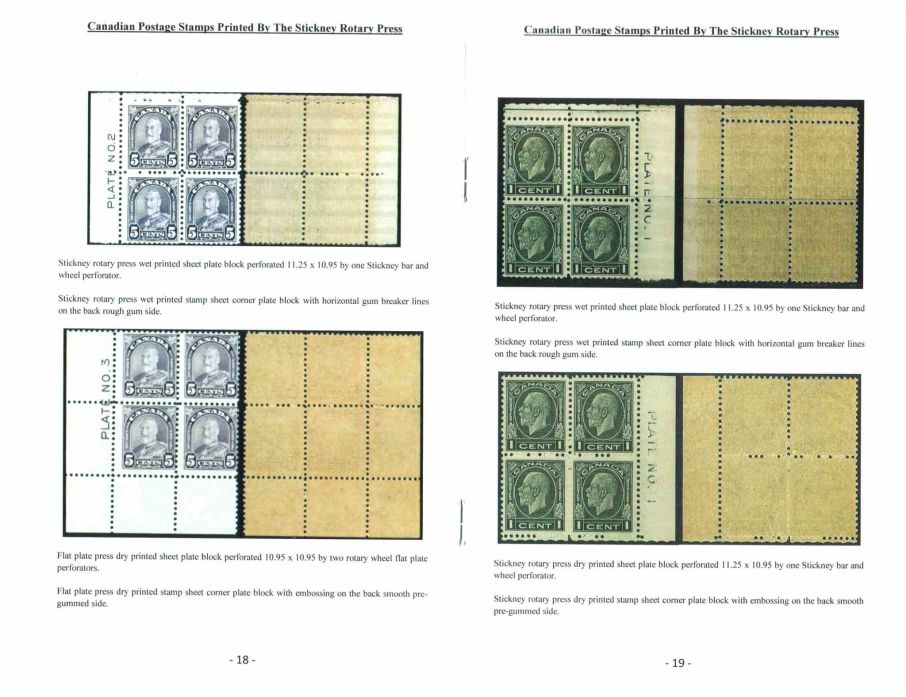 |
|
Send note to Staff
|
| Edited by jogil - 03/07/2016 6:19 pm |
|
|
Pillar Of The Community
3865 Posts |
|
|
lithograving: It would appear that the BEP U.S. web-fed rotary presses from the mid 1950's such as the Huck, Huck-Cottrell and Cottrell presses that eventually replaced the Stickney rotary press were considered dry printing presses since they used less water to dampen the paper rolls and gumming was done after printing since they still used ungummed rolls of paper. The BEP used pregummed sheets of paper for dry printing on the sheet fed 4 plate flatbed press (Scott # 1053) and the sheet-fed Giori dry printing rotary press. Also, a special sheet-fed flat plate dry press was used for Scott 1041 and a special sheet-fed rotary dry press was used for Scott 1041B. (It would appear that CBN began using dry printing web-fed rotary presses for its Canadian coil stamps from 1935 to 1969.) An excellent reference booklet on the printing of U.S. stamps by the BEP is "The Manufacture of United States Postage Stamps" by George W. Brett. |
|
Send note to Staff
|
| Edited by jogil - 03/09/2016 2:27 pm |
|
|
Pillar Of The Community
Canada
5821 Posts |
|
|
Pillar Of The Community
3865 Posts |
|
|
I am not sure if the U.S. Bureau of Engraving and Printing (BEP) ever printed on pre-gummed paper rolls any web-fed dry printed stamps like the British American Bank Note Company (BABN) did. There are some that dispute that BABN was able to really do this and try to make it look like it was printed on pregummed sheets by a sheet-fed rotary press like the dry printing of the Admiral Canada stamps from December 26, 1922 onwards until fully implemented around January 1926 onwards by the Canadian Bank Note Company (CBN). The proof is in the corner plate block format of the Stickney rotary press issues with a horizontal scalloped cutting edge (like for Stickney rotary press wet printing) and in the compound gauge of perforation being 11.25 x 10.95 for a Stickney web-fed bar and wheel perforator (like for Stickney rotary press wet printing) with the horizontal bar perforations not perforating through all the margins rather than 10.95 x 10.95 for a sheet-fed perforator that fully perforated through all margins. |
|
Send note to Staff
|
| Edited by jogil - 03/12/2016 10:26 am |
|
|
Pillar Of The Community
3865 Posts |
|
|
Some Printing Terms and Examples:
1) Sheet-Fed Flat Plate Wet Printing (flat printing plates used on cut wet sheets of paper which were gummed after printing) Example: Canada 111 with plates 1 and 2
2) Sheet-Fed Flat Plate Dry Printing (flat printing plates used on cut dry sheets of paper which were gummed before printing) Example: Canada 169a with plate 3
3) Sheet-Fed Rotary Plate Wet Printing (rotary bent printing plates used on cut wet sheets of paper which were gummed after printing) Example: Canada 111 with plates 3 and 4
4) Sheet-Fed Rotary Plate Dry Printing (rotary bent printing plates used on cut dry sheets of paper which were gummed before printing) Example: Canada 109 with all plate numbers
5) Web-Fed Rotary Plate Wet Printing (rotary bent printing plates used on wet uncut rolls of paper which were gummed after printing) Example: Canada 169 with plates 1 and 2, Canada 195 with plates 1 through 6
6) Web-Fed Rotary Plate Dry Printing (rotary bent printing plates used on dry uncut rolls of paper which were gummed before printing) Example: Canada 195d with plates 1 through 3
|
|
Send note to Staff
|
| Edited by jogil - 03/12/2016 10:24 am |
|
|
Rest in Peace
7742 Posts |
|
|
Pillar Of The Community
3865 Posts |
|
|
Rest in Peace
7742 Posts |
|
|
What I am trying to say is Julian J Goldberg has presented a wonderful paper that you might think about finding and reading.
Robert |
|
Send note to Staff
|
|
|
Pillar Of The Community
923 Posts |
|
|
Pillar Of The Community
3865 Posts |
|
|
The Canadian Bank Note Company (CBN) started to use around 1935 a web-fed dry printing rotary press that they made for printing coil stamps that was similar to the BABN one for printing sheet stamps. The CBN web-fed rotary press dry printed coil stamps from 1935 to 1969 are Canada Scott/Unitrade # 228-230, 238-240, 263-267, 278-281, 295-300, 309-310, 331-333, 345-348, 406-409, 466-468. |
|
Send note to Staff
|
|
|
Pillar Of The Community
3865 Posts |
|
|
The United States Bureau of Engraving and Printing (BEP) had supplied the British American Bank Note Company (BABN) with a large Stickney rotary printing press sometime from late 1929 to early 1930. The Stickney rotary press was a web-fed press that wet printed sheet, booklet and coil stamps. In addition to wet printing many stamps, BABN managed to use it at some point to dry print some stamps too like 195d. The BEP first started to web-fed rotary press dry print stamps using pregummed paper starting in March 1971 with the dull dry gum variety. |
|
Send note to Staff
|
| Edited by jogil - 04/25/2017 08:22 am |
|
|
Replies: 16 / Views: 3,994 |
|




 Posted 03/07/2016 09:57 am


