| Author |
 Replies: 23 / Views: 3,266 Replies: 23 / Views: 3,266 |
|
Pillar Of The Community
United States
3234 Posts |
|
|
|
Curious...
Why does the Scott catalog list things like the TRAILER PERMIT stamp (RVT1/2), and yet they do NOT list the lock seal stamps, which seem to come in far more colors/varieties?
Thoughts?
|
|
Send note to Staff
|
|
|
|
|
Pillar Of The Community
United States
857 Posts |
|
|
The traditional delineation was that to be Scott listed the stamps had to express a denomination in money, rather than in product. This excludes a lot of interesting taxpaid revenues (tobacco, oleomargarine, and so forth). There are a few that have crept in - beer, tax-exempt potatoes, and the like, and I wish that Scott would continue to expand coverage to additional and more esoteric revenue types.
Lock seals never were intended to themselves show the payment of a tax, so it's hard to call them revenue stamps. |
Send note to Staff 
|
|
|
Bedrock Of The Community
United States
10864 Posts |
|
|
Most of the examples that have "crept in" started out as issues with money valuations. The pre-prohibition beer stamps for example. Only the post prohibition stamps show product. The first half or the playing cards stamps, the same thing. Tax-exempt potatoes are an extension of the potato tax stamps, which show a money value. Scott is never going to add those other stamps, it would add dozens of pages to the catalog and probably cost $200 if they did so. My understanding is that a new taxpaid catalog is in the works, and should be out in the reasonably near future. |
|
Send note to Staff
|
|
|
Pillar Of The Community
United States
3234 Posts |
|
|
AHA! That makes a lot of sense! I didn't even think about the denomination being the common denominator. Perhaps they could simply start a separate cataloging system/numbering. |
|
Send note to Staff
|
|
|
Valued Member
United States
208 Posts |
|
|
I wanted to make a pitch for listing the Filled Cheese stamps, they most certainly issued with there value in money and not product. |
|
Send note to Staff
|
|
|
Bedrock Of The Community
United States
10864 Posts |
|
|
Send a letter to the editors along with a complete listing of the values and colors as far as are known, plus any values reported but not yet seen. Add a basic intro explaining the tax rates and use, and see how they respond. I would not hold my breath, but anything is possible. |
|
Send note to Staff
|
|
|
Pillar Of The Community
United States
868 Posts |
|
|
Yes, you can certainly lobby the powers that be at Scott Publications for listing the filled cheese stamps. I must alert you that when examining the history of the filled cheese stamps that there are three series of stamps. The first series of stamps from the late 1890's were denominated by weight and did not include a monetary value (similar to the volume only beer stamps issued in 1933 and later). In the 1950's and 1960's two subsequent series were issued. The first series remains unknown in collector hands and only a very few from the Series of 1952 are known. It was only when the National Postal Museum decided to disgorge some of the remainders from the Series of 1961, did most collectors become aware of these stamps. Alas, I do not know of a single example of a used stamp from this last series that was produced by offset from what I suspect were deep etch plates, some referring to this as dry offset or letterset. The reason for the scarcity of used examples is the onerous regulations, which required a sign at the entrance to the store declaring FILLED CHEESE SOLD HERE. That plus an annual special tax stamp. For most of the years from 1897 to 1952 there were no registered manufacturers. Traditionally, beginning with the 1912 Springfield List, the filled cheese have resided in the lists of taxpaids, a tradition that was followed by Sherwood Springer. And that tradition, plus their scarcity, is largely responsible for Scott never listing these stamps.
Filled cheese is a non-dairy product with the same fat content as dairy cheese and, since the tax and special tax stamps were abolished in 1974, has become readily available as vegan cheese.
|
|
Send note to Staff
|
Ron Lesher |
| Edited by revenuermd - 09/07/2016 5:52 pm |
|
|
Bedrock Of The Community
United States
10864 Posts |
|
|
To further illustrate the special tax scarcity (all years are except 1917, when the fiscal year system was adopted):
Retail Dealer in Filled Cheese-issued for years 1897-1953. Total number of taxpayers (number of stamps issued) 21.
Wholesale Dealer in Filled Cheese-issued for years 1897-1953. Total number of taxpayers (number of stamps issued) 2.
Manufacturer in Filled Cheese-issued for years 1897-1953. Total number of taxpayers (number of stamps issued) 53.
With such small quantities as these, there would not have been large numbers of the series stamps used. |
|
Send note to Staff
|
|
|
Pillar Of The Community
United States
868 Posts |
|
|
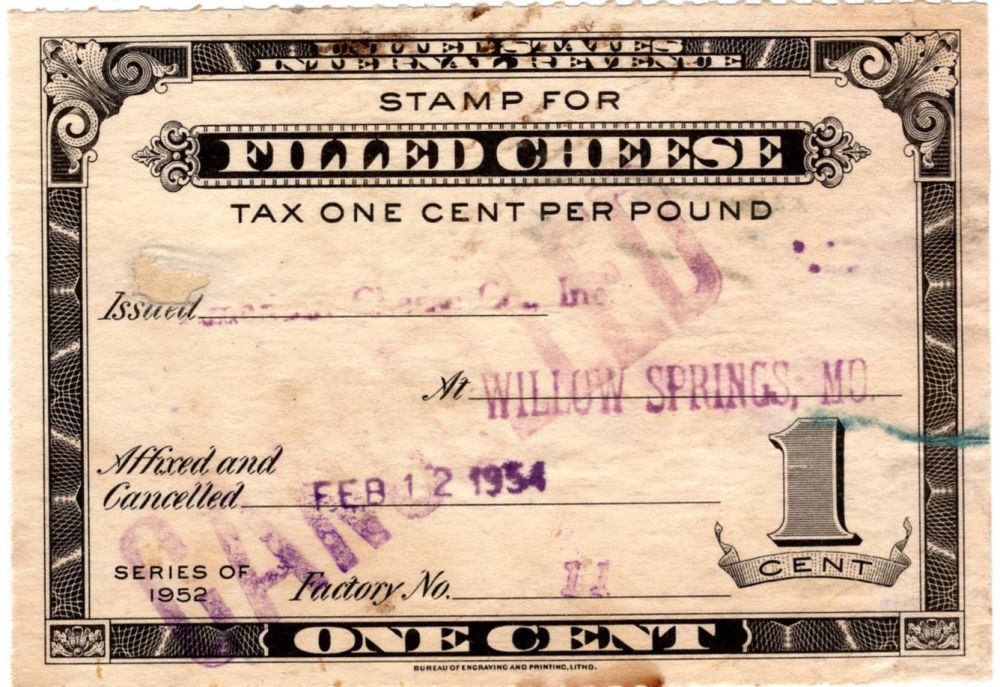 Here we have a used copy of the 1¢ Filled Cheese stamp from the Series of 1952. It was used by the Pioneer Cheese Company of Willow Springs, Missouri. 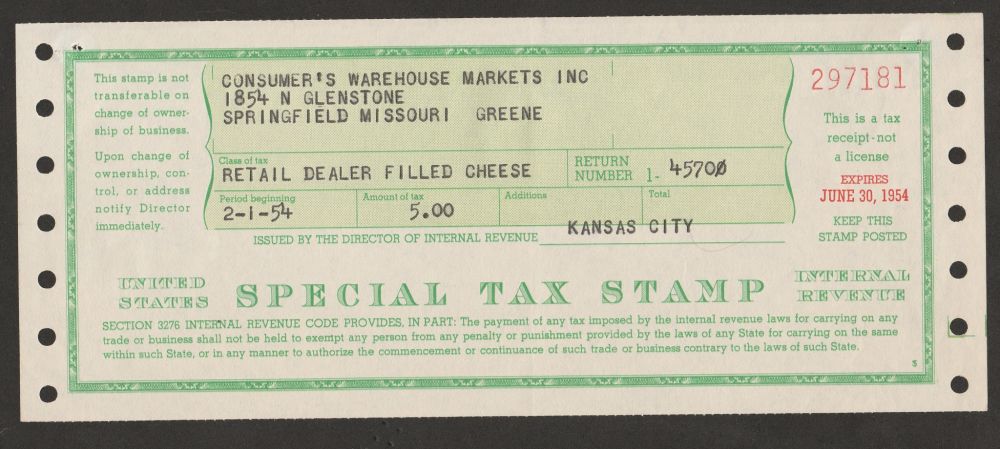 Here is one of the Special Tax Stamps (only $12 per year!) for the five month period beginning February 1, 1954 (and thus paying only $5, a dollar per month)., from Springfield, Missouri. Might they have been selling Filled Cheese from the Pioneer Cheese Co.? |
|
Send note to Staff
|
Ron Lesher |
|
|
Pillar Of The Community
United Kingdom
8636 Posts |
|
|
Bedrock Of The Community
United States
10864 Posts |
|
|
Look at the potato tax. It was declared unconstitutional before it was even implemented. At least filled cheese brought in some money, however small the amount. |
|
Send note to Staff
|
|
|
Pillar Of The Community
United States
868 Posts |
|
|
I am quite sure that the amount of tax collected for the first 50 years did not exceed the amount for administering the program. But then I remain unconvinced that such was the purpose of the tax. I think it was to drive the product out of the marketplace. And this was achieved. Success!
|
|
Send note to Staff
|
Ron Lesher |
| Edited by revenuermd - 09/09/2016 3:29 pm |
|
|
Pillar Of The Community
United Kingdom
8636 Posts |
|
|
Perhaps there was a Filled Cheese Collector sinecure somewhere in the depths of Washington. Having just spent a few days ogling a fantastic range of cheeses in French Halles, I'm having trouble coming to terms with the 'non-dairy' cheese concept. But then I don't really get decaffeinated coffee or alcohol-free wine either. |
|
Send note to Staff
|
|
|
Pillar Of The Community
United States
868 Posts |
|
|
The skepticism about Filled Cheese that led to the legislation taxing it should be viewed in the context of the Progressive Era. In 1886 oleomargarine was defined as having the same fat content as dairy butter. In the 1890's the same skepticism extended to mixed flour and filled cheese. A few years later laws were passed regulating renovated butter and adulterated butter. All of this was viewed as protecting the public welfare from these manufactured products. The dairy lobby was very active in all of these except for mixed flour. This was as much about protecting their products as shielding the public from potentially harmful manufactured food products. Business self-interest and getting the government to cooperate in promoting their self-interest has not waned in the U.S. in the past 150 years. Has it waned in the UK? I somehow doubt it. Just the means may be different.
|
|
Send note to Staff
|
Ron Lesher |
| Edited by revenuermd - 09/09/2016 4:35 pm |
|
|
Pillar Of The Community
United States
692 Posts |
|
|
Scott is notorious in its listings, and not only in revenues. The New Brunswick Connell stamp is listed in
Scott as #5. It was authorized but never issued. The Newfoundland Wazyata air mail is not listed. It was authorized but never issued. |
|
Send note to Staff
|
|
|
Pillar Of The Community
United Kingdom
8636 Posts |
|
|
revenuermd
Thank you - fascinating. As an ex-civil servant, I grew fairly used to "help" from industry. The Scotch whisky industry was always one of the most effective in seeking to protect its product - and innocent overseas consumers, of course - in export markets. And in pursuing us. The pernicious effect of lobbying and the imbalance between government and private sector resources aren't quite here what I understand they are in the US, although I have strong suspicions of Big Pharma!
Geoff |
|
Send note to Staff
|
|
|
Replies: 23 / Views: 3,266 |
|




 Posted 09/06/2016 3:19 pm


