| Author |
 Replies: 76 / Views: 9,909 Replies: 76 / Views: 9,909 |
|
|
|
Pillar Of The Community
United States
2555 Posts |
|
|
Quote:
Experimental OB is a paper variety, not a color variety. It's essentially OB ink on press paper. Quote:
Modern collectors have been calling it Experimental OB, but in fact it's the same OB ink used previously. All demonstrably incorrect. This is the second time AJ has made this claim. On the first occasion I asked AJ to explain how it can only be a paper variety when it is a known fact that the ink chemistry of the EOB's is different than the OB ink of the period, with no response. I am still waiting... |
Send note to Staff 
|
|
|
Pillar Of The Community
674 Posts |
|
|
Just catching up to this thread...but looks like a fun/interesting discussion about to take place!!
The marks on Washington's neck just look like leeches. He was probably using them to treat a temporary illness??
:) |
|
Send note to Staff
|
|
|
Rest in Peace
United States
920 Posts |
|
|
I like to think of Martha letting her passion run wild...
Chase, in his book on the 3c issue 1851-57 talked about these 'imperfections' and though my last photo differs from the one shown in Chase's book, figure 44, he stated that the defect on 20L4 "...varies considerably with different impressions, sometimes being quite noticeable...The flaws such as have been described very possibly occurred while the plate was being hardened. During this process tiny pieces of steel sometimes flake off from the plate leaving slight impressions which, when the plate is inked, show as flaws."
It's possible the 'flaw' on mine was one of these 'varied' impressions, or as Sinclair opined, a mere 'ink spot'. |
|
Send note to Staff
|
|
|
Valued Member
213 Posts |
|
|
Pillar Of The Community
United States
2948 Posts |
|
|
Was press paper only used in printings of plate 1L?
That seems un reasonable. |
|
Send note to Staff
|
|
|
Pillar Of The Community
United States
2555 Posts |
|
|
Methinks "the APS expert on US 19th century stamp and stationery paper" doth protest too much. For it was he in his first post here at SCF, using his title as an expert, tried to discredit me. I am not aware of anybody here that is exempt from the golden rule. Now, if spreading the truth is thievery then I must be the Robin Hood of SCF. Anybody interested in this discussion should read the article: The U.S. 1851 3¢ Stamp: Color, Chemistry, and Changes in Proceedings of the First International Symposium on Analytical Methods in Philately. https://repository.si.edu/handle/10088/21391 |
|
Send note to Staff
|
|
|
Valued Member
213 Posts |
|
|
Stampcrow,
There is no plate-by-plate breakdown at this time. Plate 1L is rather tricky to analyze with respect to its early printings. A sharp early impression looks a lot like plate paper, even though it may be press paper.
For instance, there were a number of inks introduced about the time Plate 1L went into service. The early bright BC's have rather sharp impressions. About this time there was BC, BC w/red, BC w/brown, claret, and the rare yellow brown. I'd say these were all on press paper because following the sharp early impressions the quality fell-off rapidly. Not to say the quality was bad, rather it remained very good, just not as good as say impression quality on the OB's.
Talking about OB, remember there was OB, OB w/red, OB w/brown, and the so-called late OB. The late OB were clearly on press paper since the impression quality is not up there with OB. The one thing very noticeable about the late OB is the colors are not as deep or dark as OB. I believe the reason for this is the combination of ink and paper. Although the late OB is somewhat color shifted, that may be due to contamination either by residual ink in recesses of the plate, old ink on the wiping rag, or old in in the reservoir.
When one compares late OB with ExOB, it seems they are very much the same. The late OB does have some ink contamination, otherwise the two share that lighter and brighter color. The impression quality is also much the same, and on that basis alone ExOB may be confirmed as printed on press paper.
I can't write a whole article here, obviously. Also, color and plating are not my expertise. It's going to be up to other specialists and experts to take a hard look at the paper transition and make new findings. The whole area is up for re-examination, and that is a good thing. |
|
Send note to Staff
|
|
|
Valued Member
213 Posts |
|
|
Stampcrow wrote: "AJ, any documented or even guesses at how much of the press paper was purchased and used? Was it used beyond the OB ink use dates?" About 3-5 reams of plate paper were delivered in early June of 1851, and from these the first printings were made (for numbers of stamps issued on June 30, 1851, see Chase Ch.V "A Valuable Old Record Book"). Soon thereafter TCC&Co. ran out of paper and deliveries dropped off, this according to a letter of July 10 by PMG Nathan Hall (Chase ibid). It was about this time the TCC&Co. turned for further supply to Messrs. McWilliams, a printer and paper distributor who's offices were at 229 Christian St., this according to a June 1852 letter in the Crane Correspondence (see "The Problem Papers" by AJ Valente, AP, Nov 2001, Endnote #3). In short, only the first 1400 sheets of stamps issued were produced on the high quality paper, and after that the regular paper (i.e. press paper) prevailed. Best guess is, the regular paper came into production in August of 1851. You can clearly see the differences in paper in the image posted by ClassicCoins (see below). So, stamps first appearing in October of 1851, such as ExpOB, were likely printed between late August and mid-September. I would project that certain other 3c printings of early August such as Brownish Carmine and Claret, were the first printed on the regular paper. However, one cannot exclude the 1c stamp, as it too was certainly among the first uses of the regular paper. (below) Note how the impression at left on regular paper is much lighter overall than those printed on the "plate paper" at center and right. Lighter impressions are also a characteristic of late OB printings from Plate 2L, etc. Thus, the late printings of OB are proof positive of the change in paper. 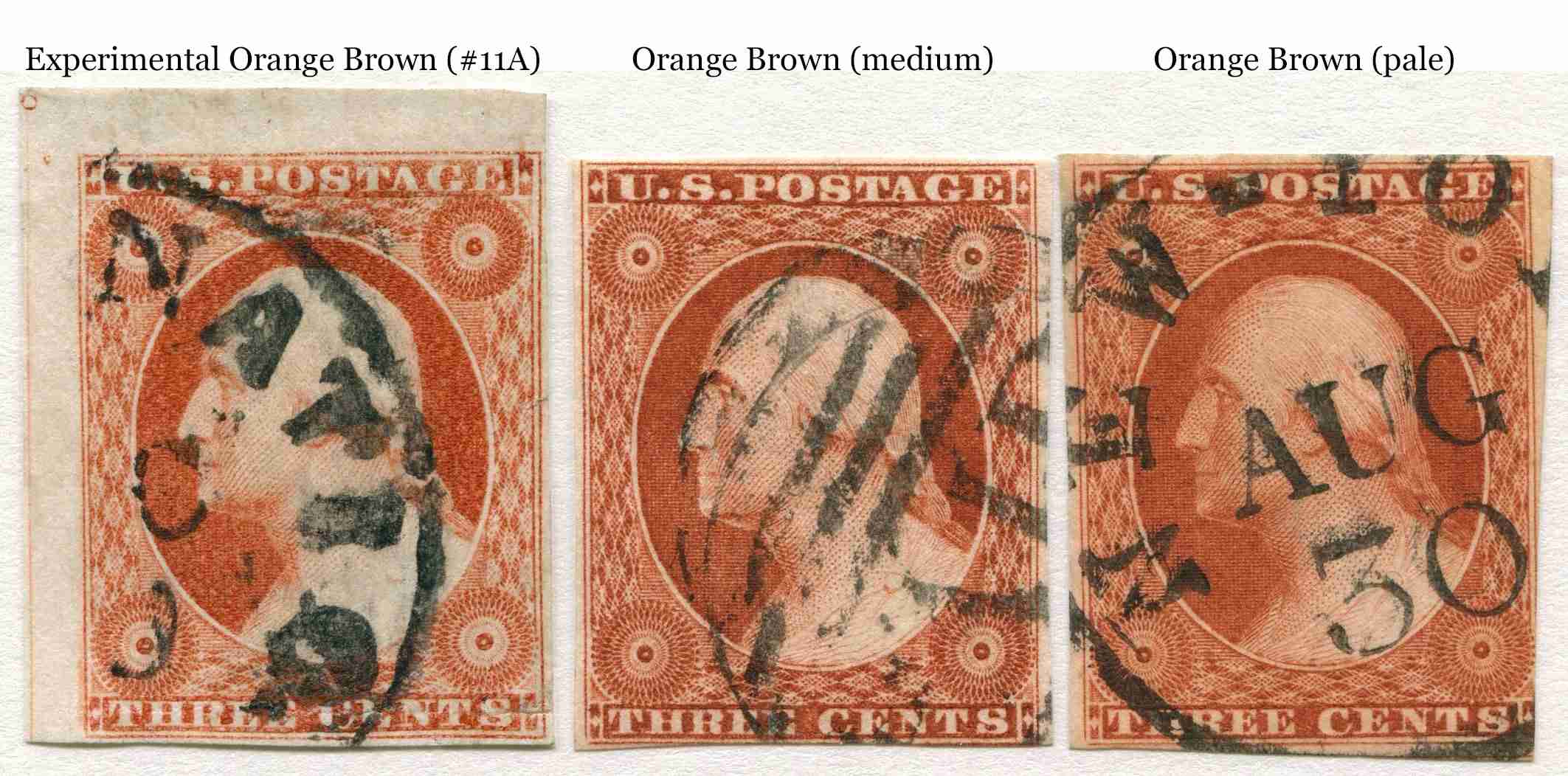 |
|
Send note to Staff
|
|
|
Pillar Of The Community
United States
2555 Posts |
|
|
AJ, If your number of 1400 sheets is correct, all examples of stamps printed on plate paper would be found on Plate 1E stamps. Even if the number were 14000, you would probably still only find them from Plate 1 printings although some could come from the intermediate state of the plate.
I suspect without actually plating the stamp that ClassicCoins AUG 30 stamp is a Plate 5E stamp. The middle stamp is probably from Plate 2E or 0. |
|
Send note to Staff
|
|
|
Valued Member
213 Posts |
|
|
Pillar Of The Community
United States
2948 Posts |
|
|
AJ, you've given much to digest. It will take some time for me to sort through. But one thing that quickly jumped out was your reference to the EOB being lighter... Quote:
Note how the impression at left on regular paper is much lighter overall than those printed on the "plate paper" at center and right. Lighter impressions are also a characteristic of late OB printings from Plate 2L, etc. Thus, the late printings of OB are proof positive of the change in paper. Classic Coins EOB example is just one stamp. Are there NO deeper/darker EOB examples? |
|
Send note to Staff
|
|
|
Pillar Of The Community
United States
2230 Posts |
|
|
The medium OB in my image above is 16R5e; a late usage, of course with the large-diameter Boston Paid. the pale OB with the Aug 30 CDS is 33R5e. |
|
Send note to Staff
|
|
|
Valued Member
213 Posts |
|
|
Stampcrow and ClassicCoin, I appreciate the opportunity to again make this point. Since you asked, I've photographed a few Plate 1i OB's. Intersperced are two Experimental OB; a medium color (left), and a deeper color (right). And before you ask, yes that's a rare Cincinnatti & Louisville Mail line cancel. OK, it's fairly obvious the OB color of Plate 1i and Exp OB of 1L is much the same. The only real difference is the surface treatment of the paper. The very, very, smooth surface of "plate paper" picks up more ink and preserves the details much better. The same OB ink on ordinary "press paper" produces a good quality impression, but not as deep. Also, the overall impression is noticeably lighter and brighter, and that is typical of LateOB impressions as well. Again, this is typical of OB color, but not all colors. Colors as claret and brownish claret react somewhat differently to press paper with regard to impression quality and brightness. One may even suppose this is one reason why the printers went away from OB. But, that's a conversation for another day. Thank You. 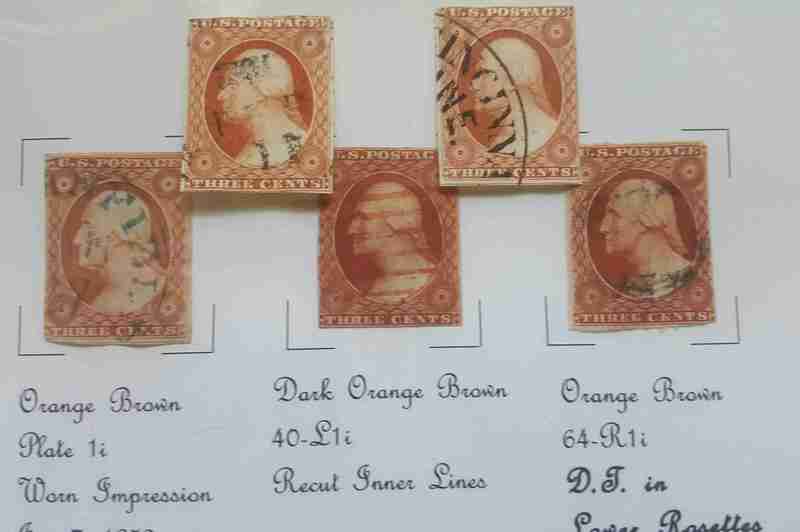 |
|
Send note to Staff
|
|
|
Pillar Of The Community
674 Posts |
|
|
I read that Martha W. hated the color orange because it reminded her of the hair piece of her former British lover. She had it banned from Mt Vernon & when George brought home a portrait of Benedict Arnold with shades of orange, she bit him on the neck. He died shortly thereafter. Ironically, Martha lived our her life in the Orange River Colony...
It says so on the internet?!?!!!! |
|
Send note to Staff
|
|
|
Valued Member
97 Posts |
|
|
Quote:
it's fairly obvious the OB color of Plate 1i and Exp OB of 1L is much the same No. It is obvious that the colors are different. Are you like the blind man who touches the leg of an elephant and declares that an elephant is much like a tree? You may know something about paper, but you extrapolate to bizarre conclusions about color. I call BS. |
|
Send note to Staff
|
|
|
Replies: 76 / Views: 9,909 |
|



 Posted 06/04/2018 10:00 am