| Author |
 Replies: 29 / Views: 3,056 Replies: 29 / Views: 3,056 |
|
|
|
Pillar Of The Community
3865 Posts |
|
|
51studebaker: Wouldn't the stamps be stored in a vault of some kind and not left out in the open? Also, with such an increase in humidity wouldn't the gum start sticking to the stamp sheets under it? Don't they usually try to finish print runs in complete groups for practical inventory purposes? Wouldn't the perforated stamps also be affected as well if they are stored in the same place? |
Send note to Staff 
|
|
|
Moderator

United States
12330 Posts |
|
|
jogil, Quote:
Wouldn't the stamps be stored in a vault of some kind and not left out in the open? I have no idea about the security situation in the buildings in the mid-to-late 1800s. Would they have a vault that could hold large pallets of stamps or would they simply hire a security guard? Would handling large, heavy amounts of paper make it feasible to move pallets in and out of a vault? Quote:
Also, with such an increase in humidity wouldn't the gum start sticking to the stamp sheets under it? At some point, yes. I am unaware of any humidity/environmental controls in buildings in this time period. (Heck, they may have been using gas lighting in the 1860s.) So they were completely at the mercy of the ambient temperatures and RH in this time period. If it was summer, it was hot and sticky. They certainly had a heat source during winter but I am unaware of anything that would be controlling RH in a 1800s building. Quote:
Don't they usually try to finish print runs in complete groups for practical inventory purposes? I would think so but who could say that this was always practiced? Quote:
Wouldn't the perforated stamps also be affected as well if they are stored in the same place? Imagine that you have three stamps in front of you; each was perforated with different moisture content in the paper in the 1870s. They come off the perforator at perf 12 but the run was not contiguous and each lot had a paper/moisture content that differed by 10%. Now decades later, all the stamps now have the same moisture content. Would the perfs still measure exactly 12? Or looked at another way, if you cut out a piece of paper that is exactly 1 cm square while each has a different moisture content. As they dry they change size (shrink based upon the direction of the paper grain). Once dry and all now having the same moisture content the first one is 0.99 cm, one is .0.98 cm, and last one is 0.97 cm. The only way to get them all back to exactly 1 cm would be to change the moisture content back to whatever it was when the cutting process was done. Don Edit; If someone has the time the following experiment would be interesting. Take a stamp and place it in the oven at low temps for 15 minutes to lower the moisture content of the paper. Then carefully measure the stamp perfs and/or scan the stamp at 1200 dpi or higher. Then throw the stamp in a bath and allow it to soak for a minute. repeat perf measurement and/or rescan (do both axis since the paper will shrink/grow more with the grain). Compare the two. I think this issue rears it head when we get down to very exact measurements. Will the delta be seen at two decimal place perf measurement? Three decimal place perf measurement? |
|
Send note to Staff
|
|
|
Pillar Of The Community
3865 Posts |
|
|
What I have read and know is that according to Argenti, Marler, Johnson and other philatelic specialists is that for older stamp issues they have found that the perforation gauge can vary in any one sheet along any one perforated line due to the uneven spacing of perforating wheel pins and holes so that single stamps from the same pane can vary in perforation gauge. Also, Jamieson found that stamps that have been wetted and vigorously pressed to dry in a stamp drying press can have an effect on the stamp's dimensions but can be returned to original dimensions if rewetted and left to dry without any pressure added to it. Also, there are know differences that have been found between wet and dry printed stamps. However, it looks like very extreme procedures and conditions are needed and necessary in order to get any such extreme results. See: http://www.printing.org/Effects-of-...ity-on-Paper |
|
Send note to Staff
|
| Edited by jogil - 10/29/2016 07:24 am |
|
|
Pillar Of The Community
United States
728 Posts |
|
|
One must also remember that temperature changes affect the metal equipment. Presses, plates, and perforating equipment can also vary slightly in size and shape with temperature extremes. The paper being affected by temperature, humidity and the printing and perforating equipment by temperature could cause minor variances in the printed product. The stamp itself may further change slightly over time due to soaking, humidity, gum disturbance, and other environmental conditions. Even stamp paper over time may show signs of deterioration such as toning or wrinkling due to gum deterioration. So minor changes can be present in stamps for environmental reasons. |
|
Send note to Staff
|
|
|
Moderator
United States
12330 Posts |
|
|
watermark, good point. I ran the experiment I note above. This image illustrates how moisture content can affect paper dimensions and perf measurements. This is the same (kind of sad) Queen; full image is stamp after drying in oven. Perfs shown to the left are the same perfs (flipped) after the stamp was soaked. The perfs have obviously changed substantially (I didn't measure but I would say close to 1/3 to 1/2 perf). In results I didn't expect, the wet stamp appears to be shorter than the dry stamp. 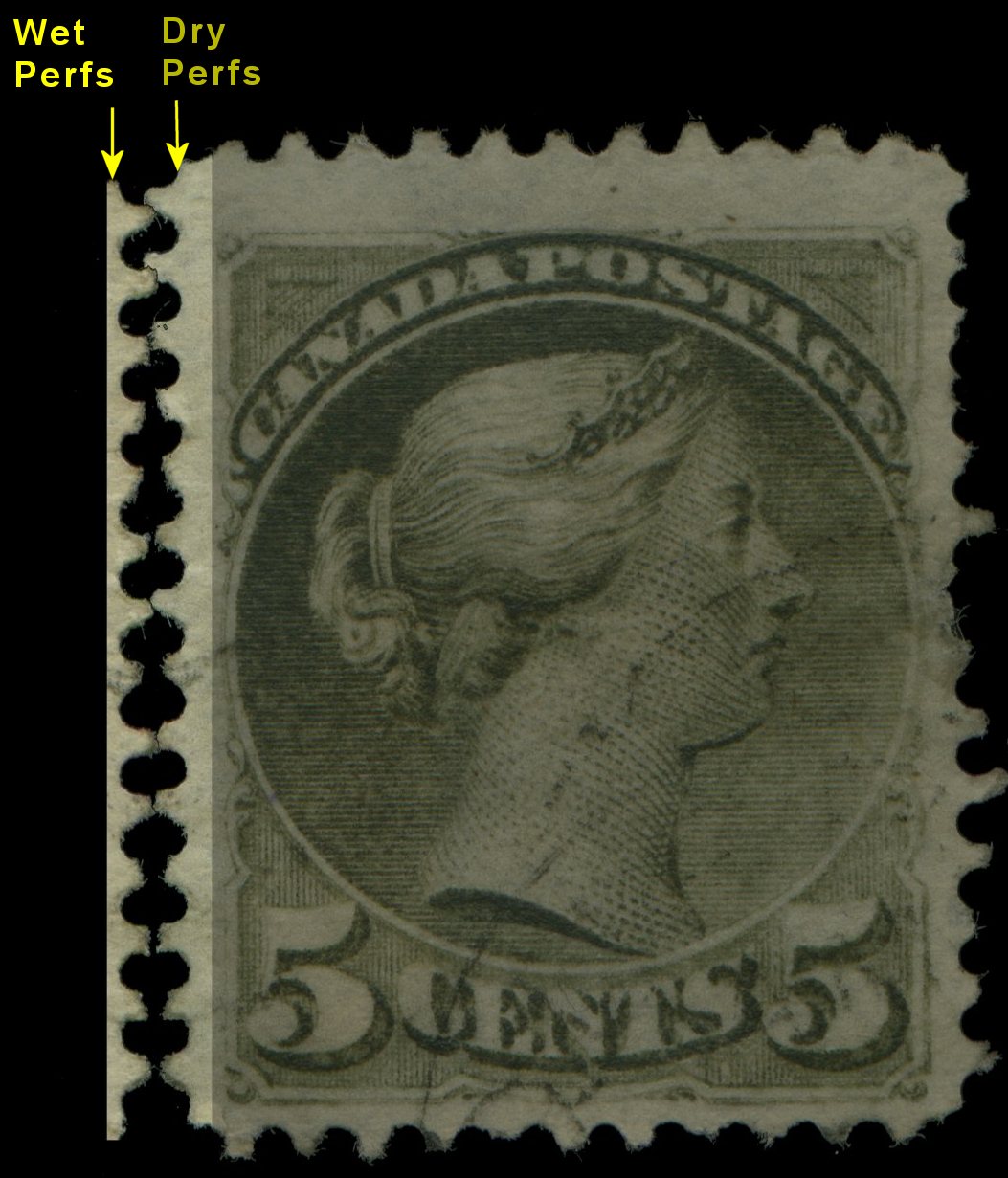 While we often discuss some pretty exacting perf measurements we do not seem to ever discuss the RH or paper moisture content of the stamps at the time we measure or time of manufacture. I have not ever seen any articles on this topic; at what point in exact perf measuring does this come into play? If we are talking about a perf delta between 12.25 or 12.30; would not the paper moisture content become important? It could be that measuring the perfs during winter, when there is a static producing low RH of 10-15%, will be noticeably different than measuring the same stamp in the summer time when RH is a sweaty 70%. I certainly agree that this test/illustration is the extreme. Ideally and in a formal test we would want to accurately measure RH, paper moisture content, and perfs over the entire range to best understand the issue. Don |
|
Send note to Staff
|
|
|
Pillar Of The Community
Canada
1416 Posts |
|
|
Welcome to the wonderful world of testing materials and standards deviation. World experts go a great length to develop proper standards for all kind of measurements. For example, when you trade a liquid, its volume will vary depending on the temperature. A ruler will increase in length in hotter days, and shrink in winter, depending on what material is used (wood, steel, plastic, paper or glass.
This is why many standards also set the required conditions for testing such as "measured at 20.0 degree C, 1.00 Bar and 40% relative humidity. Result will be given in a unit, say millimeters, and in the case of perforations, as Don suggests, it may be more appropriate to state 12.2 + or - 0.1, meaning that anything between 12.1 and 12.3 is not statistically different and could be considered the same. Lastly, if the precision is + or - 1 decimal (0.1), then measurement should not be expressed with 2 decimals |
|
Send note to Staff
|
| Edited by Gilles le timbre - 10/29/2016 09:37 am |
|
|
Rest in Peace
Canada
5701 Posts |
|
|
That is a pretty good experiment Don. Assuming that the stamps were perforated in the wet (expanded) stage, then after sitting around drying, the stamps would shrink, then the perforation distances would become closer together.
It is very similar to the effects of drying veneer in the plywood industry - except we start with wet. When the wet veneer is peeled from a log, it is trimmed approximately 53" x 101". This is to account for shrinkage during drying and to trim square for producing the final 48" x 96" size board. Different species of wood have a certain initial moisture content, and each have there own longitudinal, tangential and radial shrinkage, measured in %.
In the case of veneer, the longitudinal (with the grain direction) the shrinkage is almost negligible. The tangential (across the grain) is anywhere from 6 - 10% for most common species. The radial (thickness) would be about 4 to 6%.
I bring this up because, though I know little about paper production, the small queens are known to have woven grains in either direction. This, I assume, would be similar to veneer, and cause the shrinkage (or expansion) to be different in either direction.
As you say, your experiment is to the extreme. In reality we may never know what happened 140 years ago, and whether the differences in moisture content play that much in the average perforation differences today.
This of course would not apply just to early Canadian stamps, but also to those of any other country.
|
|
Send note to Staff
|
|
| Edited by BeeSee - 10/29/2016 10:17 am |
|
|
Pillar Of The Community
3865 Posts |
|
|
Would this apply more to earlier stamps such as from the 19th century than the 20th century since there were less quality controls available in printing production and storage? In order to prove any legitimate perforation differences of even 1/10 th of a difference, one has to go into how the stamp was printed and perforated. It is important to note what the accepted size of the stamp design itself is around in its measurement. Some have argued against 1/10 th of a perforation difference. However, you can take Canadian coil stamps that are perforated 8 as an example. The ABN/CBN coil stamps from 1912 to 1930 were perforated around 9.95 by a sheet-fed rotary wheel perforator and they were sheet-fed (wet and dry) rotary press printed. The CBN coil stamps from 1935 to 1948 were perforated around 9.85 by a web-fed rotary bar perforator and they were web-fed (dry) rotary press printed. If there is a question as to perforation gauge both horizontal and vertical, then a measurement of the stamp design both horizontal and vertical should be taken and compared against a standard. (Sometimes scans can be distorted on the outside images compared to the inside ones. I was comparing perforations by cut and paste on a scan and it looked like there was a difference in perforations. However, I decided to cut and paste the design size and found that it was off on the one on the outside than the inside ones. A similar thing probably occurs with altered stamps.) |
|
Send note to Staff
|
| Edited by jogil - 10/29/2016 11:07 am |
|
|
Moderator
United States
12330 Posts |
|
|
Quote:
...Sometimes scans can be distorted on the outside images ... The CCD on a typical consumer grade flat bed scanner has a lens. The lens introduces distortion around its edges (think eye-fish). So to eliminate or reduce chances of distortion you should always place the stamp in the middle of the scanner glass bed (platen). Arranging stamps towards the edges of the platen will subject them to distortion. Don |
|
Send note to Staff
|
|
|
Rest in Peace
7742 Posts |
|
|
Jogil...I have a 12.25 (12.50), 1888 stamp and I believe it is Montreal printing..I will look for it when I get a chance and post.
Robert |
|
Send note to Staff
|
|
|
Rest in Peace
Canada
5701 Posts |
|
|
Robert, I mentioned above: Quote:
According to an updated "Shoemaker" table in BNAPS BNA Topics, Jul-Aug-Sep 1999 No.3, the 3c Small Queen is know perf 12 x 12.25 dated Sep 13, 1888 in "Dull Orange". It is classified as a regular Montreal printing, not a Montreal Gazette printing. Perhaps that is your stamp. I suspect my 1886 version is an earlier known date of that stamp. |
|
Send note to Staff
|
|
|
|
Pillar Of The Community
3865 Posts |
|
|
For U.S. stamps, there is the US Specialty Precision Multi-Gauge which has templates for different design sizes along with perforation gauges. |
|
Send note to Staff
|
|
|
Pillar Of The Community
3865 Posts |
|
|
Rest in Peace
Canada
5701 Posts |
|
|
Replies: 29 / Views: 3,056 |
|




 Posted 10/29/2016 04:40 am


