| Author |
 Replies: 24 / Views: 3,147 Replies: 24 / Views: 3,147 |
|
|
|
Pillar Of The Community
United States
1043 Posts |
|
|
I'm confused.. Please excuse my beginner-like pondering over Great Britain stamps. Are you saying that the nomenclature for centering of US stamps is not the same for British stamps? For instance I would describe (although subjective) the penny black above as perhaps f-vf. I would describe the scott 4, blue 2p next to it as VF-XF or even just XF (they both appear sound under mag to me)
I understand the calling out the margin thing, as US collectors tend to do similar, especially with US scott 1-2 and scott 10-11 and scott 17. But are British collectors using an entirely different system than US collectors? I guess I need to know this if I am going to start this up.
What confuses me more is the Scott Catalog! Values seem so high, but perhaps "very fine" stamps or better are extremely rare. Meaning that if you truly have a sound, very fine, non heavily canceled used stamp -- it will actually sell around catalog. I pose the question that if the scott 4 blue above is VF-XF or better, would I get the approx 80$ catalog value at auction or is it a pipe dream and the reality is scott is wrong and I'm looking at 5$-10$ even for a sound, VF-XF or better example.
|
Send note to Staff 
|
|
|
Pillar Of The Community
United Kingdom
8632 Posts |
|
|
Sorry to confuse! The description of a stamp from any country by someone in the US would mean the same. But the use of the word "fine" in Great Britain refers to the stamp as a whole, not the centring, which is usually described separately - "well-centred" etc. I think this is also the practice in mainland Europe. Yvert, for instance, refers to "tres bon centrage" or "bon centrage". Thus descriptions of auction lots will often refer to a "fine used collection" - which certainly doesn't mean that someone's been through it looking at centring! Thus isn't an issue for you unless you're buying from, or selling in, Europe. |
|
Send note to Staff
|
|
|
Pillar Of The Community
United States
1873 Posts |
|
|
The relationship of cat value to market prices is an old debate and using the Search button here you will find many relevant threads. To briefly answer your main question, yes, thru a New York auction house for example, a truly VF or XF example of a desirable stamp can sell for full cat value or higher. Many factors affect this such as color, freshness, cancel clarity and type, cancel rarity, perfect condition, provenance and others. Take a look at the "prices realized" listings of an active auction house like Kelleher. |
|
Send note to Staff
|
|
|
Pillar Of The Community
United States
1043 Posts |
|
|
although in my post above about prices for scott 1 USA, I I was referring to centering not condition (as CJ pointed out) when I used the terms VF, XF, fine, etc…
CJ,
However, in the US and scott catalog, these terms also interchange with grade. Grade encompasses condition/soundness as well as centering. A stamp in the US could have XF-superb centering but be graded as very fine due to an inclusion, nibbed perfs, heavy cancel or tiny scuff etc. |
|
Send note to Staff
|
|
|
Pillar Of The Community
United States
1043 Posts |
|
|
I went to siegel and did search. Seems it is all the same as USA when they auction this stuff off there. 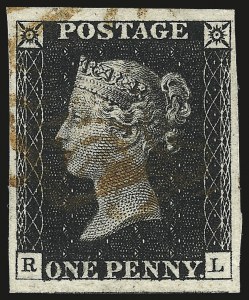 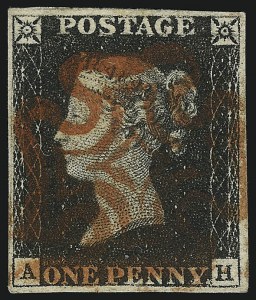 top sold 500$ (XF) bottom 225$ (VF) |
|
Send note to Staff
|
|
|
Pillar Of The Community

United States
1773 Posts |
|
|
GB stamps are hard to understand for me. I had several GB stamps with decent Catalog value that I auctioned on ebay as individual stamps I never got over 5% of Scott. However when I breakup a Scott International collection GB is one of the countries that sells for the highest price and is often the highest and is always in the top 5. It's a mystery! |
|
Send note to Staff
|
|
|
Pillar Of The Community
Germany
1714 Posts |
|
|
Just taking the Penny Black as an example... 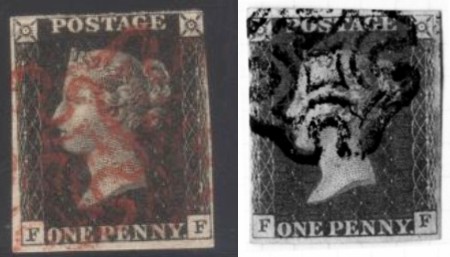 Neither of these Penny Blacks can be regarded as even FINE as the margins, for one example, do not correspond to that definition yet the right hand stamp will probably fetch 7 or 8 times more than the left one. There were around 8.5 million of the left hand stamp printed and only around 160,000 of the right one. |
|
Send note to Staff
|
|
|
Pillar Of The Community
United States
1043 Posts |
|
|
I am beginning to get the idea that the initial grouping of stamps I showed are a "dime a dozen", especially in the condition they are in. Kind of what I expected.
Was hoping maybe there was a stamp or two in the group that was exciting, but I guess not. Regardless, perhaps I'll put them in an album and gradually add/improve on it.
Thanks for the input |
|
Send note to Staff
|
|
|
Pillar Of The Community
United States
3528 Posts |
|
|
I appreciate this thread, as I find myself in about exactly the same situation as rgstamp. I bought a Great Britain collection not unlike his, about 20 years ago. I've done nothing with it yet, but was looking at it last week in some depth.
There are a lot of interesting stamps in there, and interesting things to collect. I think one of the main reasons I haven't pursued it is because many of the stamps are heavily cancelled, and, therefore not as attractive as a result. Nothing aesthetically wrong with the stamp designs themselves, I just can't see them in many cases due to a heavy numeral cancellation. I note that the early Maltese Crosses on the Penny Blacks are often very nice cancels to get, but almost all of the rest seem to be kind of harsh with their result.
I'm curious if there were any GB postal regulations regarding the type and nature of the cancels required, that led to this? In the US, at some point, I want to say, the town postmark was supposed to be separate from the stamp, with a separate killer applied to the stamp. These numeral cancels from GB, I suspect perform a dual purpose of identifying the station and killing the stamp. Maybe that helped the demise of used GB stamps? |
|
Send note to Staff
|
|
|
Replies: 24 / Views: 3,147 |
|



 Posted 12/04/2016 08:55 am


