| Author |
 Replies: 153 / Views: 19,334 Replies: 153 / Views: 19,334 |
|
|
|
Bedrock Of The Community
Australia
38679 Posts |
|
|
Thanks for broadcasting encouragement Greg,
A good thread title, interesting material, varied contributors,
are like a well in the desert.
You may come and relieve your thirst for knowledge, one sip at a time.
|
Send note to Staff 
|
|
|
Pillar Of The Community
United States
1106 Posts |
|
|
Greg, I'm glad you enjoyed the thread! Ireland doesn't get much attention but it is an interesting area to explore. There is a lot of complexity in the early issues not covered in this thread. I didn't know how this thread would be received but it worked out well. It was fun to put together and I'm pleased that other, more knowledgeable collectors have contributed. Let's see your stuff! Dan  |
|
Send note to Staff
|
Experienced stamps need a home too. I'd rather have an example that is imperfect than no example.
I collect for enjoyment, not investment.
APS Member #223433
Postmark Collectors Club Member #6333
Meter Stamp Society Member #1409 |
|
|
Bedrock Of The Community
Australia
38679 Posts |
|
|
Pillar Of The Community
United States
1868 Posts |
|
|
@Rod thanks for linking the Triangle Cancels article. At Great American Stamp Show I picked up this cover showing the "Sword of Light" definitive with triangle cancel ANU for An Uaimh (Navan, Co. Meath) paying the printed matter rate to the US, then forwarded to a different seminary location with a Fourth Bureau 1 1/2c definitive paying the printed matter rate within the US. Both cancels are mute, of course, so we cannot date the cover except roughly based on the issue dates of the stamps.  For me, it's a triple win: my first Irish triangle cancel on cover; my first example of ANU; and a nice solo Fourth Bureau use. Now I have a problem, do I display it with my triangle cancel collection, or with my Fourth Bureau solo uses collection. |
|
Send note to Staff
|
|
|
Bedrock Of The Community
Australia
38679 Posts |
|
|
Quote:
For me, it's a triple win: my first Irish triangle cancel on cover; my first example of ANU; and a nice solo Fourth Bureau use. Now I have a problem, do I display it with my triangle cancel collection, or with my Fourth Bureau solo uses collection. Suggestion: Both Christopher, the less preferred, use a printed scanned image. Based on the ideology that new information is shown by both. |
|
Send note to Staff
|
|
|
Pillar Of The Community
United States
1026 Posts |
|
|
It looks like St. Columban's Seminary is still active in Nebraska and they may very well have information on Reverand Edward O'Doherty. They migrated the organization from Ireland in 1918 so early 20s to early 30s would make perfect sense. |
|
Send note to Staff
|
|
|
Pillar Of The Community
Netherlands
6641 Posts |
|
|
Some further information on the coil stamps for that first definitive series first page, "Steiner page 6." Originally, rolls of stamps were made from sheets cut into strips and pasted together. This gave rise to the "coil joins." During experiments with vending machines, it was found that these rolls sometimes jammed the machines. To overcome the problems, rolls were printed from continuous reels. The coil stamps with (part) imperforate sides were printed from continuous reels. The first coil stamp printed in continuous reels was the carmine 1d "Map of Ireland." It was issued in April 1933. This was printed vertically and had horizontal perforation gauge 15. The vertical sides had a single perforation hole at the top. In July 1934, the coil stamps no longer had the single perforation hole on the vertical sides. 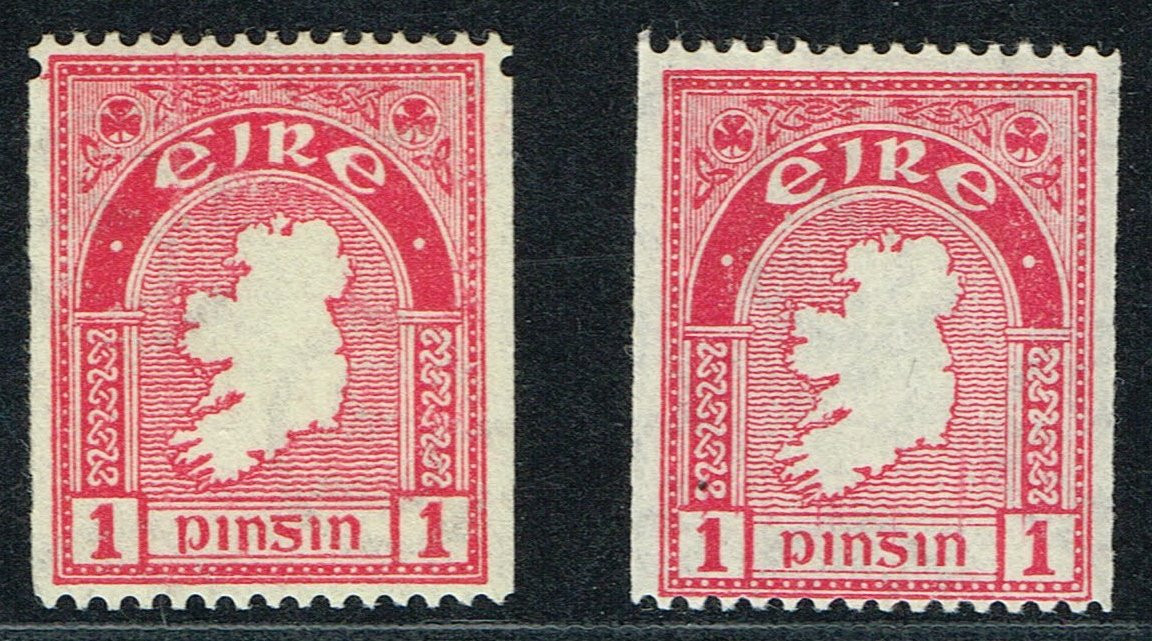 The stamp with wholly imperforate vertical edges exists with inverted watermark, as does its counterpart with the later "e" watermark (horizontal perforation 15) shown by danstamps54 on his "Steiner page 8." The latter is slightly more common with the inverted watermark. The 2d "Map of Ireland" stamp also exists with imperforate vertical sides. This is very rare. A single example is known unmounted mint. The 1/2 d "Sword of Light" and 2d "Map of Ireland" stamps were printed for coils with sideways delivery. It is thought these were not used for vending machines but for use by businesses that had stamping machines. These stamps not only have imperforate horizontal edges and vertical perforation gauge 14. They also have the watermark sideways. 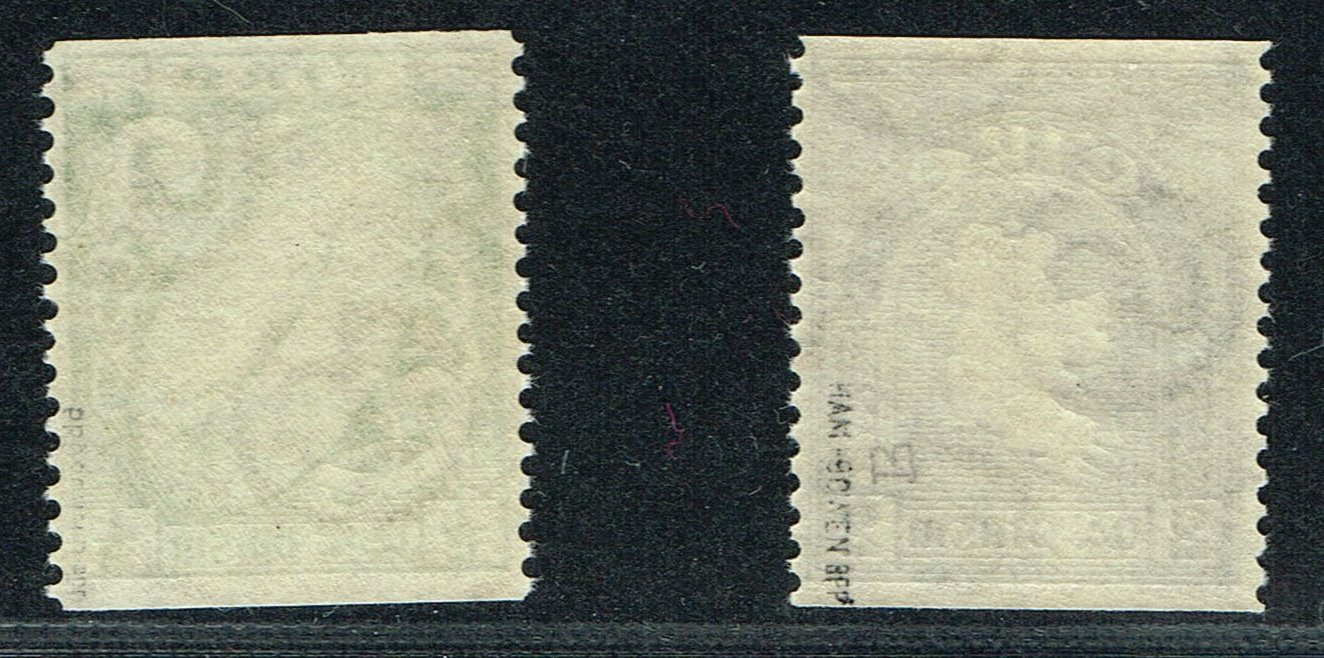 |
|
Send note to Staff
|
|
|
Pillar Of The Community
Netherlands
6641 Posts |
|
|
Quote: Interesting post. It appears her parents emigrated as well. The air letter shows the QEII Wilding portrait next to the parliament buildings in London. Or did she come from Northern Ireland? |
|
Send note to Staff
|
| Edited by NSK - 09/28/2021 06:59 am |
|
|
Bedrock Of The Community
Australia
38679 Posts |
|
|
Quote:
The first coil stamp printed in continuous reels was the carmine 1d "Map of Ireland." It was issued in April 1933. This was printed vertically and had horizontal perforation gauge 15. The vertical sides had a single perforation hole at the top. In July 1934, the coil stamps no longer had the single perforation hole on the vertical sides. Fascinating, thanks NSK Quote:
Interesting post. It appears her parents emigrated as well. The air letter shows the QEII Wilding portrait next to the parliament buildings in London. Or did she come from Northern Ireland? Took me a while to understand what you were getting at. Your guess as good as mine I would say Yes. As a real estate agent in Adelaide, I often would sell a house 3 times, once when the family immigrated, then sell it when they became home sick, and again when the came back again. It's tough dragging a family away from all that you know and love, I was bullied incessantly with my Somerset accent, at school. Looking back, it was all worth it. PS: I lived just 900 metres away from the National Archives in East Victoria Park. Would visit to buy paper and storage etc. |
|
Send note to Staff
|
| Edited by rod222 - 09/28/2021 07:15 am |
|
|
Pillar Of The Community
Netherlands
6641 Posts |
|
|
Another one to look out for are pairs of the overprints on high values (Seahorses). In 1925, an overprinting of the British Seahorses was performed by the Irish Government Printers at Dublin Castle. From February 1926, the overprinting was done by the Stamp Printing Branch at Somerset House in London. It is believed this was done at British insistence. The Stamp Printing Branch at Somerset House used the same plates as the Irish Government Printers at Dublin Castle. In 1927, Somerset used plates with both "narrow" and "wide" clichés to overprint the "Seahorses" high values. In the "narrow" clichés the year "1922" was 5 mm wide. In the "wide" clichés it was 6 mm wide. Both horizontal and vertical "composite" pairs of these stamps exist. Below image shows a composite pair with the wide setting at left and narrow setting at right. Note the "1" in the year "1922" aligns with the left leg of the "R" above it. On the left stamp, the year extends to the inside of the left leg of the first "n." On the right stamp, it extends to the space between the "a" and "n." There are other differences, most notably in the "9." 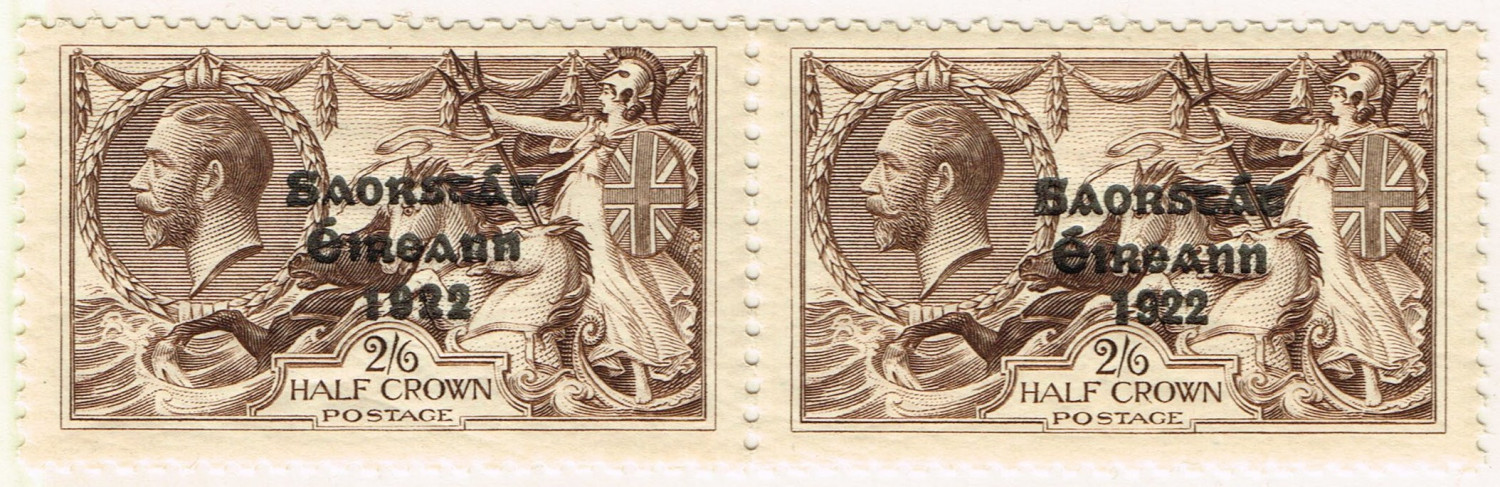 |
|
Send note to Staff
|
|
|
Pillar Of The Community
Netherlands
6641 Posts |
|
|
Page 1 again: Quote:
Recent scholarship has shown that the 9d issue of 1922 also was printed in a small quantity with a carmine, not red, overprint. Neither Steiner nor Scott provide a space for it. Another interesting subject. Again, the Hibernian handbook makes interesting reading. One hypotheses is that the change in the colour from red to carmine coincides with the change in printers for this issue. From July 1922, the 4d and 9d stamps overprinted by Dollard in red ink appeared with an overprint in carmine ink. On 12 June, the Irish provisional government ended its contract with Dollard Printing House Ltd. The carmine overprint was not noted until July, after Dollard ceased the overprinting of British stamps. It is possible the Dollard plates were transferred to Messrs. Alexander Thom & Co Ltd who used a carmine ink to overprint the stamps previously overprinted in red by Dollard Printing House Ltd. Do the carmine overprints exist cancelled before late June (allowing for production and distribution after 12 June 1922)? |
|
Send note to Staff
|
| Edited by NSK - 09/29/2021 03:18 am |
|
|
Pillar Of The Community
United States
1868 Posts |
|
|
Quote:
It is possible the Dollard plates were transferred to Messrs. Alexander Thom & Co Ltd who used a carmine ink to overprint the stamps previously overprinted in red by Dollard Printing House Ltd. Barry Cousins, in his 2015 monograph "Irish Free State Plates, Controls, and Overprint Settings" (self-published), appears more certain of this, stating that "The Thom overprints on the 4d. and 9d. stamps made use of the existing Dollard stereos from setting 2, but used a different ink shade, which is classified as carmine." He states they were "released for sale on the 12th June 1922" but has no comments on cancels or earliest dates of use. However, the focus of the monograph is the nature, style, and positioning of the overprints, plate, and control markings for unused stamps, rather than postal uses. |
|
Send note to Staff
|
|
|
Pillar Of The Community
Netherlands
6641 Posts |
|
|
Roy Hamilton-Bowen remarks these stamps were not identified until late in July 1922. He also states that 12 June 1922 was the date the contract passed to Thom. I wonder how Barry Cousins can be so certain about being released on 12 June. It is doubtful there was an official release date for existing stamps printed by a new printer. At best new information can have surfaced about supplying the post office with stamps on a certain date. Still, a realease on 12 June would imply Thom had started printing from Dollard plates before they held the contract. |
|
Send note to Staff
|
| Edited by NSK - 09/29/2021 09:43 am |
|
|
Pillar Of The Community
United States
1106 Posts |
|
|
When I began this thread in 2017, there were almost no threads on Ireland. So, I thought my one-and-done collection might spark some interest. The thread has grown with much more technical information. Great work contributors!  Keep it coming! It's sending me back to work on my Ireland collection! Dan |
|
Send note to Staff
|
Experienced stamps need a home too. I'd rather have an example that is imperfect than no example.
I collect for enjoyment, not investment.
APS Member #223433
Postmark Collectors Club Member #6333
Meter Stamp Society Member #1409 |
|
|
Pillar Of The Community
Netherlands
6641 Posts |
|
|
@Rod222 Quote:Unknown BAILE AN ?? OHBA  Ballinrobe: Baile an Ródbha (also Baile an Róba). You might prefer the spelling in the cancellation. 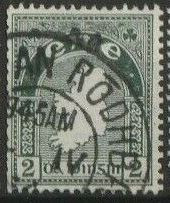 |
|
Send note to Staff
|
| Edited by NSK - 09/30/2021 06:51 am |
|
|
Replies: 153 / Views: 19,334 |
|




 Posted 07/13/2021 10:01 pm


