| Author |
 Replies: 117 / Views: 27,232 Replies: 117 / Views: 27,232 |
|
Valued Member
146 Posts |
|
|
I have several several old Japanese documents with revenue stamps and wonder as to the contents of these documents? Also help with how to write up and display the documents as there are 3/4 tied pages to each document? 1.   2.  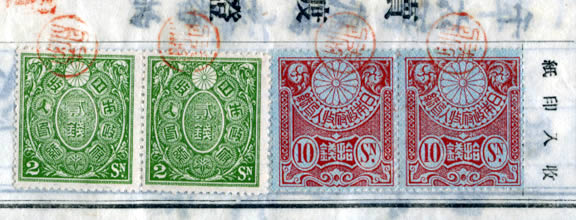 3.  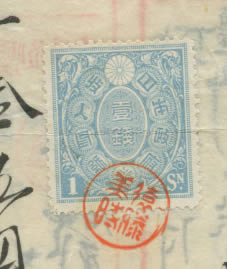 4.  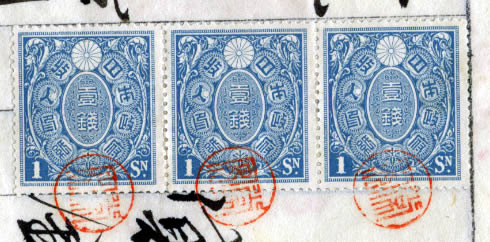 5,   Many thanks Andrew |
|
Send note to Staff
|
|
|
|
|
Bedrock Of The Community
Australia
38679 Posts |
|
|
The Blue stamps (and similar designs in other colours) are Tax Stamps 1898 -1909 I have also read they are revenue stamps added to stock certificates Full set (15) of various designs Hopefully "Unechan" will drop by for confirmation. Design is Vine Scroll "Karakusa"  |
Send note to Staff 
|
| Edited by rod222 - 10/26/2017 10:21 pm |
|
|
Bedrock Of The Community
Australia
38679 Posts |
|
|
Valued Member
146 Posts |
|
|
Hi rod222
Thank you for input on the revenue stamps. I will google 'Japan tax revenue stamps' and see what comes up.
Andrew |
|
Send note to Staff
|
| Edited by agb - 10/27/2017 02:31 am |
|
|
Bedrock Of The Community
Australia
38679 Posts |
|
|
Valued Member
146 Posts |
|
|
rod222, Thanks for the link, I am on it right away.. Should I try to keep the revenues on their documents or cut around them for writing up my pages? Its very hard to decide the best course of action. The problem being is how do you display the full document with the revenues? Having had a good look at the above link, prompted me to look though my documents with revenue stamps. I came across a strip of three of the 50 sen green/grey stamp which appear to be rouletted?   Could someone confirm that the stamps are rouletted and hopefully could also help with the translation of the partial document and the 'chop' marks. Andrew |
|
Send note to Staff
|
| Edited by agb - 10/27/2017 11:24 am |
|
|
Bedrock Of The Community
Australia
38679 Posts |
|
|
Hi Andrew. Quote:
Should I try to keep the revenues on their documents or cut around them for writing up my pages? In the pursuit of good Philatelic husbandry, one should never decrease the item, it devalues the example, and destroys any scholarship for collectors in the future. I am ignorant of your items, but find them really attractive, I would be making full Album pages, with additional album pages for information collected here. You are fortunate to have such items in your possession. Please resist any thoughts of cutting. Here are the length I go to to preserve history............. They look fabulous at "back of book" in my Japan collection Hope they inspire you.   |
|
Send note to Staff
|
|
|
Bedrock Of The Community
Australia
38679 Posts |
|
|
Bedrock Of The Community
Australia
38679 Posts |
|
|
Quote:
Could someone confirm that the stamps are rouletted and hopefully could also help with the translation of the partial document and the 'chop' marks. Be patient, someone will come along one day to reply. (You are obviously a budding Philatalist, by the mere action of asking advice prior to action...well done you) Not sure about the separation method....  It may be "sewing machine perfs" (Not sure if Japan used that technique) |
|
Send note to Staff
|
| Edited by rod222 - 10/27/2017 4:44 pm |
|
|
Valued Member
146 Posts |
|
|
rod222
Wow, I am certainly inspired by your layouts for the revenue stamps.
Thanks you so much for sharing your knowledge on these issues, I will certainly be looking at some form of layout for my revenues.
Its a lot to take in at present, but I am seeking out more background information. Would it be fair to assume that these revenues and others are hard to find on complete documents?
Andrew
|
|
Send note to Staff
|
|
|
Bedrock Of The Community
Australia
38679 Posts |
|
|
Quote:
Would it be fair to assume that these revenues and others are hard to find on complete documents?
Hard to say Andrew, I would suggest yes, to the everyday collector, as you and I, but the world is a vast place, there will be Japanese Revenue collectors out there, somewhere, with buckets of them. Philately always surprises, no matter how long you collect. When you do (if) you offer your collection for sale, abstruse objects like you have, enhance the intrigue of collectors and (hopefully) the final price. |
|
Send note to Staff
|
|
|
Valued Member
146 Posts |
|
|
During the past few days I have spent time sorting out my revenues mostly which are on documents.
The ones that I find appealing are the revenues from 1873 the hand-engraved series of 8 values.
Maybe someone could suggest any philatelic literature which would be useful showing, plate layouts, different perfs and colours/shades of the values. I have looked on the web, unfortunately I have not managed to find any philatelic works which covers the above.
I am aware of the Japanese Revenue Catalogues by Shimomura and the other by Furuya, but do they cover the above?
Any help would be most appreciated.
Andrew |
|
Send note to Staff
|
| Edited by agb - 10/29/2017 07:16 am |
|
|
Valued Member
146 Posts |
|
|
Help required in a brief translation of the two documents/legal letters, which were in the envelope. 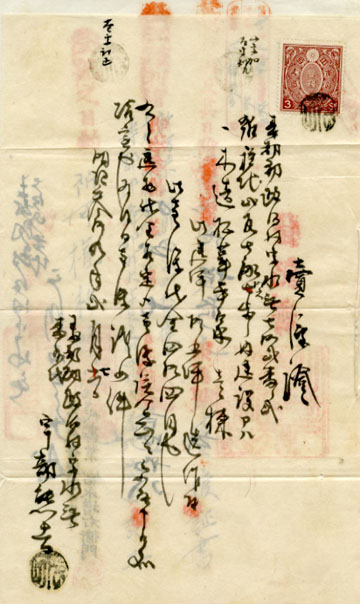  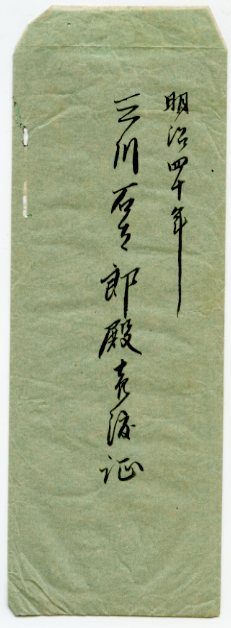 Reverse of envelope 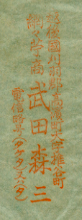 Many thanks Andrew |
|
Send note to Staff
|
| Edited by agb - 10/29/2017 12:38 pm |
|
|
Valued Member
Japan
350 Posts |
|
|
Hi Andrew and all,
All your posts are really interesting; please let me take some time during this weekend to enjoy the details.
At a quick glance, I would way that the document with three 50 sen green rouletted revenues (the first series of the hand engraved revenues) is really a gem... Wow
As for the revenues, you definitely should not take them away from documents. As revenues are cancelled with private chops and do not have datestamps, the date written in the document should be considered as equally important to datestamp on a postage stamp. This is especially important for hand engraved revenues, as they have so many varieties in paper, perforation and plates.
- Hironobu
|
|
Send note to Staff
|
| Edited by unechan - 11/01/2017 05:08 am |
|
|
Valued Member
Japan
350 Posts |
|
|
Quote:
The ones that I find appealing are the revenues from 1873 the hand-engraved series of 8 values.
Maybe someone could suggest any philatelic literature which would be useful showing, plate layouts, different perfs and colours/shades of the values. I have looked on the web, unfortunately I have not managed to find any philatelic works which covers the above.
I am aware of the Japanese Revenue Catalogues by Shimomura and the other by Furuya, but do they cover the above?
Andrew, I bet you're now entering the most important, interesting and complicated area of Japanese revenues  . The hand engraved series you've mentioned are, I believe, something comparable to the classic Cherry Blossom stamps for their variety in paper, perfs, color/shades, plating and errors. I certainly can share my experience and what I know about these revenues!! The most detailed reference is the Furuya catalogue, with the new version issued recently by Hasegawa. They do list the known varieties that you're looking for. I think it's available from a Japanese seller on ebay. -Hironobu |
|
Send note to Staff
|
|
|
Valued Member
Japan
350 Posts |
|
|
Andrew, Quote:
Could someone confirm that the stamps are rouletted and hopefully could also help with the translation of the partial document and the 'chop' marks. Yes they are rouletted. The first and second issues are on native (Japanese) paper, rouletted, the third issue on native paper and perforated, the fourth issue (and fifth, according to Hasegawa) are on western (normal) paper and perforated. Note that there's some exceptions for some high value revenue stamps. I'll come back later  - Hironobu |
|
Send note to Staff
|
|
|
Replies: 117 / Views: 27,232 |
|



 Posted 10/26/2017 3:35 pm