| Author |
 Replies: 44 / Views: 4,728 Replies: 44 / Views: 4,728 |
|
Rest in Peace
United States
1189 Posts |
|
|
I've puzzled my way around this stamp for some time and have finally decided to see if I'm even close to correct on identifying it. If I'm off, what is sending me in the wrong direction? Here's what I believe is Scott 21: 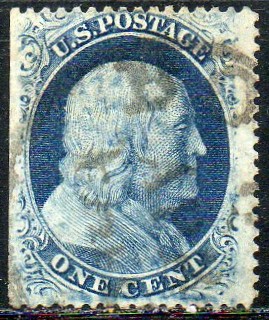 I look forward to what our experts think about this stamp. |
|
Send note to Staff
|
|
|
|
|
Pillar Of The Community
United States
1043 Posts |
|
|
I don't believe it is scott 21.
But the stamp is interesting....there are perf remnants down lower left side. ? Tampered or altered.
Initially I thought type V. But could be Va. better scan to plate it would help |
Send note to Staff 
|
|
|
Pillar Of The Community
United States
1820 Posts |
|
|
I agree with rgstamp: #24 (right side ornaments not all complete), type Va (reverse C-shaped ornament at LR complete). I'm guessing you went in the wrong direction because you looked at the broken frame lines first instead of the right-side ornaments. As for the left-side straight-edge, scissor-cutting was not unusual for stamps from the first vertical row of the right pane or the tenth vertical row of the left pane. Try typing your stamp using this tool: http://www.stampsmarter.com/feature...ingTool.html |
|
Send note to Staff
|
|
|
Pillar Of The Community
United States
2555 Posts |
|
|
E relief stamps can pose problems because there are no side scratches that many people believe must be there for the stamp to be a Type V. A, B and F relief stamps can cause similar mis-identifications although they usually get called Type Va rather than Type III. |
|
Send note to Staff
|
|
|
Pillar Of The Community
United States
1360 Posts |
|
|
Will add to what Winston posted in that the E Relief are the most difficult relief to find in Type Va. Of the 40 available positions on Plate 5, more positions are not Type Va than any of the other reliefs.
Your stamp has a lot of mottling, which in a lot of cases points to Plate 7. If you could post a minimum 600 dpi scan, someone here would have a good shot of plating it for you....(I'm thinking Winston or Dudley here)....
Ray |
|
Send note to Staff
|
|
|
Pillar Of The Community
United States
3528 Posts |
|
|
I'll use this opportunity to point out that this stamp exhibits relief bruising quite well. The so-called 'mottling' in the head, was finally explained by Dave Zlowe. This mottling has well-defined patterns to it, that Dave noticed, and presented to the 1c study group back in 1999 at a show. I recall watching his slideshow, where he was making his argument for this, and realizing that I was watching what was obviously a significant discovery and advancement of our understanding of the Ty V plates. People had plated these things for 100 years, and these giant blotches were in front of everyone's face, but no-one put it all together until Dave finally looked at things from a different angle. At the time, I felt that this was the most significant discovery related to the 1c stamp, since the Neinken book came out in 1971. It still seems like it. I don't spend my time plating Ty V's much - I focus more on the earlier plates -- so I'd be interested in hearing what other students of the Ty V's think of this discovery, and how it has helped (or not) in plating Ty V's, or how it has helped you at all. I was having some issues this morning with the USPCS website - probably my fault, so I'll just refer you to Chronicle Whole numbers #249, 250, and 251 for the 3-article series on 1c 1857 relief bruising by Dave Zlowe. This will get you to the web Chronicle jump page: https://www.uspcs.org/resource-cent...b-chronicle/Getting back to this thread - before I even looked at the side ornaments, or anything else, I knew it was a Ty V (or Va) right away from the bruising pattern in the head. |
|
Send note to Staff
|
|
|
Pillar Of The Community
United States
1820 Posts |
|
|
txstamp, I regard the Zlowe series as one of the most important pieces of philatelic scholarship I've encountered in over five decades. I've found his discoveries regarding the blotches to be of great use in identifying reliefs when other means fail, though the very inconsistency of these blotches is a drawback to their use in direct position plating. |
|
Send note to Staff
|
|
|
Pillar Of The Community
United States
1340 Posts |
|
|
I was unable to view the link as I was not a member. It just pushed me to the membership page. Dead link. |
|
Send note to Staff
|
|
|
Pillar Of The Community
United States
1043 Posts |
|
|
Pillar Of The Community
United States
1820 Posts |
|
|
Quite possible, rg. Once I downloaded and enlarged the image I can see that it is probably not a Type Va. |
|
Send note to Staff
|
|
|
Pillar Of The Community
United States
3528 Posts |
|
|
jaxom - I'm sorry for tempting you but not delivering, with the link behind a paywall. I routinely link to Classics Society pages, but they keep recent journals limited to members only - my mistake.
This discovery was made in the 90's so for me it seems like a long time ago, but in reality, Dave just published this in 2016, so its recent.
edit: last night I went through one of my notebooks, and I found the handout that Dave gave us all in about 1999 when he presented this to us.
Its a really complex subject, which is why I didn't go into much detail originally. The net of it is that those mottled blotches are largely consistent by 'relief'. At least part of the issue had to have come from the laydown - aka the transfer roll. Dave goes into gory detail on other expanded theories, but the root cause isn't 100% known. |
|
Send note to Staff
|
| Edited by txstamp - 04/10/2018 11:20 am |
|
|
Pillar Of The Community
United States
3528 Posts |
|
|
jaxom - you should consider joining the US Classics Society. They are one of the few societies that has successfully navigated their business model into the 21st century. Their website offers terrific content, and the journal is first rate. Additionally, given the type of original work that you are producing, such as the plating charts, you might find the Chronicle as a good outlet for you to publish an article at some point. I hope you will consider it. |
|
Send note to Staff
|
|
|
Pillar Of The Community
United States
1340 Posts |
|
|
Txstamp, I looked at the application for the US Classics Society. I see why very few apply. they ask for applicants to submit two philatelic trade references. I have no idea what they are looking for. That is a good way to chase off applicants. I wonder how many others have read that and just moved on. It is a deal killer for them. |
|
Send note to Staff
|
|
|
Pillar Of The Community
United States
1820 Posts |
|
|
jaxom, just provide the names of two dealers or auction houses you've ever done business with. It should be no biggie. |
|
Send note to Staff
|
|
|
Pillar Of The Community
United States
3528 Posts |
|
|
jaxom - you can use me as a reference - I'll PM you my info.
PM sent. |
|
Send note to Staff
|
| Edited by txstamp - 04/11/2018 10:46 am |
|
|
Valued Member
9 Posts |
|
|
Sorry for a late reply, but I've just registered.
To answer the OP, the stamp is a Type V (Scott #24), from the top row of the plate, relief A. Due to the strong relief bruises (the "dot" in Franklin's head, and the interstitial relief bruises in the bottom margin) it is most likely from Plate 7. The item was likely scissors separated at left.
Enjoy your stamp!
BTW, thanks to those who expressed kind words about my research articles in The Chronicle. |
|
Send note to Staff
|
|
|
Replies: 44 / Views: 4,728 |
|




 Posted 04/08/2018 12:09 pm


