OK, Let's back up a bit for one last try at this. What is the actual perforation rate? There has been too much guessing at 10, 11 and 12. Why not establish that fact.
Since the top perforations are somewhat problematic, here is a scan of 3 stamps, from left to right,
perf 10 (a coil, very wide perforation bridges between the holes),
perf 11 (an offset printing),
and perf 12 (an early Franklin, narrow pointed bridges between the holes).
No doubt about the perf rates of these three.
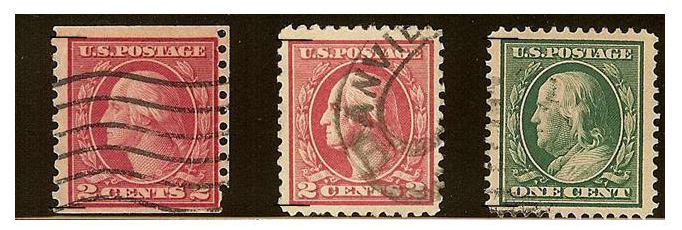
While I cringe at "perf-counting" methods, I have added 2 thin black lines at the left sides of each design extending to the left vertical row of perforations. Each stamp has an image height of almost exactly 22mm (despite very small differences in printing methods and paper grain). This 22mm is 10% more than the 20mm (2cm) width of a perforation gauge.
The number of perforations coincident with the height of the printed area will be extremely close to:
On the perf 10 stamp: 10+10%=11 complete perforations
On the perf 11 stamp: 11+10%=12.1 complete perforatins
On the perf 12 stamp: 12+10%=13.2 complete perforations
More simply, count the vertical perfs in line with the printed area and subtract 1 to get the standard gauge rate.
Using this crude field method, the original poster's stamp is clearly perf 12 at the side (The original poster got this fact correct!). Don and Jaxom both clearly demonstrated the top perforation rate matches the side rate. 12 x 12. The Scott number can only be 405, either sheet or booklet. Several of us have voted for "booklet", due to the straight edges and wide blank area which would have had a guide line if it were of sheet origin. The aspect ratio could be easily measured to confirm this. Amazing how much time a 25 cent stamp takes!
I will make the same offer the OP made, please correct me where I am wrong in any of this.





 Posted 11/14/2018 2:48 pm