| Author |
 Replies: 16 / Views: 1,839 Replies: 16 / Views: 1,839 |
|
Valued Member
United States
351 Posts |
|
|
I ran across this on e-bay and I am very curious about it. Is this a real wedding or bad Hollywood movie? On e-bay they are saying it is a rare historical document and it is selling for nearly 1000. dollars. And how did that black fellow squeeze his feet into those little white boots? I do not know what to think of this. Any opinions? 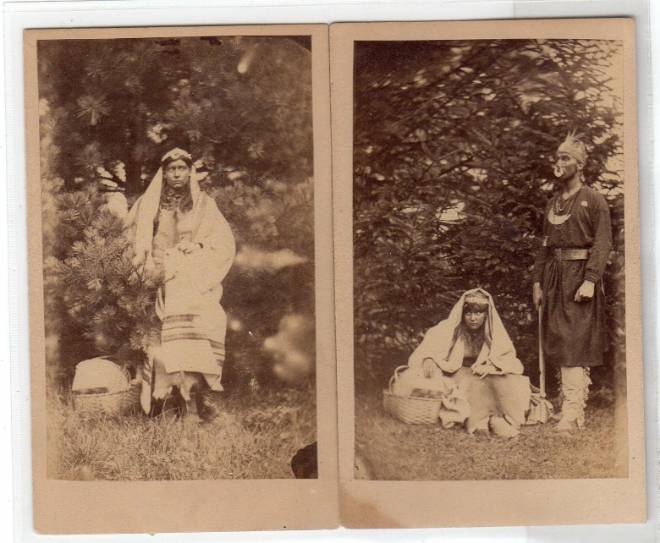 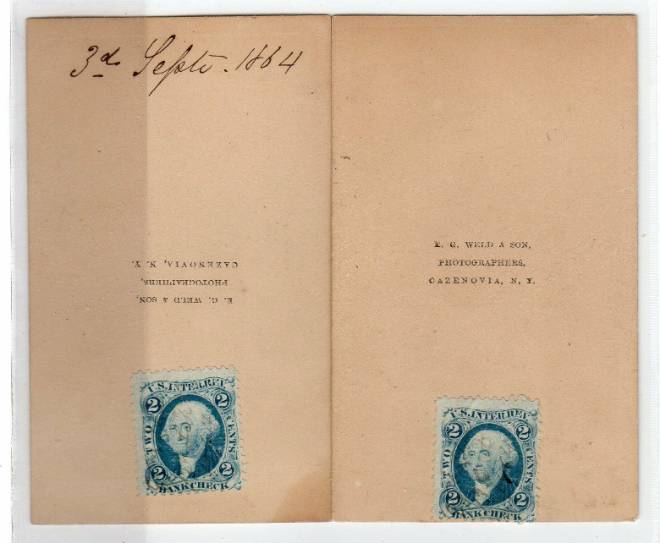 |
|
Send note to Staff
|
|
|
|
|
Pillar Of The Community
United States
901 Posts |
|
|
Pillar Of The Community
United States
2782 Posts |
|
|
Pillar Of The Community
United States
6469 Posts |
|
|
Native American image CDVs are very scarce. I'm not surprised there's a bidding frenzy. |
Send note to Staff 
|
|
|
|
Valued Member
United States
106 Posts |
|
|
His nose piece makes me think NW coast of USA but everything else is wrong for that. By 1864 hundreds of Native Americans had visited DC and had their pictures taken. They were widely collectible and frequently reproduced with no geographic relation to subject and printer/photographer. I have a Sioux man printed in West Virginia about 1875 for example. He is wearing leggings, on ebay you can see his toes better- either barefoot or open toed sandals so they would have been laced to his legs. Can not tell if he is holding an Ax or a pipe. My guess now is Oneida but will keep trying. They look legit to me but her eyes are weird... staged? hard to say. I asked a friend who should know so will return... RnC |
|
Send note to Staff
|
| Edited by Revenue N Covers - 02/22/2019 8:18 pm |
|
|
Pillar Of The Community
United States
2782 Posts |
|
|
They are probably from one of the Iroquois groups given the area the picture was taken plus the style of the marriage basket. |
|
Send note to Staff
|
|
|
Pillar Of The Community
United States
3224 Posts |
|
|
As for the "black fellow", you'll find that black and white film, even up to the 1900s and perhaps even later, made people with even moderate color in their skin show up quite dark. Plus it looks like his jaw may be painted. That might be a clue. |
|
Send note to Staff
|
|
|
Bedrock Of The Community
12741 Posts |
|
|
Pillar Of The Community
United States
1162 Posts |
|
|
I suspect none of us on this forum are experts on the subject matter at hand - native American photographs of the 1860's and/or the photographer's history of photographing native subjects. Perhaps an expert on the subject would know whether this photographer has worked with these specific subjects and whether the 'models' are truly native or not We are stamp experts. Claims on other aspects of this are simply opinions. As we all know, opinions are like a**holes - everybody has one. My OPINION is that there is no reason, based on appearance, to think that these people aren't native, but that is simply based on their high cheekbones. Their skin tone also seems about right, but color correction (if you wish to consider shades of gray [or sepia] as colors) in 1860's photography was minimal, at best. My advice would be to find a CDV, or historic photography, forum. Anything is possible on the www.
PS: I would hope that any bona-fide expert with REAL knowledge on this would state that, when he posts his knowledge here. |
|
Send note to Staff
|
|
|
Pillar Of The Community
United States
2782 Posts |
|
|
While I doubt there's not many top of the line experts on Native American photographs there are folks here who do have backgrounds in other things aside from philately. We do have people on here who are Native Americans (at least one that I know of). There also people who are historians and other folks from similar backgrounds. I myself have a back ground in cultural anthropology and history and worked on many Native American archaeology sites for 20 years. There are also others on here with first hand lifetime experience. When we come to a site like this an analyze a historical and/or philatelic we bring that knowledge and experience that's beyond the scope of philately. Some of our opinions do have some weight so don't be too quick to dismiss them. Yes, I wouldn't use physical traits to make an assessment as there's a wide range of diversity and there's nothing to say some Native Americans don't have mixed heritage. I would concentrate not such much on physical traits, but as you said the history of the photographer which is historically known for taking photos all around Cazenovia, NY which is home to Iroquois groups. Also the cultural elements of the photo is important. Many groups had marriage baskets, but the baskets have unique styles to each group. There's an Iroquois museum in New York - the pics can be submitted to them for further information.
|
|
Send note to Staff
|
|
|
New Member
United States
3 Posts |
|
|
Staged photos were the meat and potatoes for photographers back then. The couple may well have been authentic native americans in their tribal dress but the tax stamps verify their authenticity for the era.
This from Wiki: Among the more notable instances of tax stamp usage occurred in the photography trade. As the Civil War progressed, the demand for photographs of family members, soldiers going off to war and returning war heroes increased dramatically, but not without the notice from the Federal government who saw the advent as an opportunity to raise much needed revenue for the war. On August 1, 1864 the Internal Revenue department passed a 'photograph tax' requiring photographers to pay a tax on the sale of their photographs. By 1864 there were no 'photography tax' stamps issued, so other stamps were substituted, typically, the proprietary or playing card revenue stamps was used, usually affixed to the back of the photograph. Already burdened with high overhead costs and scarcity of materials because of the war, large photograph companies organized and petitioned Congress, complaining that they were shouldering too much of the tax burden placed on the public. After exactly two years their constant efforts resulted in the tax being repealed on August 1, 1866.
I'm sure the photographer sold prints of those pictures from his studio, at fairs and other functions. They may well not be the only copies in existence but they fit the era perfectly for being historic.
|
|
Send note to Staff
|
|
|
Pillar Of The Community
United States
1162 Posts |
|
|
Battlestamps - thank you for your response. You indicate that you have some pertinent knowledge, and gave what seems to be valid info. There may very well be people on this forum with the knowledge that the original poster needs. I encourage them to enlighten us all. I posted as I did because it seemed to me that some of the previous posts were basing their statements on the appearance of the subjects from the POV of, for lack of a better term, amateurs. If there really was a response from someone with real knowledge, I was asking that they state what their experience is. People with experience have more to bring to the table, but if they don't say that they have this expertise, their statements would get lost in the 'noise' of all the others espousing their opinions. I wasn't trying to belittle anyone. If I were the original poster, and I saw a wide range of opinions, which should I believe? If one of those opinions was accompanied by a statement of "I myself have a back ground in cultural anthropology and history and worked on many Native American archaeology sites for 20 years", I would tend to give that statement more weight. Short of specific knowledge of these subjects, or this series of photos, I would tend to put more weight with those posters that have some real training in this, or a closely related, field.
Again, thank you for your response. It is valuable and pertinent to the subject at hand. It appears that I have underestimated the cross-expertise of the people on this forum! And, for that, I apologize. |
|
Send note to Staff
|
| Edited by mootermutt987 - 02/24/2019 03:21 am |
|
|
Valued Member
United States
106 Posts |
|
|
Hi Mooter, Fair enough. I am a professional archaeologist who specializes in collecting Native American ephemera, especially photographs, for fun on the side. Some times professional and hobby worlds collide- in April at our national professional meetings I will be spending some time with the archivists from Chaco Canyon as I recently found about 30 glass lantern slides from 1896 taken just weeks before the first professional archaeological work began by a crew from Harvard. Some of these may be the first ever taken of a number of the structures.
I wasn't certain about the couple but knew enough to ask others. Pictures are from Oneida County- home of the... Oneida. Person I asked actually thought Mohawk slightly more likely than Oneida but those were his top two suggestions. Asking Cultural Resource people from either group would almost assuredly get them properly identified to group and possibly put names to them as well.
One easy to remember mnemonic device for the west to east alignment of the League of the Iroquois is SCOOM- Seneca, Cayuga, Onondaga, Oneida, Mohawk. I may not be ready to write a book about this area but I have enough sense to find things out... Cheers, RnC |
|
Send note to Staff
|
|
|
Bedrock Of The Community
12741 Posts |
|
|
I was working on a large construction project in Boston once and as we excavated on the Boston Common we were required to have three archeologists from the MA Historical Society observing. At one point they became very excited and stopped further work while they mooned over a "Colonial nail" and started documenting it, locating its in-situ position etc.. Finally the Superintendent grabbed it and examined it while chomping on a big cigar and said 'its a f***ing form tie" and then chucked it over the fence. Work started again. They look like actors.  |
|
Send note to Staff
|
|
|
Valued Member
United States
106 Posts |
|
|
Yikes.... yeah aah, definitely not that kind of archaeologist. I can't stand that kind of stuff. I work primarily at the extremely early end- what we call Paleoindians, typically everything older than 10,000 years ago across the New World. Didn't get to post much in January because we were excavating a mastodon underwater near Tallahassee. One truly incredible thing that came out of the BIG DIG on the water side was the discovery of something like 8,000 6-7 foot poles stuck in the ground prehistorically for fish weirs. Sorry, 65,000 poles.... https://en.wikipedia.org/wiki/Boyls...eet_Fishweir |
|
Send note to Staff
|
|
|
Bedrock Of The Community
12741 Posts |
|
|
Yes, a lot of interesting things underground in Boston. We uncovered many wooden water lines and a lot of Colonial era pottery and such. Broken of course. We excavated on Charles Street through all of the layers of paving from asphalt to brick to cinders to cobbles. A very difficult place to perform sub surface work because when the tide came in it would raise the water table all of the way to Tremont Street. A 40 foot excavation on the Common would fill with salt water from the harbor. Amazing. |
|
Send note to Staff
|
|
|
Replies: 16 / Views: 1,839 |
|



 Posted 02/22/2019 4:52 pm