Quote:
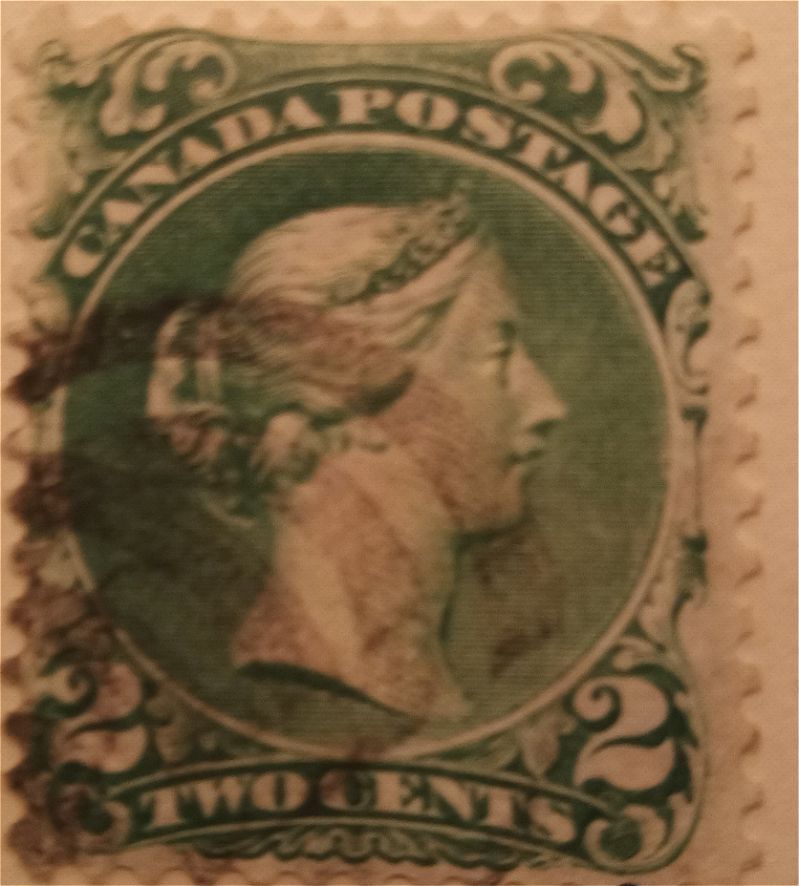
There is NO laid paper!
We are dealing here with some kind of watermark of parallel lines.
I am happy to challenge you on this,
Whilst I won't argue the point, Nor shall I shout YES in capitals, in apparent dominance of an argument, I'll just lay out my understanding of the accepted interpretation of "laid" paper.
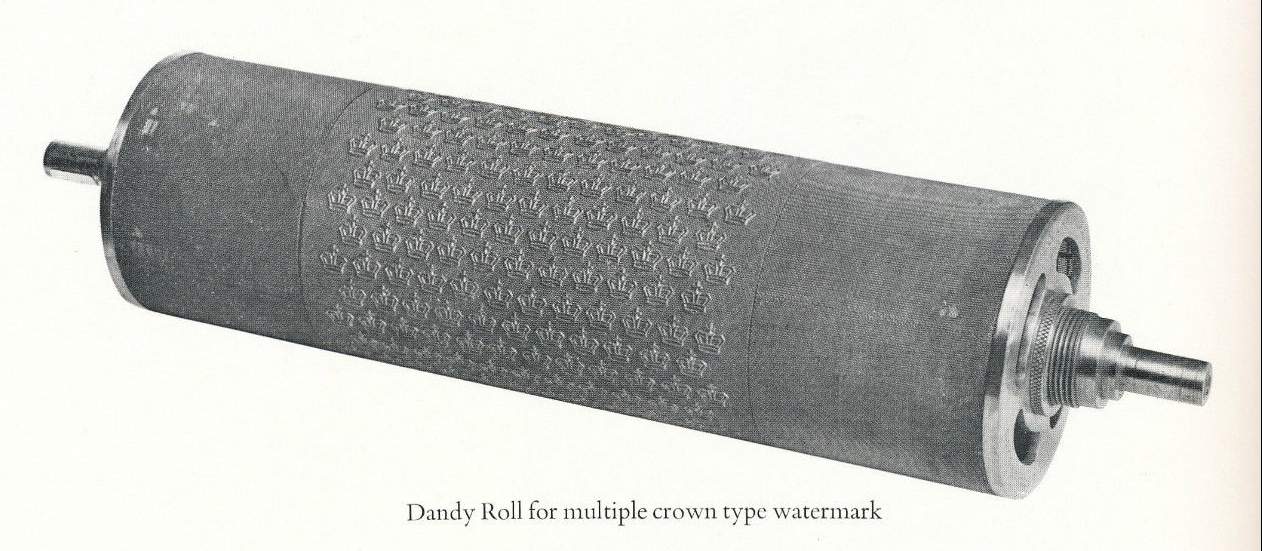
First, the dandy roll. This cylinder applies to the wet pulp the finish
that we describe as "wove" or "laid" paper. If the cylinder is made
of a wire screen in which the horizontal wires are equal in number
to the vertical wires — as, for instance, ordinary mosquito netting
then the pulp that passes under it will be known as "wove" paper. If
the surface of the roll is made up of parallel wires held in place by
widely spaced supporting wires, the pulp passing under it will be
known as "laid" paper. The lines of the dandy roll will appear as laid
parallel to each other. The supporting wires, which also show up on
laid paper, are called "batonnes" and we have "laid batonne"; or if the
wires are close to each other we call the result "laid quadrille," or
plain "quadrille" paper.
Both laid and wove paper are, of course, actually watermarked paper
for the laid lines or the even texture we see, when holding the paper
before a light, is the result of the surface of the Dandy Roll being
pressed into the wet pulp. However, watermarks are actually an
added device. Small bits of metal, called "bits," are stamped out in
required design and soldered or wired to the surface of the Dandy
Roll. This can, and often is, done on either a wove or a laid-surface
dandy roll. But whether on wove or laid paper, if there be a
watermarked device, collectors refer to the paper as "watermarked."
Source: The Complete guide to Stamp collecting
Author : Prescott Holden "Pep" Thorp (Minkus) 1948
Grosset and Dunlap New York
I hope that members can understand this, "laid" as not being a physical
occurence, rather a reference to the type of screening.





 Posted 03/30/2019 11:11 am