|
This page may contain links that result in small commissions to keep this free site up and running.

Welcome Guest! Registering and/or logging in will remove the anchor (bottom) ads. It's Free!
To participate in the forum you must log in or register.
| Author |
 Replies: 17 / Views: 3,173 Replies: 17 / Views: 3,173 |
|
Valued Member
United States
25 Posts |
|
|
|
I'm relatively new to the forum, so my question is one of uncertainty, ignorance, suspicion, and psychological awareness.
I can't help but notice that there are numerous examples of certificated philatelic items that don't seem to match the certification criteria ascribed to them. Doing a simple online search for various Scott numbers brings up pages of links to items, often presented in a collected format, that show little resemblance to each other in any number of characteristics, but yet still manage to bear the same expertised certification. Given that it is a de rigeuer modus operandi among collectors, especially "mature" collectors, to react with almost knee-jerk dependability to any identification doubt by suggesting, or even insisting, that a certificate be obtained, I can't help but wonder if there isn't an Emperor's New Clothes dynamic in play. I could and can provide numerous examples to bolster my assertion, but I'm not interested in proving my point as much as getting people's opinions about the situation I describe above.
Do people on the forum really believe that expertisers are philatelic Wizards of Oz, because because because because because of the wonderful things they does? Or do people just sort of grit their teeth and hope for the best (knowing that the outcome is little better than a crap shoot)?
As I see it, expertisers are humans and humans are roiling cauldrons of personality quirks. It seems pretty inevitable that there will be a variety of different "styles" of expertisers.
--Expertisers who WANT to have a rarity come across their desk just because they want to actually see an example in real life, and so they have a propensity to "call" items a rarity when a majority of others (even non-experts) might well conclude no such thing.
--Expertisers who are aware that, historically, stamp collecting has been riddled with ne'er-do-wells and fakers who have attempted all manner of manipulations in order to increase sale values of their stock. As a result they anticipate that pretty much every "appearance of rarity" is actually a fake just waiting to be uncovered. In matters that are a judgment call, they will almost regularly come down on the "Sorry..." side of the ledger.
--Expertisers who are well-meaning, but really probably ought to be in a different line of work.
--Expertisers who are driven by integrity, but who are nevertheless susceptible to the vagaries of the vocation, where the passage of time causes a sea-change in the understanding of a given Scott number.
Of course, all expertisers, as mentioned above, are human and susceptible to error, even if professionalism (in some cases) inures them to being error prone.
My point is this: as mentioned above, I can find NUMEROUS (bordering on excessive) examples of expertised and certificated stamps online that almost anyone, philatelist or man-on-the-street, would immediately identify as badly misclassified. Given that, why do people constantly default to recommending a process that is so often--and it really IS pretty often--demonstrably WRONG?
|
|
Send note to Staff
|
| Edited by Gallejois - 09/13/2019 04:20 am |
|
|
|
|
Pillar Of The Community
France, Metropolitan
3753 Posts |
|
|
Understand your reaction; but could you show an example or two of these errors?(bordering on excessive)If its just a seller expertising their own material ;just forget about it. |
Send note to Staff 
|
|
|
Valued Member
United States
25 Posts |
|
|
Exhibit #1 (Expertised items w/ "too-wide" variance)This web page identifies ALL examples of 78c (blackish violet) that Seigel is aware of (not sure if this is isolated to specimens that have passed through their doors [most likely], or is a global catalog). https://siegelauctions.com/display_...s.php?id=130In my opinion, there is too much variance in this census, and many appear to be closer to other shades. Some could say "that's just your opinion", and they would be exactly correct...just as this census is a grab bag of opinions from a multitude of different people. But to make my point, notice this snippet (taken from http://www.usphila.com/us/stamp/pri...8-page-1)...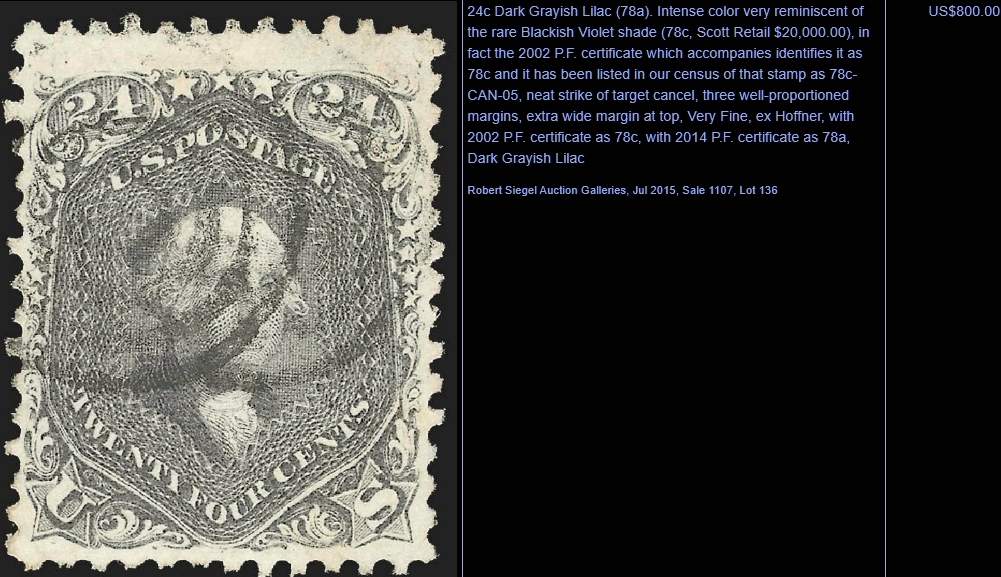 This stamp has been given two certs which i.d. it as two different Scott #'s. Notice that the first cert. is a stamp from the 78c census web page above. Guess what? This is NOT an isolated example, because on the very same web page one can find this... 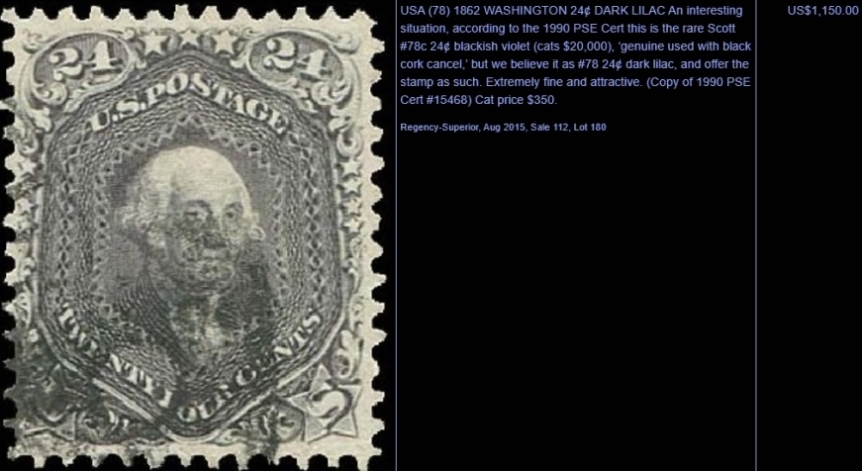 But here's the real  of the matter...I don't perceive anything like lilac in either pic. Yeah, pics can be unreliable, but most of these pics do portray what is claimed. Besides, "dark" grey lilac (which IS NOT the same as grey lilac) may be just as rare as the 78c shade. Do you see lilac in these? I doubt it. Exhibit #2 (color-blind identification)From the same USPhilia website, ALL of the following stamps are id'd as 70c's (I don't believe that for a second, and you shouldn't either)... 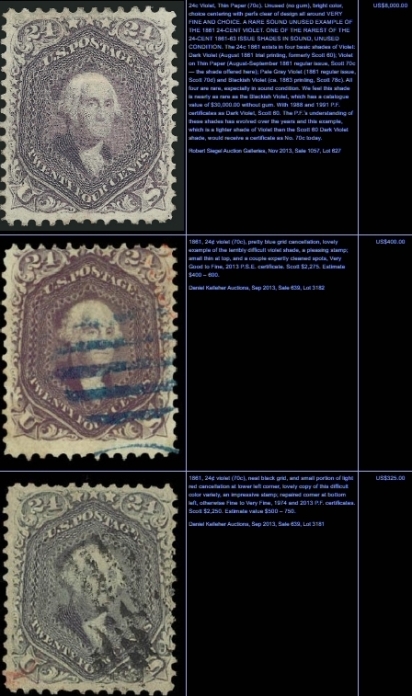 All three of these stamps have certs saying that they are 70c. CRAZY! I could go on and on and on and on and on. But you don't have to take my word for it. Just run searches on various Scott numbers that typically "require" a cert for identification, and you will see a smorgasbord of variation. It's not just color issues, either. It often happens for centering, as well. You may see two certs for the same stamp, one w/ and 85 and another w/ a 95, or even a 98. Like I said...crap shoot. I bet both of the 78c's that got re-cert'd to (or simply auctioned off as) 78a's ($20K+ down to a few hundred $) wish they had NEVER rolled the dice. Sorry to  and to be so  , but this stuff makes me wanna  .  |
|
Send note to Staff
|
| Edited by Gallejois - 09/13/2019 07:06 am |
|
|
Bedrock Of The Community
12708 Posts |
|
|
Gallejois - I have confidence in certificates from the Philatelic Foundation for the types of issues shown.
As far as grading numbers go that horse has been beat here and I am not going down that road again except to say that if you think that centering alone is what the assigned value is for you do not understand grading at all.
Would love to see your reference collection for the issues you chose as examples.
This is the perfect topic for Mr Crowe to reply to if he so chooses. I hope that he does.
|
|
Send note to Staff
|
|
|
Bedrock Of The Community
United States
10824 Posts |
|
|
Using a group of Siegel scans (or any long term group, for that matter) to discuss shades is an exercise in futility. They were created at different times, on different equipment, under different conditions, by different people. And then using them to blame the expertisers is doubly useless. |
|
Send note to Staff
|
|
|
Moderator

United States
12330 Posts |
|
|
What!?! Images are not a good substitute for a stamp in the hand!?! That would explain why I see these great looking, juicy burgers in the commercials but I get a dried up nasty burger when I order one!  Don |
|
Send note to Staff
|
|
|
Bedrock Of The Community
12708 Posts |
|
|
Pillar Of The Community
United States
713 Posts |
|
|
Correct me if I am wrong but The Philatelic Foundation used a group of members to certify stamps. These collectors/professionals must agree on the certification. There are different members that are on the committee for different areas. These members change over time and these members add more knowledge about their area of expertise. Also the procedures and techniques used to identify the stamps change and are improved over time. These things lead to different opinions over time. Most expertizing firms suggest, when you are ready to sell your stamps, getting an up to date certificate for any that are over 10 years old. There is 12 years between your first example so that seems to be within the standards of the profession. |
|
Send note to Staff
|
|
|
Rest in Peace
United States
652 Posts |
|
|
My comment on this matter is that basing an opinion as to the correctness of shade identification by viewing a scan on the internet is a recipe for disaster. You are looking at a reproduction of a reproduction plus dealing with the variation of color displays on computer monitors. Not all display monitors are created equal. I am not saying that there are not inaccurately identified certified stamps in existence, but you must see them in person and have the proper reference to determine the accuracy on inaccuracy of an opinion.
I can attest to having purchased more than one example of a shade on E-bay based on the scan only to find that reality is different from the scan.
In regard to 78c The Philatelic Foundation has at least two examples on cover in their reference collection. The shade of a 78c is fairly constant, but that of Scott 70c varies with the exposure to light. There are very few rich examples of that shade still extant as the violet is very susceptible to fading due to light. To see the original shade find a Scott 70P4. That shade rarely exists any more. In the late 70s Lou Grunin exhibited two Civil War patriotic covers bearing examples of this shade. Due to exposure to light they no longer have that rich color.
|
|
Send note to Staff
|
|
|
Rest in Peace
United States
652 Posts |
|
|
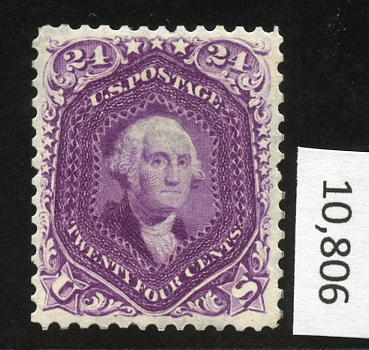 From my reference collection (I could not get it to load in previous reply). Shaved and perforated 70P4. |
|
Send note to Staff
|
| Edited by wtcrowe - 09/13/2019 10:09 am |
|
|
Pillar Of The Community
United States
3521 Posts |
|
|
Bill is of course spot on, when he indicated that the color of a stamp can change over time. It is perfectly valid for a stamp to get a cert as one color, and then, 10 years later, get a cert as something different, due to, for example, light-exposure. This happens. |
|
Send note to Staff
|
|
|
Valued Member
United Kingdom
363 Posts |
|
|
I don't see this as a valid test of expertisation.
Comparing colours based on scans is an exercise in futility, as the apparent colour will be determined by the scanner and the viewing screen, as well as by the stamp.
On top of which the shades of this issue, from what I have read, make it one of the hardest to classify correctly. |
|
Send note to Staff
|
|
|
Pillar Of The Community
United States
1565 Posts |
|
|
It would have been helpful if the original poster had specified that his concern/interest is in expertization of US stamps.
Regarding "dodgy" expertizations, I think there has to be a certain amount of trust that the expertizers know what they're doing. I've had lots of stamps expertized over the years. Back in the early 1990s, I had a copy of Newfoundland C!8 done by the Philatelic Foundation, the only time I've used the PF, and was pleased with the result. The PF cert helped me get a good price when I sold the stamp a decade later.
I've used the APS several times with what I think are good results. I have around 80-100 certs from the International Society for Portuguese Philately (ISPP), done by one person who also does that area for the APS. This is high quality stuff done by an individual with a solid reputation. Same for stamps I've recently purchased, with certs from Sr. J. Miranda da Mota in Portugal, who also edits the Mundiphil catalogues. |
|
Send note to Staff
|
| Edited by Climber Steve - 09/15/2019 2:52 pm |
|
|
Pillar Of The Community
1363 Posts |
|
|
Those who have certificates and especially those who benefit from them when selling will swear by their reliability. Hardly a surprise there. They may very well be right. And the expertizers themselves may be reliable and accurate far more often than not. But clearly human judgement is going to be "off" at times. No question about it. What was judged by one expert to be "rose violet" will be judged by another to be simply "violet" and who is to say which is right?
This is all part of the long, somewhat ridiculous path Scott Publishing led us down in overly minute detail over a hundred years ago when it issued catalogues that attempted to make these minute and highly vague distinctions between common and "rarer" varieties. It's partly guesswork. Even the light source you use will change the color of a stamp. In broad daylight it's a different color from an incandescent bulb from an LED bulb. Knowing for sure what color a stamp is will always be guesswork to some extent.
Consequently, the enormous price differences from one shade to another are just a tiny bit silly at the very least, and approach fraud at times. And a seller is going to want to believe that any common stamp might just be its rarer slightly-different "blackish violet" or "dark lilac" shade variety - since they benefit from the far higher sale price. And using such language as "very reminiscent of" a rarer color variety sounds awfully weasely to me. A seller should reliably know what they're selling and not pass the responsibility on to the buyer who is going to very much want to believe it's a rare stamp since the seller thought it might be, and the seller is presumably some kind of expert or why str they in the business of selling rare stamps? In what other business is the customer left to be the sole judge of what he's getting but the seller gets to only make guesses? Not many, that's for sure, if they wanted to stay in business.
For me, I avoid completely the minute shade differences, especially on U.S. stamps where it has always been truly silly, thanks to J. Walter Scott and his nonsense during the era when there weren't enough stamps to collect so every tiny, tiny difference was catalogued to create another variety to collect.
Expertizing is well-intentioned guesswork that varies from one expertizer to another. It's not unusual for a seller to shop a stamp around from one expertizer to another until one bites with the higher price valuation. And then you have "proof" it's a rare "blackish violent" and not merely a black.
If I can examine the stamp in person under reasonable light with a good magnifying glass using a reliable color chart, at least I have a halfway decent chance of knowing what I'm buying. But trusting a dealer to know is taking a big chance. And trusting a grainy photo to prove anything is unlikely to ever work. Fortunately, you can always send their mistakes back to them and ask for your money back. But how many of their mistakes never get re-evaluated by overly trusting colllectors? A lot, I'd guess. If rare cars or paintings were sold this way -- "We think it's a rare Alfa Romeo but we can't be sure" or "Possibly a Rembrandt, but possibly not" -- it would just be silly. I think a lot of this is silly, too. |
|
Send note to Staff
|
| Edited by DrewM - 09/16/2019 03:54 am |
|
|
Valued Member
224 Posts |
|
|
Agree with darn near everything DrewM posted. Although technological advances have made expertising much less iffy than even just a few years ago, it is useful to keep in mind that a credible cert will state that it only represents the opinion -- however well-based -- of the experts. And in general the more eyeballs on a stamp, the better. |
|
Send note to Staff
|
|
|
Valued Member
United States
25 Posts |
|
|
Quote:
rogdcam: Gallejois - I have confidence in certificates from the Philatelic Foundation for the types of issues shown. Interesting...so can you hone this down a bit? For the stamp below, are you confident the 2002 PF cert. is legit (says it is 78c), or are you confident the 2014 PF cert. is legit (says it is 70a)? Or are you confident in PF certs. no matter what the result may be? 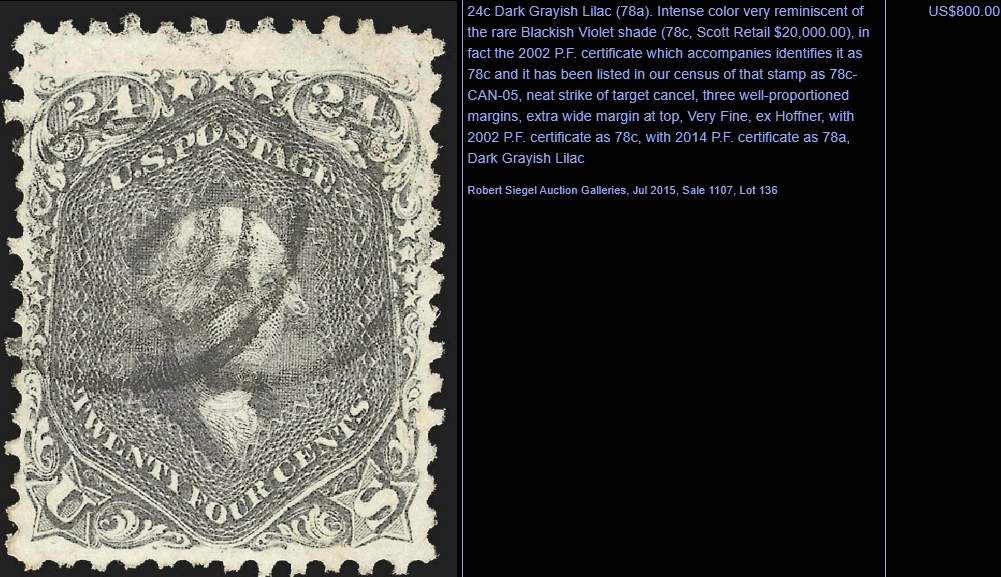 Another "bother" I have is the valuation that is given to the stamp as a result of the CHANGE of Scott number. First, is "DARK gray lilac" a real Scott shade variation? From what I am able to determine, the sub-type is 78a = gray lilac, w/ a three-figure valuation. But why lump this stamp into the "gray lilac" category if it isn't merely "gray lilac" but rather DARK gray lilac. Isn't it possible that DARK gray lilac (a theoretical sub-type of sub-type 78a) is even MORE RARE than 78c (blackish violet) w/ a five-figure valuation? Didn't both of the DARK gray violet stamps that "used to be" 78c's suddenly become rarer than the 78c's? Do the math: they were part of a 61 stamp collection of "rare" 78c's...now, because cert. happens, they are 2/61 RARER than the remaining 59 78c's in the census. Maybe these two DARK gray lilacs should have 6-figure valuations?? |
|
Send note to Staff
|
| Edited by Gallejois - 09/16/2019 1:10 pm |
|
|
Replies: 17 / Views: 3,173 |
|
|
To participate in the forum you must log in or register. | |
 Kem Playing Cards Still Sealed, Year? What Did You Do Philatelically: Today Or Recently? Indypex 2026, September 18, 19, And 20, 2026 The Strand Stamp Fair Closes After 57 Years Serbia 2025 - Second Half Of The Year: Kenmore Stamp Company Joins Mystic Bridges, Bridges, Bridges! On Stamps Statues On Stamps Help With 3 Cent Queen Victoria Stamp Type/Color? Modern Industrial Art And Design Cover Calendar For Month And Day -Pics Postmarks.day By Day Nashville Philatelic Society-Your Invitation To Our Auction Night Meeting Monday, September 28, 2026 Norse Mythologies On Stamps Egyptian And Near Eastern Mythologies Pushing 330,000 All Different Worldwide Stamps In One Collection . Don't Use Magic Photo Albums For Stamps J92 (4 Cent) Dull Gum Discovered Kiloware And The Next Generation. Recommendations Of Stamp Auctions - For Smaller Budgets China Postal Stationery Card Sent From ? To Tsingtau/Kiautschou (1904) Help Id'ing Japan Letter Sheet Used By US Soldier In 1919 Stamps Of Small Animals / Mammals / Fauna Newspapers, Printed Journalism On Stamps Latin Species Names For Plants & Animals Kem Playing Cards Still Sealed, Year? What Did You Do Philatelically: Today Or Recently? Indypex 2026, September 18, 19, And 20, 2026 The Strand Stamp Fair Closes After 57 Years Serbia 2025 - Second Half Of The Year: Kenmore Stamp Company Joins Mystic Bridges, Bridges, Bridges! On Stamps Statues On Stamps Help With 3 Cent Queen Victoria Stamp Type/Color? Modern Industrial Art And Design Cover Calendar For Month And Day -Pics Postmarks.day By Day Nashville Philatelic Society-Your Invitation To Our Auction Night Meeting Monday, September 28, 2026 Norse Mythologies On Stamps Egyptian And Near Eastern Mythologies Pushing 330,000 All Different Worldwide Stamps In One Collection . Don't Use Magic Photo Albums For Stamps J92 (4 Cent) Dull Gum Discovered Kiloware And The Next Generation. Recommendations Of Stamp Auctions - For Smaller Budgets China Postal Stationery Card Sent From ? To Tsingtau/Kiautschou (1904) Help Id'ing Japan Letter Sheet Used By US Soldier In 1919 Stamps Of Small Animals / Mammals / Fauna Newspapers, Printed Journalism On Stamps Latin Species Names For Plants & Animals
Disclaimer: While a tremendous amount of effort goes into ensuring the accuracy of the information contained in this site, Stamp Community assumes no liability for errors. Copyright 2005 - 2026 Stamp Community Family - All rights reserved worldwide. Use of any images or content on this website without prior written permission of Stamp Community or the original lender is strictly prohibited.
Privacy Policy / Terms of Use Advertise Here |
| Stamp Community Forum |
© 2007 - 2026 Stamp Community Forums |
| It took 0.41 seconds to lick this stamp. |
 |
|
|
|


 Posted 09/13/2019 04:04 am


