Stamp Community Family of Web Sites
Thousands of stamps, consistently graded, competitively priced and hundreds of in-depth blog posts to read


Stamp Community Forum
 
Username:
Password:
Save Password
Forgot your Password?

This page may contain links that result in small commissions to keep this free site up and running.

Welcome Guest! Registering and/or logging in will remove the anchor (bottom) ads. It's Free!

Japan Odds And Ends Identification Help Needed

Previous Page
 
To participate in the forum you must log in or register.
Author Previous TopicReplies: 21 / Views: 2,203Next Topic
Page: of 2
Bedrock Of The Community
Australia
38679 Posts
Posted 12/15/2019   6:14 pm  Show Profile Bookmark this reply Add rod222 to your friends list  Get a Link to this Reply
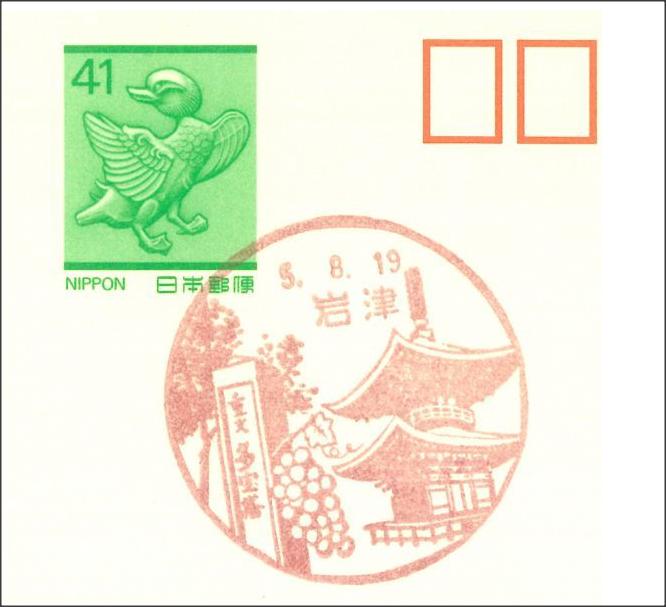
"Govt produced Postcard" Dated 2007? Hence my catalogue would not cover it.


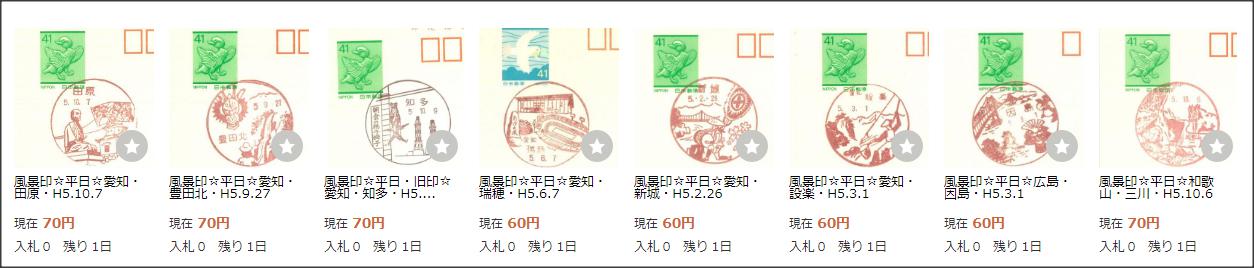
Various PICTORMARKS on the above stationery.
Send note to Staff  Go to Top of Page
Edited by rod222 - 12/15/2019 6:19 pm
Pillar Of The Community
United States
1430 Posts
Posted 12/17/2019   04:44 am  Show Profile Bookmark this reply Add erilaz to your friends list  Get a Link to this Reply
It's year-month-day on your postmarks, Rod, so it's Heisei 5, not Heisei 19 (compare the "H5" under the small pictures at the bottom). Heisei 5 = 1993.


Quote:
Among other things I have learned that 'Shôwa' means 'Era'.

Um, no, you've misunderstood. Shôwa is the name of a specific era, namely the one corresponding to the reign of Emperor Hirohito. Only the last five eras are particularly relevant to collectors of Japanese stamps:

Meiji: 1868–1912 (the first Japanese stamps were issued in Meiji 4 = 1871)
Taishô: 1912–1926
Shôwa: 1926–1989
Heisei: 1989–2019
Reiwa: 2019–

The Japanese word for "era" is jidai.
Send note to Staff  Go to Top of Page
Edited by erilaz - 12/17/2019 04:50 am
Bedrock Of The Community
Australia
38679 Posts
Posted 12/17/2019   05:33 am  Show Profile Bookmark this reply Add rod222 to your friends list  Get a Link to this Reply
Thanks for correcting me Erilaz,
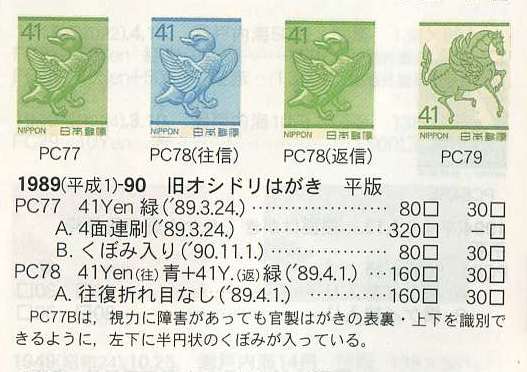
Found it at last in Sakura.
Postal Stationery : Postal Cards

I'd suggest the embossing is part of a commemorative Pmk

Send note to Staff  Go to Top of Page
Edited by rod222 - 12/17/2019 05:34 am
Valued Member
Canada
236 Posts
Posted 12/18/2019   3:27 pm  Show Profile Bookmark this reply Add rrogers to your friends list  Get a Link to this Reply
Thanks for correcting me on the meaning of Shôwa Erilaz.
Since the *10* and *19* represent the year of the emperor's reign how do you know which era they belong to when determining the date? And, thanks again to you and rod222 for sharing your knowledge; it is much appreciated.
Send note to Staff  Go to Top of Page
Pillar Of The Community
United States
1430 Posts
Posted 12/19/2019   12:04 am  Show Profile Bookmark this reply Add erilaz to your friends list  Get a Link to this Reply

Quote:
Since the *10* and *19* represent the year of the emperor's reign how do you know which era they belong to when determining the date?

That can sometimes be tricky!

In the case of your meter stamps, it's pretty easy, because they also have the last two digits of the year in the Western calendar on them. The Isaji meter has *10* and 98 on it, and since Heisei 10 = 1998, there's no difficulty. Similarly, the Iwade meter has *19* and 07, and Heisei 19 = 2007. Both of those meter stamps have the date in the usual Japanese order: year-month-day.

Some of Rod's examples, however, have the date in Western order (day-month-year). When it's something like 08.03.94, it's obvious that 94 is the year, since no month has 94 days in it. But when it's something like 01.12.06, it's trickier, because the year could be either 2001 or 2006. But since the meter stamp with the date 01.12.06 has *18* on it, that can help you figure it out.
Heisei 18 = 2006, so the date is 1 December 2006.

When dealing with postmarks on Japanese stamps or covers, however, you'll normally only have a Japanese era year and no Western year to help you out. This usually isn't too much of a problem, because Shôwa was such a long era. You can usually tell pretty easily whether something with the year 5 on it looks like it came from Heisei 5 (1993) rather than Shôwa 5 (1930). As we progress further into the Reiwa era, it may become more difficult to differentiate between a Heisei date and a Reiwa date, but we're only in the first year of the Reiwa era right now.

Older stuff can be trickier. It may be obvious that something with the year 5 is much too old to be Heisei 5 (1993), but is it from Shôwa 5 (1930) or Taishô 5 (1916)? Here you would need to look for other clues. Does the cover have a Western date on it somewhere, such as a receiving postmark from another country? If not, you may need to look up the stamp(s) in a catalog.

Case in point: I have a Japanese cover with a postmark of 5.1.9 on it. It looks like it's from before World War II, so I can safely rule out Heisei. I determine that the stamps are Scott numbers 131b, 133, and 194. Since #194 wasn't issued until 1926, that rules out Meiji and Taishô (1926 was Taishô 16 and Shôwa 1). So the year 5 in the postmark must be Shôwa 5 (1930).

Coin collectors don't have this problem. Japanese coins have both the name of the era and the year on them.
Send note to Staff  Go to Top of Page
Edited by erilaz - 12/19/2019 12:12 am
Valued Member
Canada
236 Posts
Posted 12/25/2019   4:35 pm  Show Profile Bookmark this reply Add rrogers to your friends list  Get a Link to this Reply
Thanks again for all the useful information.

I have solved the mystery of the 'embossing' on the postal card example. I'm a little embarrassed but it is too funny not to tell... upon closer examination I discovered it was a bit of paper towel that had adhered to the card during drying; I remember soaking the piece to remove a stamp and there must have been some adhesive from the stamp still on the card when I covered it with the paper towel.
Send note to Staff  Go to Top of Page
Page: of 2 Previous TopicReplies: 21 / Views: 2,203Next Topic  
Previous Page
 
To participate in the forum you must log in or register.

Go to Top of Page

Disclaimer: While a tremendous amount of effort goes into ensuring the accuracy of the information contained in this site, Stamp Community assumes no liability for errors. Copyright 2005 - 2026 Stamp Community Family - All rights reserved worldwide. Use of any images or content on this website without prior written permission of Stamp Community or the original lender is strictly prohibited.
Privacy Policy / Terms of Use    Advertise Here
Stamp Community Forum © 2007 - 2026 Stamp Community Forums
It took 0.14 seconds to lick this stamp. Powered By: Snitz Forums 2000 Version 3.4.05