| Author |
 Replies: 78 / Views: 6,985 Replies: 78 / Views: 6,985 |
|
Valued Member
Norway
451 Posts |
|
|
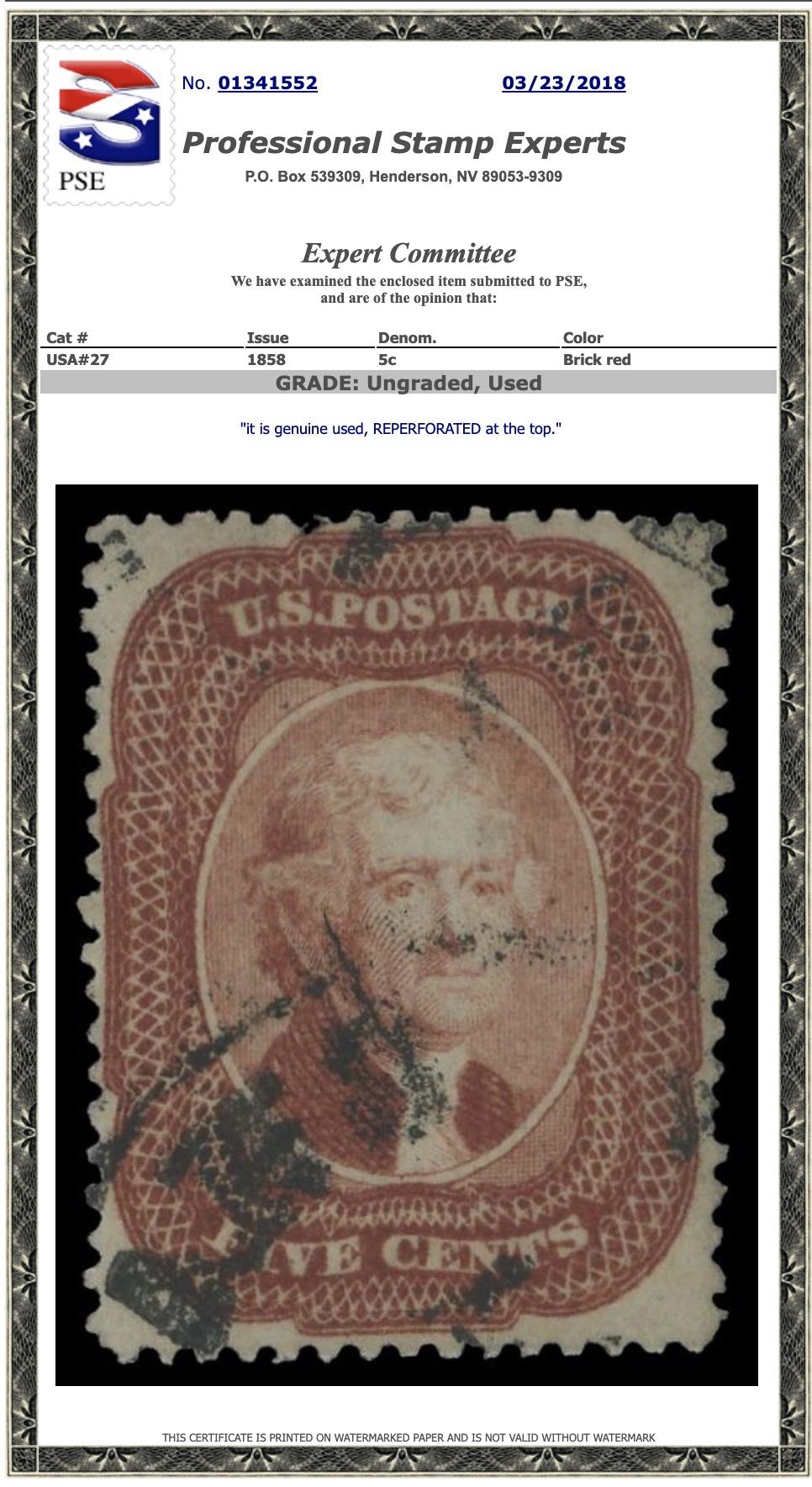
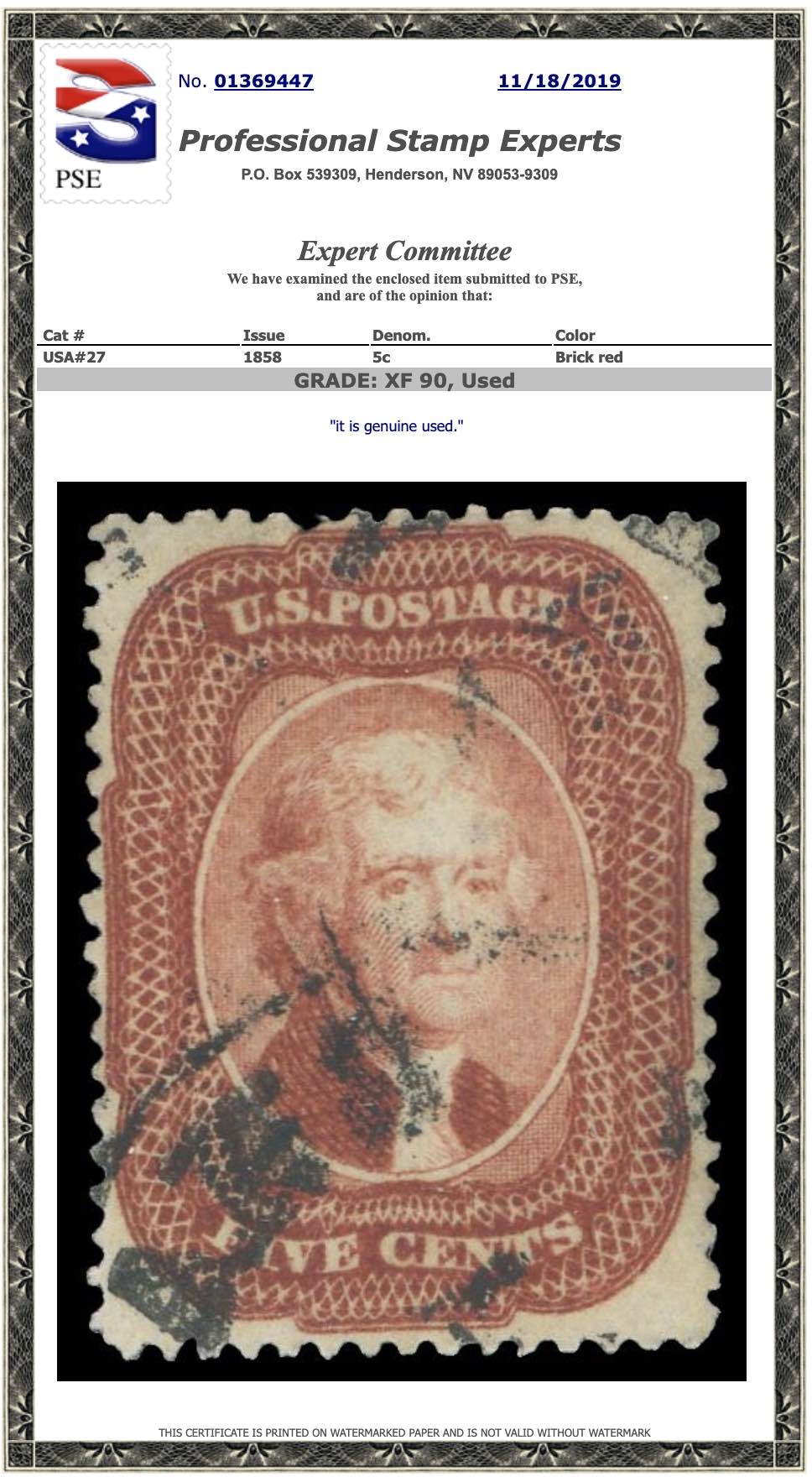
I collect classical US stamps, and in addition to buying directly from various dealers, I participate regularly, via the internet, in many of the major auction house sales. No matter where I buy, I rely heavily on the opinions of the expertizing services before making the purchase of any stamp worth more than $500. I want to first and foremost be aware of any faults that may have been mentioned on all earlier certificates, but I also am interested in the grade that may have been assigned by previous examiners. I may agree or disagree with the latter, but it is an expert's opinion, and I have to take that into account when I decide on the value of the stamp. The problem is that both dealers and auction houses, whether knowingly or unknowingly, may not disclose all previous certificates on the stamp. Considering the volume of stamps that the dealers and auction houses have to deal with, and the time it takes to vet an individual stamp, it is understandable that they can't afford to do it. In addition, only the PF has a searchable database, and although they attempt to link all previous certificates on a stamp, their system relies, at least in part, on submitters making them aware of the existence of earlier certificates. I have found dozens of undisclosed certificates since I began carefully searching both the PF database and previous auction listings on the StampAuctionNetwork. Recently, I've built my own database of PSE certificates back to 2005, and the discoveries I've made astound me. I'll give just one example below to start the discussion, but the real point that I'd like to make is that we need to somehow pressure all of the grading entities to create searchable databases. My example is a #28b listed on HipStamp. I rarely buy on HipStamp or ebay, but I find them sometimes useful just to compare what is available in the market. This #28b caught my eye because it looked very nice for the issue, and it has a PF cert from 2005 and a PSE cert from 1997. The problem is that there is another opinion rendered on a 2014 PSE cert. The seller may not even be aware of the conflicting certificate, but when buying a stamp costing over $4000, the buyer ought to be aware of it.     |
|
Send note to Staff
|
|
|
|
|
Valued Member
United States
363 Posts |
|
|
The three opinions align with regard to catalogue number. Is the problem then that the most recent cert mentions reperforation and the others do not? Do you think the state of the art of expertizing improves over time and so does the ability to identify such faults? Thank you for your post. |
Send note to Staff 
|
|
|
Bedrock Of The Community
12734 Posts |
|
|
And that is in part why everything that I purchase over a certain amount goes on extension at auction and is conditioned on a new cert if it is a dealer offering.
As an example, just about every Siegel non-name auction contains quite a few stamps for sale that were placed on extension and came back with faults noted. They are clearly noted and sold as such and it is a part of doing business. The auction firm can by contract choose to go back to the consignor if a consigned item is not as represented.
This past year I had a few stamps come back with fresh certs noting reperfing, regumming and repairs. They all had certs as sold, some as recent as 2012. It is a pain for sure.
As you noted it would be a tremendous tool to be able to search all certs. |
|
Send note to Staff
|
|
|
Moderator

United States
12330 Posts |
|
|
 The lack of transparency in this hobby is sometimes a bit overwhelming. Don |
|
Send note to Staff
|
|
|
Valued Member
Norway
451 Posts |
|
|
Moderator
United States
12330 Posts |
|
|
Valued Member
Norway
451 Posts |
|
|
Just keep re-submitting until you get a favorable cert?
Don
That does seem to be the lesson - great for the expertizers, and I think part of the reason that the for-profits aren't interested in searchable databases. |
|
Send note to Staff
|
|
|
Moderator
United States
12330 Posts |
|
|
Agreed, this issue has had several threads in the past here. Frankly I would like to see the actual people who influenced the opinion names on each cert. But this idea often gets pushed backed on with justifications like 'few people would be willing to become cert experts'. If certs are simply opinions, I do not fully understand this justification.
I think there is one way to get certifications listed online; if someone start counterfeiting certs and undermining the confidence in the certifying body they would become motivated to publish their databases.
Don |
|
Send note to Staff
|
|
|
Bedrock Of The Community
12734 Posts |
|
|
Those conflicting 27 certs are very disturbing and worthy of a conversation with the PSE. Crap like this hurts the hobby. |
|
Send note to Staff
|
|
|
Valued Member
Norway
451 Posts |
|
|
Rodcam -Those conflicting 27 certs are very disturbing and worthy of a conversation with the PSE. Crap like this hurts the hobby.
I would be very surprised if the PSE would do anything other than remove the old cert from their database. No one would ever be able to find it, and they don't have to explain anything to anybody. Do you really think they want to be held accountable? Another point - #27's this nice aren't exactly common. Don't they have some obligation to look through their own records and database to see if it has been certed before? |
|
Send note to Staff
|
|
|
Bedrock Of The Community
12734 Posts |
|
|
Widglo - Your points are well taken. It would be interesting to see what the explanation was if anybody was willing to offer one which is unlikely. It should be noted that stamps may be resubmitted for reconsideration as per PSE boilerplate. It might be worth contacting that particular dealer and asking the question about the two certs. From my experience he is a straight shooter. |
|
Send note to Staff
|
|
|
Pillar Of The Community
United States
796 Posts |
|
|
it appears that some services make no effort to check their data bases for prior submissions when an item is submitted. imo a dealer/collector can be unaware of prior certs for items, but a service should at minimum review its data base for priors before rendering an opinion.
Don I disagree with you re counterfeiting certs, the hobby has enough bad eggs doing undesirable things now and does not need any additional headaches. Most certifying experts are known to those who care to seek them out and render an opinion based on there references and experience. what a submitter does with certs after receipt is up to there moral or ethical compass. there is no substitute for knowledge in a collectors area of interest. |
|
Send note to Staff
|
|
|
Moderator
United States
12330 Posts |
|
|
m and m,
Please note that I was not suggesting that this should happen, I agree it would be heartburn the hobby does not need. I was only suggesting that if this were to happen the certifying organization would not have many remedies other than giving people a way to lookup a cert to see if it was legitimate. It is easy to make counterfeit certs but difficult to hack/hijack an online database.
Don |
|
Send note to Staff
|
|
|
Bedrock Of The Community
12734 Posts |
|
|
The Plot Thickens I searched for this stamp on SAN database and found it in a Schuyler Rumsey auction without a certificate. Sale 85, Lot 1424 on 4-26-2019. Shows as unsold in the archived catalog but the SAN extended features database shows it selling for $130 plus $20 buyers premium for a total of $150. Not sure which is correct. Schuyler Rumsey notes that the stamp has a "couple tiny thin spots". https://stampauctionnetwork.com/sr/sr8572.cfm#191  |
|
Send note to Staff
|
|
|
Pillar Of The Community
United States
752 Posts |
|
|
This area has been well plowed many times on this board including the recent thread regarding shades on the 24 cent 1861. I don't see an obvious solution to the problem. Competing organizations like competing individuals not uncommonly offer variant opinions on the same problem or issue without concluding that anyone is doing anything wrong or nefarious. But how do you know which opinion on the same stamp to trust? It is only human nature to expect a negative opinion to be hidden or trashed and the stamp being offered for new cert either be accompanied by a clean older cert or no cert at all so as to not negatively bias the new opinion.
Do we really believe that an unused Scott 67 or 70b/70c70d, being offered up as a virgin submission has truly never been expertized in the past? I do however agree that PSE and APEX should put all of their prior opinions on line and that the expertizers names should be listed on the certs as they were on early PSE opinions.
|
|
Send note to Staff
|
|
|
Pillar Of The Community
United States
2555 Posts |
|
|
This is the kind of stuff that set me on the trajectory that I have been on for quite some time now. It is also why I am pretty adamantly opposed to my philatelic property being held hostage by the good people that are in the cert business. One thing that doesn't square very well in this discussion though, is the focus on old certificates. If certificates are so great and so important that collectors have to bow to this defacto philatelic transaction tax, why shouldn't old certificates just vanish? |
|
Send note to Staff
|
|
|
Replies: 78 / Views: 6,985 |
|




 Posted 01/20/2020 11:12 am