|
This page may contain links that result in small commissions to keep this free site up and running.

Welcome Guest! Registering and/or logging in will remove the anchor (bottom) ads. It's Free!
To participate in the forum you must log in or register.
| Author |
 Replies: 169 / Views: 20,410 Replies: 169 / Views: 20,410 |
|
|
|
Bedrock Of The Community
Australia
38679 Posts |
|
|
Quote:
and command a bit of a premium (especially for a full strike).
Coincidentally, I was perusing my duplication, which seemed to highlight the Japanese high standard, of postal clerk use and clarity of Postmark ink. In my minute test set, I figured (due to the stamp size format ) the occurence of a "Full Strike" or, SON "socked on the nose" is less than 6% in pre Earthquake stamps. Most part strikes hit the bottom or lower edges, those that hit higher, would suggest multiple stamps on cover.   |
Send note to Staff 
|
|
|
Pillar Of The Community
United States
898 Posts |
|
|
Rodney, do you think your perfin looks like this?   (Found on ebay. Cropped and reoriented for readability.) |
|
Send note to Staff
|
|
|
|
Pillar Of The Community
United States
898 Posts |
|
|
Bedrock Of The Community
Australia
38679 Posts |
|
|
 See, there are brighter souls than me, here. That's it ! Solved, yet, bearing in mind, it is on a paper fragment, at back of stamp. The punctures do not pierce the stamp. Maybe my suggestion may carry weight, perhaps used on a cheque etc? Nicely solved, you. |
|
Send note to Staff
|
|
|
Bedrock Of The Community
Australia
38679 Posts |
|
|
Bedrock Of The Community
Australia
38679 Posts |
|
|
Philatarium,
I beg your forgiveness, the HSBC Perfin DOES actually impinge on the Earthquake stamp (Under high magnification)
albeit, "Blind Perfs" (Nice oxymoron there)
So, the stamp must have been affixed to some sort of stationery, then PERFINNED at the Bank.
|
|
Send note to Staff
|
| Edited by rod222 - 05/30/2020 12:25 am |
|
|
Pillar Of The Community
United States
898 Posts |
|
|
Outstanding work, Rodney! I greatly admire your diligence. (On this and all the threads you're active in.)
Three tiny remarks about the New Year stamps:
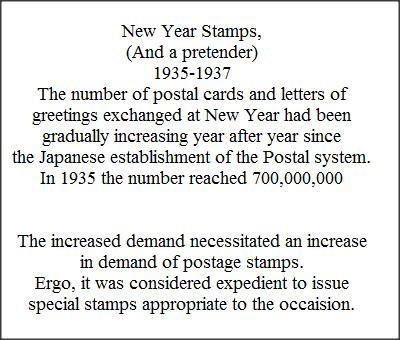
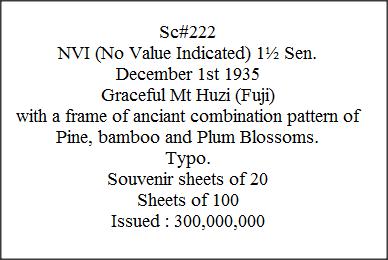
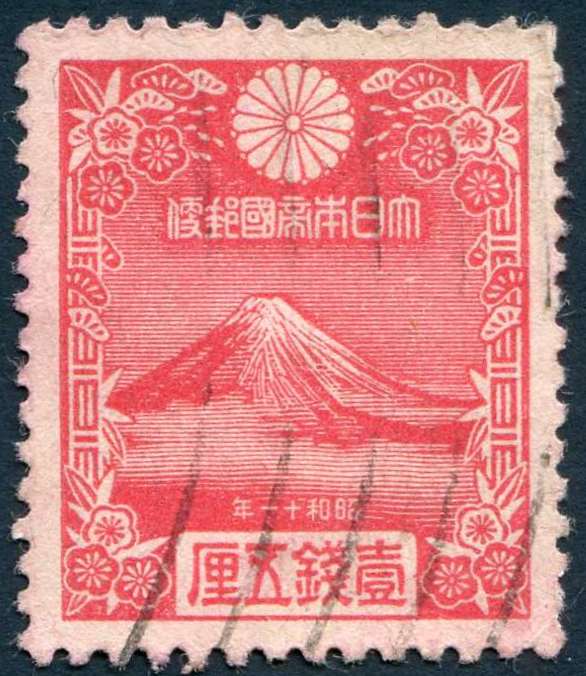
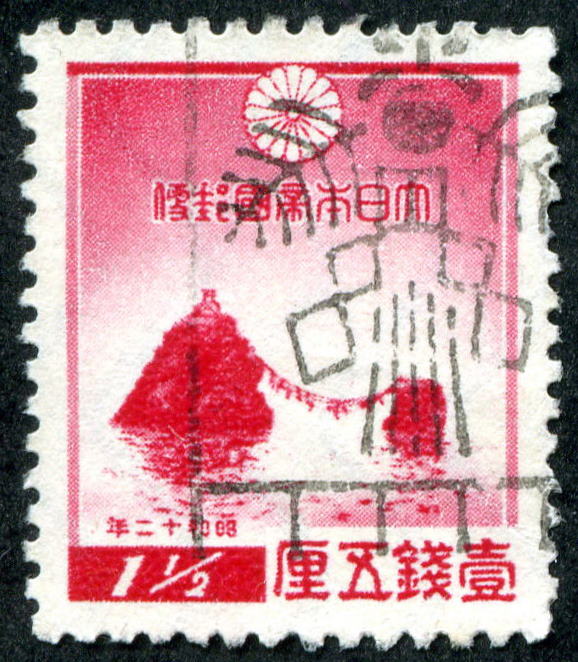
For #222, there *is* a value indicated, just not using Arabic numerals. The value tablet is the writing at the bottom center. From right to left, it reads as "1 sen 5 rin", which is the same as 1-1/2 sen. (The smaller writing above it (not in the value tablet), says "Meiji Showa 11", which would be 1936.)
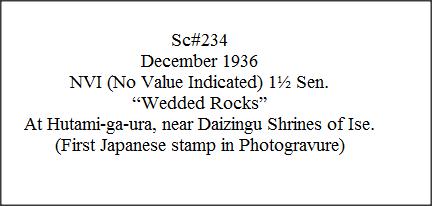
For the second stamp, #234, your write-up says NVI, but the value is there in Arabic numerals. (I imagine that was just a copy-and-paste typo.) (And the smaller writing above it says "Meiji Showa 12", for 1937.) According to the Sakura catalog, the issue date was December 10, 1936.
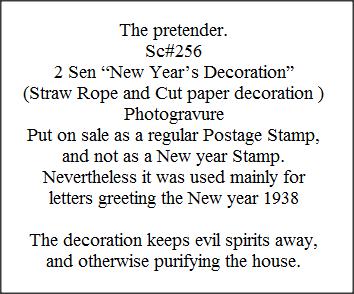
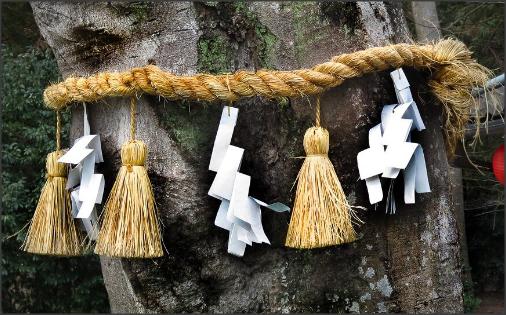
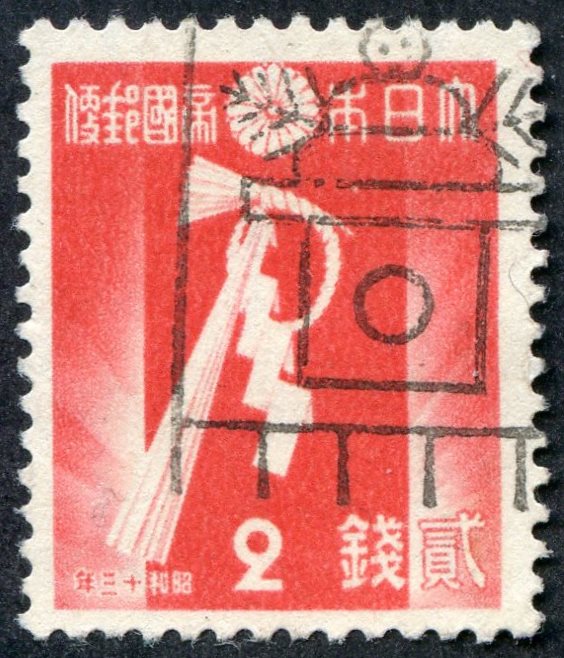
For the third stamp, #236, I didn't know that about being "the pretender". I'm not disputing your source at all, but it is listed in the Sakura as "N3", indicating that it's New Year's stamp #3, and it was issued December 15, 1937, which is about the right date for a New Year's stamp. The small writing on the bottom left of the stamp says "Meiji Showa 13", which is 1938. So it certainly seems like it fits the format of that time for a New Year's stamp. All respectfully submitted, just fwiw. But I had no idea what the design represented, so, as always, it's a learning experience with your posts. Thank you!
|
|
Send note to Staff
|
|
| Edited by Philatarium - 05/30/2020 6:43 pm |
|
|
Pillar Of The Community
United States
1430 Posts |
|
|
A correction to your dating, Philatarium: Your dates according to the Western calendar are correct, but where you've written Meiji, you should have written Shôwa. Shôwa 11-13 are 1936–1938, whereas Meiji 11-13 would be 1878-1880. |
|
Send note to Staff
|
|
|
Pillar Of The Community
United States
898 Posts |
|
|
Oh, God yes, Erilaz, you're absolutely right! (Senior brain, and it's not getting any better. I should make sure I'm in a totally quiet room whenever I make a public post.)
Thank you, and if I can still edit these, I will. Many thanks!!
Updated to add: Fixed, with a strikethrough to show the original error.
Thank you again for the correction! (I may never trust my knowledge again ...) I was doing a little research for someone that involved the Meiji era, and my brain did not refresh, even though I clearly saw the kanji for Showa on the stamps. Grrr... |
|
Send note to Staff
|
|
| Edited by Philatarium - 05/30/2020 6:47 pm |
|
|
Bedrock Of The Community
Australia
38679 Posts |
|
|
Thank you gentlemen, for your corrections and contributions. Taken on board. Quote:
For the third stamp, #236, I didn't know that about being "the pretender". I'm not disputing your source at all, but it is listed in the Sakura as "N3", indicating that it's New Year's stamp #3, and it was issued December 15, 1937, I put it to you, This may be a cross over from vignette design and common usage, to catalogue position (esp in Japanese Catalogues) It seems to me, given the visible "2" for value, and the claim it was issued as a normal postage stamp, then it can lie in either corner, depending on the catalogue producer. My reference is "Japanese Tourist Bureau #30" Yokiti Yamamoto 1940 I also acknowledge I believe he made a mistake with the description of the Earthquake stamps, quoting the "dotted vert. and horiz. lines" were "watermarks" which clearly they are not. Mr. Yamamoto's consulting bibliography.......  |
|
Send note to Staff
|
|
|
Pillar Of The Community
United States
898 Posts |
|
|
I'm thinking that perhaps there was a rate change in 1937. I say that because if you look at the commemorative sets issued in the late 1920's through the end of 1936, they were in the values of 1-1/2, 3, 6, and 10 sen.
The next commemorative sets, issued in 1938, were for 2, 4, 10 and 20 sen. So I think the postcard rate changed from 1-1/2 to 2 sen sometime in 1937. To add to that a little bit, the 3-value semipostal set of 1937 were issued in base rates of 2, 3 and 4 sen.
What may well be true is that that 2-sen New Year stamp was the first commemorative stamp to be issued that paid the domestic postcard rate after the increase to 2 sen.
Admittedly, this is all conjecture, based on some triangulation from those data points.
I aspire someday to purchase the digitized run of "Japanese Philately" from the ISJP, which no doubt would answer all of these questions with some rigor and authority.
Thanks for the great mental exercise, Rodney! |
|
Send note to Staff
|
|
|
|
Bedrock Of The Community
Australia
38679 Posts |
|
|
Quote:
Thanks for the great mental exercise, Rodney! That's what makes our hobby fun, Whom cares who is right or wrong, accurate or otherwise, as long as one carries an open mind, and is willing to negotiate, and accept correction, then the end result is the best result. We all are, relying on others opinions, just in print, but widely used and opined by collectors of all levels of experience. |
|
Send note to Staff
|
|
|
Bedrock Of The Community
Australia
38679 Posts |
|
|
Regarding the "pretender"
Perhaps we consider Scott's advice on the fist issue Sc#222
The stamp had dedicated usage December 1st to 31st for New Years cards.
It only gained ordinary postage use after January 1st the following year.
This may award the stamp as a genuine "New Years Stamp"
The debatable point of the Sc#256 "Issued to pay postage on New Year's cards"
If in fact it can be proved it was also used to carry normal postage of that date, then it is not a genuine New Year's card stamp, per se.
Not earth shattering news, but worthy of curiosity
|
|
Send note to Staff
|
|
|
Bedrock Of The Community
Australia
38679 Posts |
|
|
Guaging the geometrics 1914-1925. A tip I employ, it may be of use to others, if you wish to give it a try. Using offcuts from Hawid Open Top stamp mounts, I cut 2 templates, to indicate 19mm and 22.5mm respectively. It may take a few tries, but once the measurements (on the top edge) are EXACTLY 19mm and 22.5 mm Then one can discriminate easily between the "Old Die" 19 x 22.5mm and the FLAT Plate, v ROTARY plate (Vertical 22mm v 22.5mm) These reside at the front of my Album. (Example, I had 50 to 120 stamps to ID) Just hold the mount with the tweezers and hold against the face of the stamp, squarely.  |
|
Send note to Staff
|
| Edited by rod222 - 05/31/2020 12:42 am |
|
|
Pillar Of The Community
United States
1430 Posts |
|
|
Quote:
I was doing a little research for someone that involved the Meiji era, and my brain did not refresh, even though I clearly saw the kanji for Showa on the stamps. Grrr... I figured it was something like that. I certainly have those moments, too. |
|
Send note to Staff
|
|
|
Replies: 169 / Views: 20,410 |
|
|
To participate in the forum you must log in or register. | |
 China: An Out Of The Question Fake Need Help With Japan Ekcs Japan Scott #51 Or #53 - Your Thoughts On The Road Again - Eye To Eye With The Local Postal Authority Newfoundland Caribou Issue - Prussian Blue? Pottery, Ceramics, Porcelain, And Other Clayware Value Question: Full Sheet, Austria Scott # 840A-H, Issued 5'24'1969. Who Was The Upper Keswick, N.b. Postmaster In 1941 Modern Industrial Art And Design Art & Paintings On Stamps Cover Calendar For Month And Day -Pics Postmarks.day By Day Help Center For Japanese Stamps Cartoon & Comic Characters On Stamps! Indypex 2026, September 18, 19, And 20, 2026 New South Wales Numeral Cancels Nashville Philatelic Society-Your Invitation To Our Meeting Monday, September 14, 2026 Big Blue Album - How Far Along Is Everyone? Pushing 330,000 All Different Worldwide Stamps In One Collection . History And Usage Of Usir "silver Tax" Stamps What Did You Do Philatelically: Today Or Recently? Show Me Your Sports Stamps! Fruits Anyone? Food On Stamps! Chile Casa De Moneda De Chile Philatelic Souvenir Cards Of The 50's And 60's China: An Out Of The Question Fake Need Help With Japan Ekcs Japan Scott #51 Or #53 - Your Thoughts On The Road Again - Eye To Eye With The Local Postal Authority Newfoundland Caribou Issue - Prussian Blue? Pottery, Ceramics, Porcelain, And Other Clayware Value Question: Full Sheet, Austria Scott # 840A-H, Issued 5'24'1969. Who Was The Upper Keswick, N.b. Postmaster In 1941 Modern Industrial Art And Design Art & Paintings On Stamps Cover Calendar For Month And Day -Pics Postmarks.day By Day Help Center For Japanese Stamps Cartoon & Comic Characters On Stamps! Indypex 2026, September 18, 19, And 20, 2026 New South Wales Numeral Cancels Nashville Philatelic Society-Your Invitation To Our Meeting Monday, September 14, 2026 Big Blue Album - How Far Along Is Everyone? Pushing 330,000 All Different Worldwide Stamps In One Collection . History And Usage Of Usir "silver Tax" Stamps What Did You Do Philatelically: Today Or Recently? Show Me Your Sports Stamps! Fruits Anyone? Food On Stamps! Chile Casa De Moneda De Chile Philatelic Souvenir Cards Of The 50's And 60's
Disclaimer: While a tremendous amount of effort goes into ensuring the accuracy of the information contained in this site, Stamp Community assumes no liability for errors. Copyright 2005 - 2026 Stamp Community Family - All rights reserved worldwide. Use of any images or content on this website without prior written permission of Stamp Community or the original lender is strictly prohibited.
Privacy Policy / Terms of Use Advertise Here |
| Stamp Community Forum |
© 2007 - 2026 Stamp Community Forums |
| It took 0.24 seconds to lick this stamp. |
 |
|
|
|


 Posted 05/29/2020 9:23 pm