| Author |
 Replies: 3,825 / Views: 255,677 Replies: 3,825 / Views: 255,677 |
|
|
|
Valued Member
United States
178 Posts |
|
|
Jaxom, I will send IOAGOA a 1200 dpi of the 32L8 to use on Stamp Smarter. |
Send note to Staff 
|
|
|
Pillar Of The Community
United States
637 Posts |
|
|
Hi Moyock13 —
Your "perplexing" stamp that you posted yesterday is an 1857 "D" relief — so definitely a trimmed Scott #26 or #26A.
Regards // ioagoa |
|
Send note to Staff
|
|
|
Valued Member

United States
327 Posts |
|
|
Greetings all. I wanted to check in and see if I am on the right track with this one.  1. No inner lines (Plates 1e,1i,4,6,7,8) 2. CDS with year 1856 (favors later plates 4,6,7,8) 3. TLB not recut (eliminates Plate 4) 4. Bottom frame line more or less faint (eliminates Plate 8) 5. URDB not recut Observations 1-5 are pointing me towards Plates 6 & 7. 6. B Relief 7. No visible guide dots 8. Wide space between left frame line and design (Chase points to the right panes of 6&7). Positions that are B reliefs with no guide dots are going to be on right and bottom margins of plates 6&7. In addition, Chase references two positions with missing LR guide dots on Plate 6 (87L & 87R). So possible candidates are 30R, 50R, 70R, 90R and 91R-100R on Plates 6&7 as well as 87L6 and 87R6. Hopefully I am in the ball park. |
|
Send note to Staff
|
|
|
Pillar Of The Community
United States
939 Posts |
|
|
Hi Harper, I'm by no means any more than a novice at plating the 3 cent imperfs. But this is what I see:
Relatively worn plate or faded stamp.
URT has a single recut vertical line
I concur with a "B" releif
I also concur with no inner lines. However if you take a look at the URT there is a very faint line connecting the URDB and URT, to me would suggest a very faint inner line (maybe). But that makes the URT recut stand out.
Also, since the Lower Frame Line is cut off there could possibly be a Guide dot in the lower right corner.
The OP for this forum does a compression test, takes the image and compresses it down to about 10%. And then compares it to what ever candidate he may have found. For us novices that seems to be an 80% solution comparing the frame lines in that way.
Like I said initially, I'm just a novice and I'm just telling you what I see. I'm sure some of the more knowledgable folks will chime in.
Edit for spelling. |
|
Send note to Staff
|
| Edited by Moyock13 - 11/22/2021 11:45 am |
|
|
Valued Member
United States
178 Posts |
|
|
Good Afternoon Gentlemen. Have a look at this one if you would. Appears to be a possible 1R3, but my question is in regards to the printing itself. Is this what one would call an 'oily' print? Thanks...greg  |
|
Send note to Staff
|
|
|
Pillar Of The Community
United States
2230 Posts |
|
|
Hi Harper1249, I'm working on plating your stamp with the 1856 cancel. That's a pretty nice strike of the 1856 year-date. The 6 in 1856 year-date cancels is frequently blurred and hard to make out, but yours is clearly a 6, and that is nice! Regarding the very faint line connecting the URDB and URT that Moyock13 observed, that line was on the master die, and is visible on many 1851 3-cent imperforates. I have a short-list of candidate positions, including one very good candidate, but the very good candidate has a guide dot. Can you look with a high-powered magnifier and see if you can see a trace of a guide dot at the center of the circle in this image?  |
|
Send note to Staff
|
|
|
Valued Member
United States
327 Posts |
|
|
You're talking microscope kind of magnification, right? I don't have access to one at the moment, but I might tomorrow or Thursday. I tried scanning it at 9600dpi but all I got was a less pixelated blur.  |
|
Send note to Staff
|
| Edited by Harper1249 - 11/23/2021 10:26 pm |
|
|
Pillar Of The Community
United States
2230 Posts |
|
|
Thanks. I was just wondering if you could see a trace of a dot in person, maybe with a loupe or a regular magnifier. The large image you posted is just too grainy in the area where the dot should be. |
|
Send note to Staff
|
|
|
Pillar Of The Community
United States
637 Posts |
|
|
Hi tgswanner —
On your "possible 1R3" — I would lean toward a dry paper impression.
Chase described a "dry paper impression" as follows:
"Dry paper impressions are not particularly uncommon. These show most commonly in the corner stamps of the sheets, because the moistened paper was placed in a pile near the printer, and naturally the edges and corners sometimes became dry while the rest of the sheet was still satisfactorily moist. Poor impressions due to dry paper are ordinarily distinguished by the fact that the ink is not picked up cleanly by the paper, resulting in a very "muddy" impression in which the fine detail is often largely lost. The ink often shows projecting irregularly into the parts of the design which should be entirely colorless, and further white spots appear in portions of the stamp which should show solid, or nearly solid, color."
Alternatively, Chase described an impression with "too much oil in the ink" as follows:
"Occasionally an odd impression is seen which is a little different from that due to dry paper. On these, the color, particularly in the background of the medallion, appears more or less wavy. I had no idea what caused this until one of the men at the Bureau of Engraving and Printing told me without hesitation that it was due to too much oil in the ink which was used. It is difficult to describe more fully the impressions due to this particular accident but they differ from those due to dry paper in that the ink seemingly has been all picked up from the plate."
Of course the dry print and oily print could appear in combination with each other as well.
In any event, based on your scan — and the fact that the top row was at the edge of the sheet — in my opinion, your stamp looks like a good fit with Chase's description of a "dry print".
Regards // ioagoa
|
|
Send note to Staff
|
|
|
Valued Member
United States
327 Posts |
|
|
Quote:
I was just wondering if you could see a trace of a dot in person, maybe with a loupe or a regular magnifier. I looked at it through a 8x magnifier and did not see any color there. |
|
Send note to Staff
|
|
|
Pillar Of The Community
United States
2230 Posts |
|
|
Hi Harper1249, I spent some time trying to plate your 1856 stamp, and I'm having trouble with it, partially because it is a worn-plate impression, but also because of likely post-printing wear that may have altered the impression. The stamp almost certainly is from the right pane of plate 6, and I found eight candidates from R6. The best candidate I found using vertically compressed images to analyze the side frame lines is 61R6, shown below. However, the guide dot should be visible on your stamp where it shows on the stamp from the Chase photo, but it is not. Unfortunately, due to the factors I noted,I have not yet confirmed a position for this stamp.   |
|
Send note to Staff
|
|
|
Valued Member
United States
327 Posts |
|
|
Sorry I'm just now replying. Just coming out of my turkey/ham/stuffing/desert comma. Thanks for working on this one. I looked at it under even more magnification and I'm not seeing any color in the area where the guide dot should be on 61R6. What characteristics are leading you to Plate 6 vs Plate 7 or others? |
|
Send note to Staff
|
|
|
Valued Member
United States
327 Posts |
|
|
Pillar Of The Community
United States
637 Posts |
|
|
Hi Harper1249 --
Just now getting back to SCF after spending the TG holiday with family and grandkids.
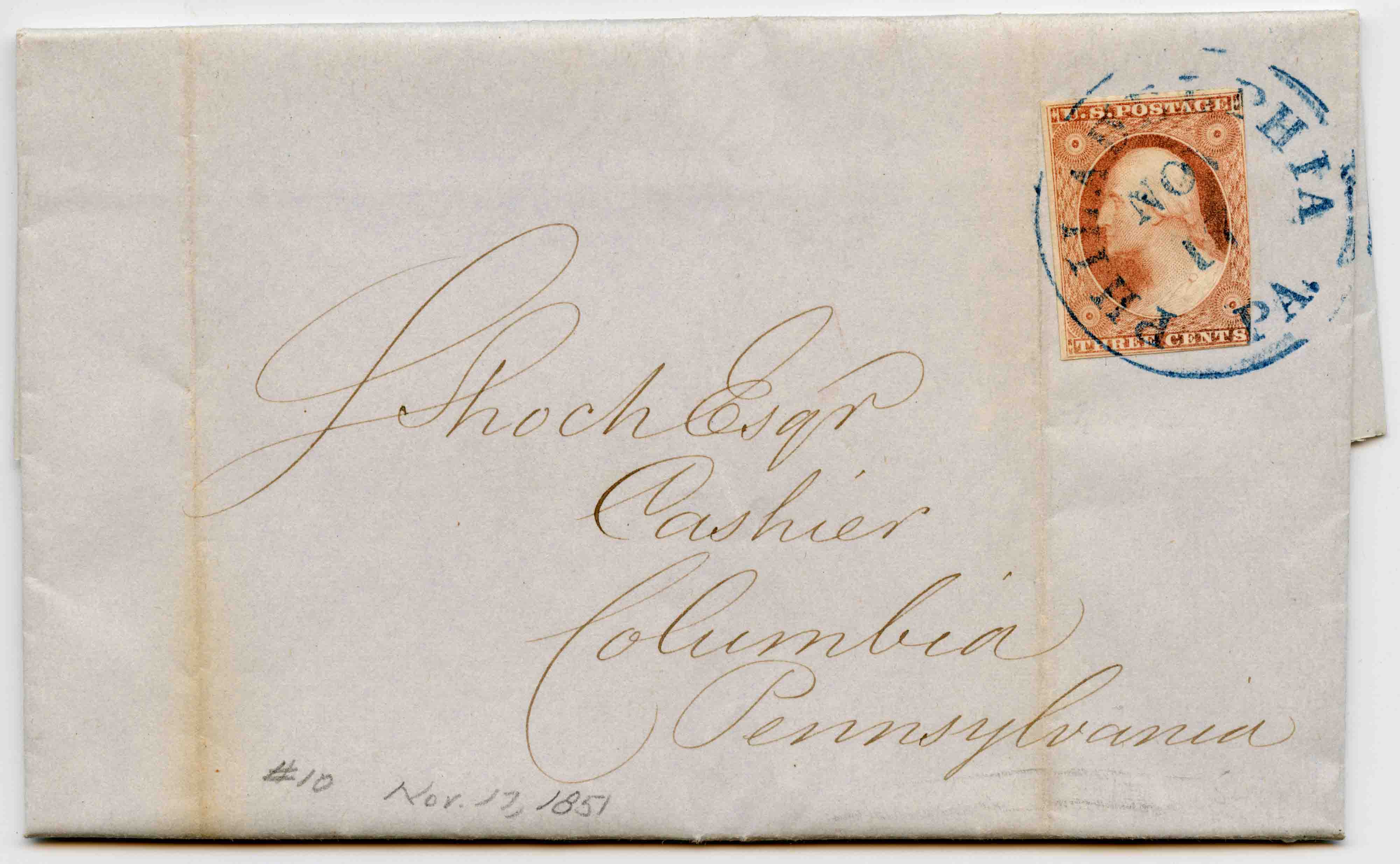
Your folded letter sheet with the Nov 17, 1851 blue Philly cancel is a very nice example of an early printing from plate 1 Late -- as it plates to position 14R1L -- so is a Scott #11A (i.e., despite the pencil notation made by the prior owner).
The stamp itself shows two recut varieties -- First -- the LIL runs up too far -- and Second -- there is a recut line joining the top of the ULDB and upper label block. The position also has a third recut variety -- but because the lower right corner of your stamp is "cut-in", the recut line joining the bottom of the bottom label block and lower right diamond block is not visible.
Additionally, unless the date has changed -- the EKU for plate 1L was 10/4/1851 -- and although impossible to colorize a stamp from a scan, your stamp fits the time frame for the experimental orange browns -- which are a fairly scarce color variety. Again -- impossible to colorize the stamp from the scan -- but it is an EOB candidate that warrants further color study.
Regards // ioagoa |
|
Send note to Staff
|
| Edited by ioagoa - 11/28/2021 12:50 pm |
|
|
Valued Member
Norway
451 Posts |
|
|
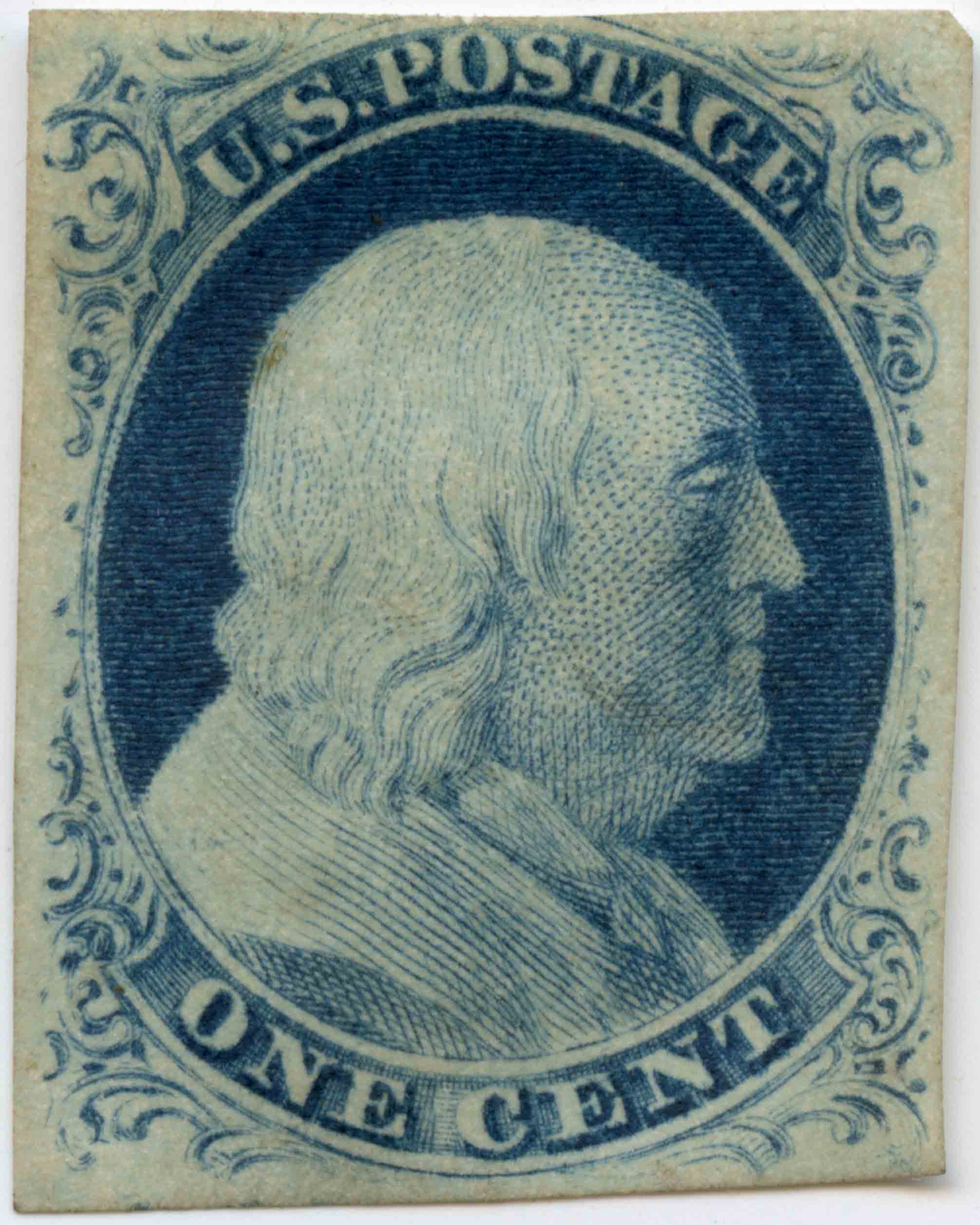
Harper1249 - Your 1¢ Franklin looks like it matches 37L1L best. |
|
Send note to Staff
|
| Edited by widglo46 - 11/28/2021 4:01 pm |
|
|
Replies: 3,825 / Views: 255,677 |
|



 Posted 11/21/2021 2:06 pm