| Author |
 Replies: 3,825 / Views: 255,560 Replies: 3,825 / Views: 255,560 |
|
|
|
Pillar Of The Community
United States
637 Posts |
|
|
Hello Hobsun --
Your scan resolution is still not fully suitable for plating -- but I am fairly certain that your stamp with the black March 23 town cds cancel is position 6R4. If you wanted to try to post a higher resolution scan, I am happy to reconfirm the position for you with 100% confidence.
FYI -- in narrowing down the possibilities -- a couple of comments -- (all of which are discussed in Chase's book):
Stamp has no inner lines recut and does not look OB -- so must be from plates 4, 6, 7, or 8.
Stamp is clear C relief with gash on the shoulder.
BFL looks too heavy for plates 6 or 7 -- so that tentatively leaves plates 4 and 8.
Both plates 4 and 8 have C relief positions across the top row. Plate 4 has no misplaced interpane C reliefs -- and plate 8 only has 1 misplaced interpane C relief (i.e., position 21L8 -- which this is not).
The TFL on your stamp appears to be recut -- which is an important feature for the process of elimination -- as all of the top row stamps on plate 4 had their TFL's recut -- but only one top row stamp on plate 8 had its TFL recut (i.e., 2R8 -- which this is not). So at this point in the process, the universe of possibilities are all top row stamps from plate 4 -- most of which are easily eliminated by comparing the guide dot positioning against your stamp.
Best I can tell, your stamp is a match for 6R4 in all regard. Aside from the GD, one of the most prominent characteristics on your stamp is the white spacing relationship between the RIL and RFL (which is a solid match to 6R4) -- and after that -- all other plating characteristics and white spacings looks "good". As a further confirming feature -- there is a weak spot in the TFL above the G of POSTAGE -- and this is a match as well.
Again -- due to the limitations of your scan resolution, I am 99% sure that your stamp is position 6R4 -- but if you want to post a higher resolution scan, I am happy to reconfirm the position for you and eliminate any bit of doubt.
Regards // ioagoa
(edited to correct grammar and typos only) |
Send note to Staff 
|
| Edited by ioagoa - 03/30/2021 12:38 pm |
|
|
Pillar Of The Community
United States
2230 Posts |
|
|
Hobsun, I agree with ioagoa that 6R4 is the most probable position, but I can't be 100 percent certain.
The next time you're in the market for a scanner, I would recommend the Epson brand for sharper stamp images. |
|
Send note to Staff
|
|
|
Pillar Of The Community
United States
939 Posts |
|
|
Sitting here frustrated (not discouraged) trying to plate a new batch of 3 cent imperfs. Some are obvious (or so I think) some less. There are a few things I have troubles with.
The first is color, my wife might be right about being color blind. I see the different shades, but to identify a shade to a plate baffles me.
Second would be inner lines, trying to determine faint from missing... IDK
This one really shakes my tree. Missing guide dots! A particular example is obviously a top plate position just from the selvage on the top and the fact that I can't find a UR guide dot. Chase doesn't say much about missing GD's except for plates 1(e) and 1(i).
And finally, Double Transfers! Can someone post a few examples of solid DT's? My perception of a DT stems from the 1st issue US revenue stamps where that DT is really obvious. I'm not seeing that in the 3 cent imperfs.
Sorry to rant. I think my success rate at plating is less than 10%, maybe 1 out of 10.
Like I said, I'm frustrated but not discouraged. Thanks for the ear. |
|
Send note to Staff
|
| Edited by Moyock13 - 04/02/2021 09:24 am |
|
|
Pillar Of The Community
United States
3532 Posts |
|
|
Quote:
a top plate position just from the selvage on the top and the fact that I can't find a UR guide dot. This can often be a clue that it may be a 10L or 10R column stamp. Those often do not have guide dots at upper right, due to how the plates were typically entered. Be patient, it will come with time. Learning to plate can be a very fun and interesting journey. There is more to learn than initially meets the eye, but once you get to a certain critical mass of knowledge, things will come faster. |
|
Send note to Staff
|
|
|
Pillar Of The Community
United States
637 Posts |
|
|
Hi Moyock13 -- Great to see you back here !! Quote:
And finally, Double Transfers! Can someone post a few examples of solid DT's? Here are 4 examples of double transfers -- or as Chase prefers to call them "shifted transfers". There is a whole section in the Chase book that talks about shifted transfers -- but in the simplest of terms -- they will always show as ink being where there would normally not be any. Here are 4 examples of obvious shifted transfers -- but in many instances, the shift will be much more subtle. I tried to annotate each of these examples as best I could using Microsoft's "PAINT" image editor with arrows pointing to the relevant part of the stamp -- but alas, my editing skills are not the best. In any event, hope this helps you out a little. Regards // ioagoa 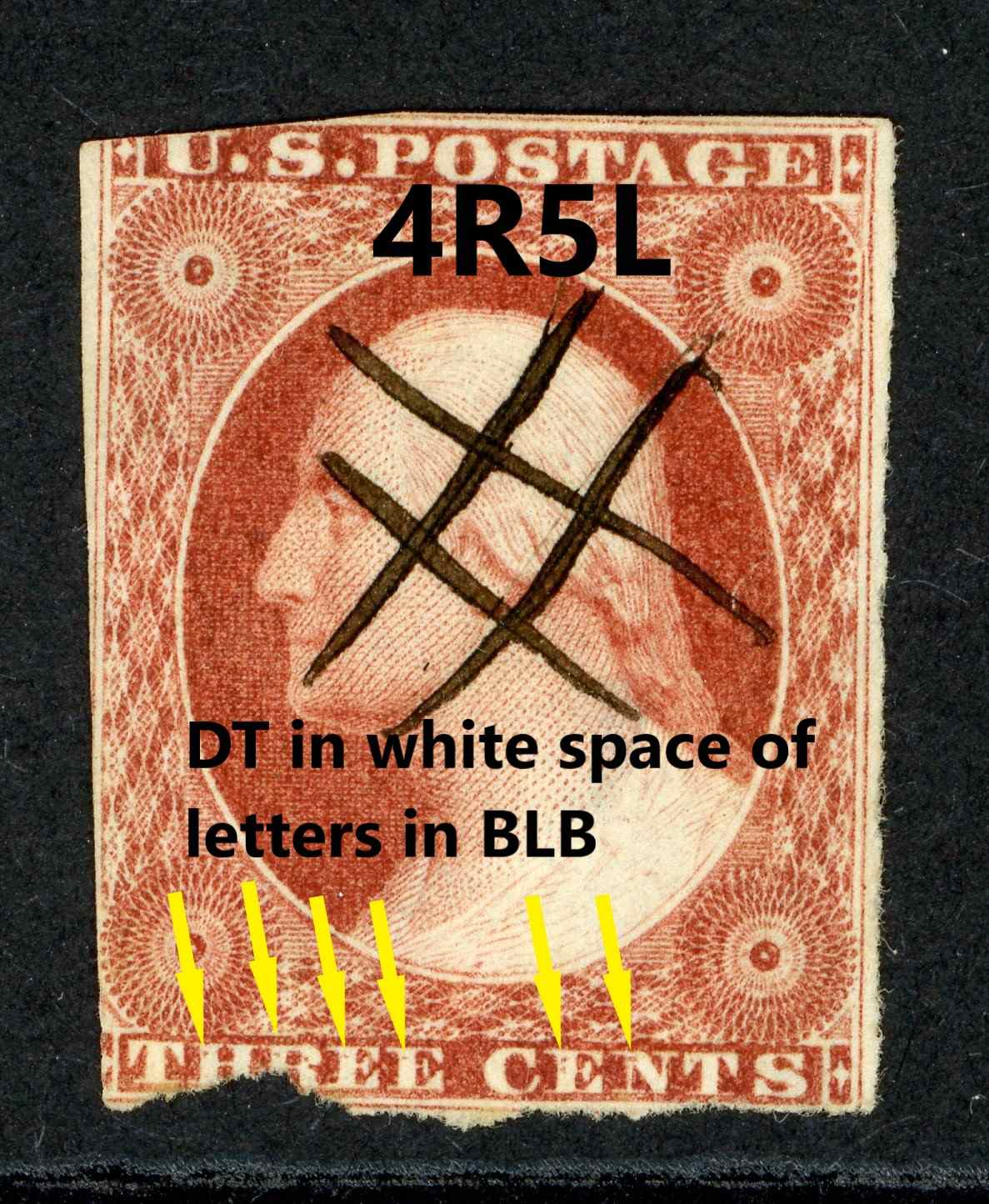 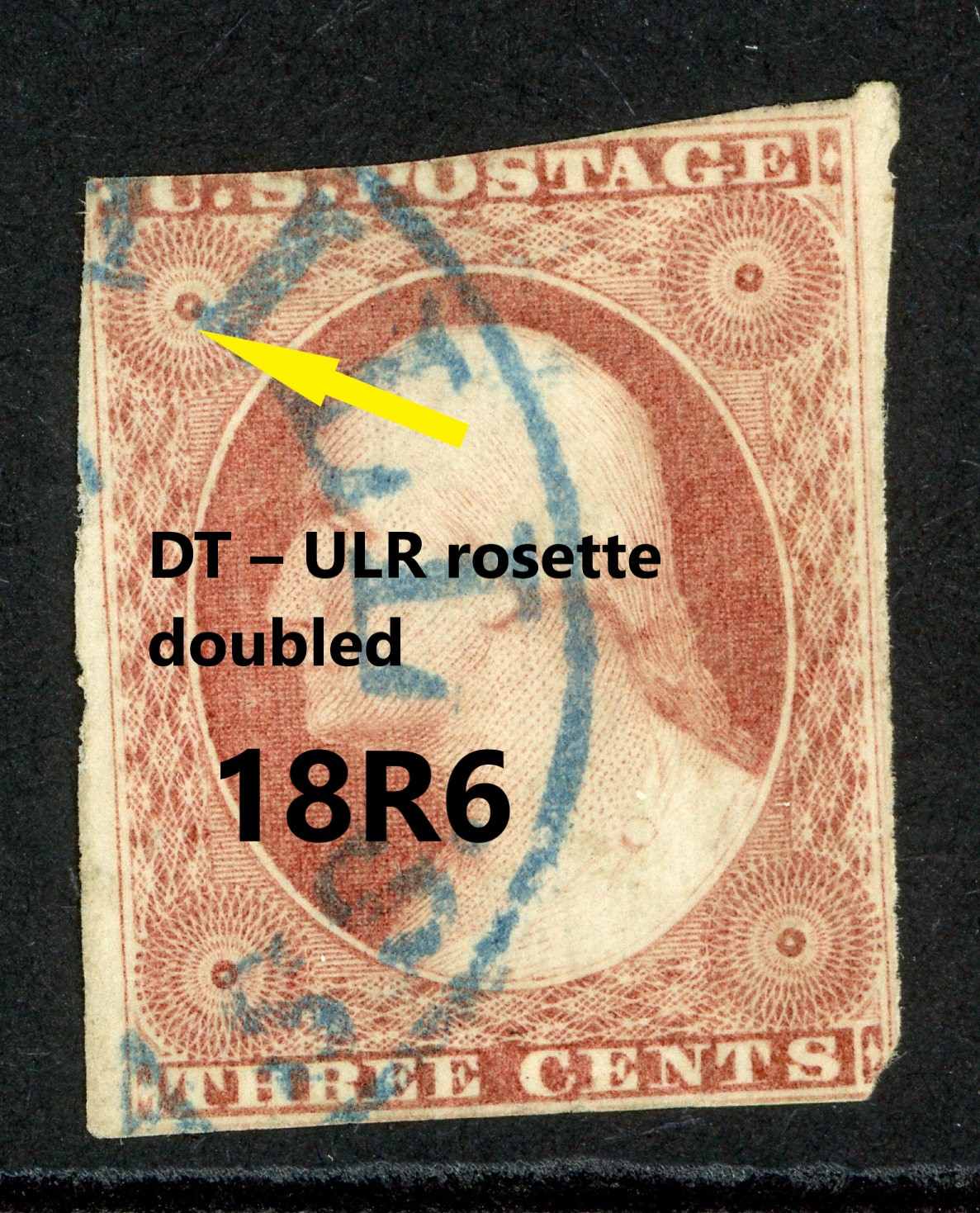 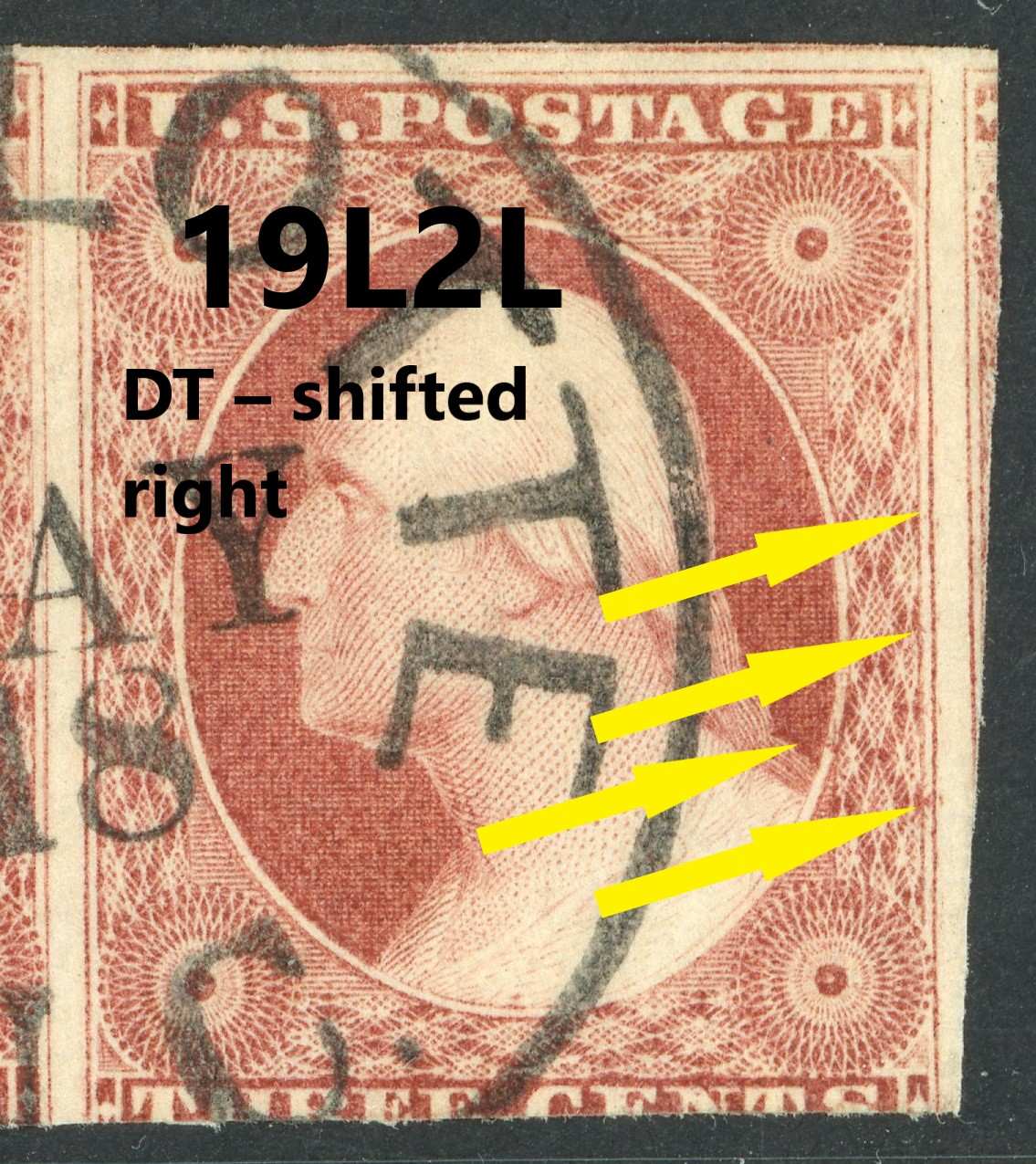 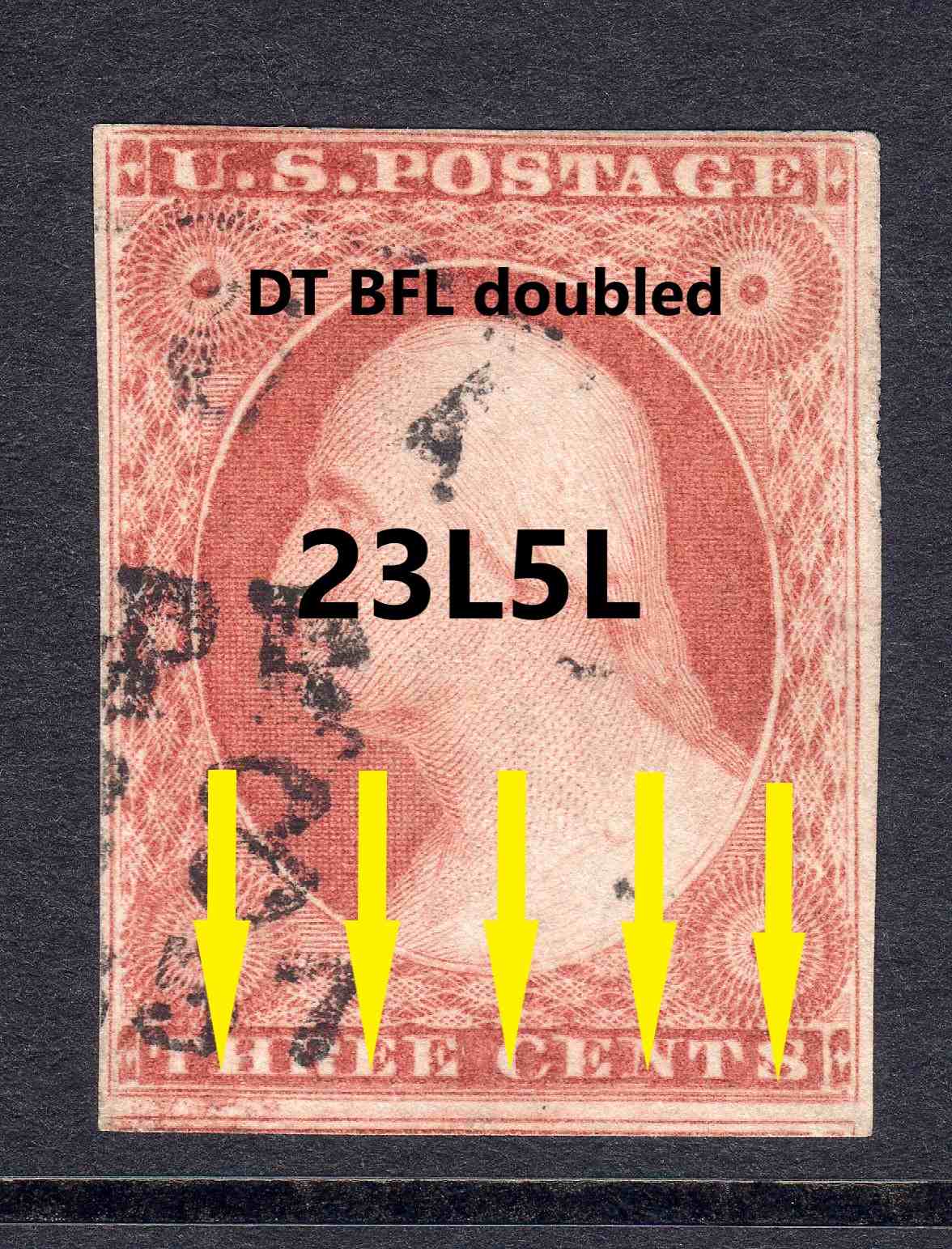 |
|
Send note to Staff
|
|
|
Pillar Of The Community
United States
939 Posts |
|
|
txstamp, ioagoa, thanks. I've been here just lurking. I get pulled in lots of directions related to stamp collecting.
ioagoa, great images of 'shifted transfers', gives me a better idea now. Thank you. |
|
Send note to Staff
|
|
|
Pillar Of The Community
United States
2230 Posts |
|
|
Great post, ioagoa. Those are some excellent examples! Here are two more double transfer examples. These show doubled rosette centers. 92L1L - The "Line Through THREE CENTS" variety:  24L2L:  |
|
Send note to Staff
|
|
|
Pillar Of The Community
United States
2230 Posts |
|
|
Quote:
Second would be inner lines, trying to determine faint from missing... Hi Moyock13, Compressing an image of the stamp vertically can make faint inner lines stand out more. The below 10A Pair (69L1i 70L1i) shows a faint left inner line on the right stamp. The second image was scanned at 2400 DPI then cropped and compressed to 10 percent of original height vertically to help with seeing the faint inner line, which doesn't run the full length of the tessellated area. Something else to be aware of, if you aren't already, is that many no-inner-lines 3-cent imperforate stamps will show a partial inner line near the upper-right rosette, as shown in the third image, which is from position 64L8. This line is a remnant from the master die, so is not considered a recut.  69L1i-70L1i cropped and compressed vertically. The left inner line of the right stamp is lightly cut, and doesn't run the full length of the tessellated area:  64L8 closeup of partial inner line from the master die:  |
|
Send note to Staff
|
|
|
Pillar Of The Community
United States
939 Posts |
|
|
And again, this is why I enjoy this forum so much. You guys are awesome! CC, you've told me that in the past about compressing images and I simply forgot. It's a drag getting old. I just used that trick to validate a 59L3 with double left frame lines. But there's a rub, the cover has two over lapping stamps, the 59L3 is underneath. Haven't identified the top stamp yet, but I'm going to assume it is a plate 3 stamp. So, here's the Mexico NY cover. 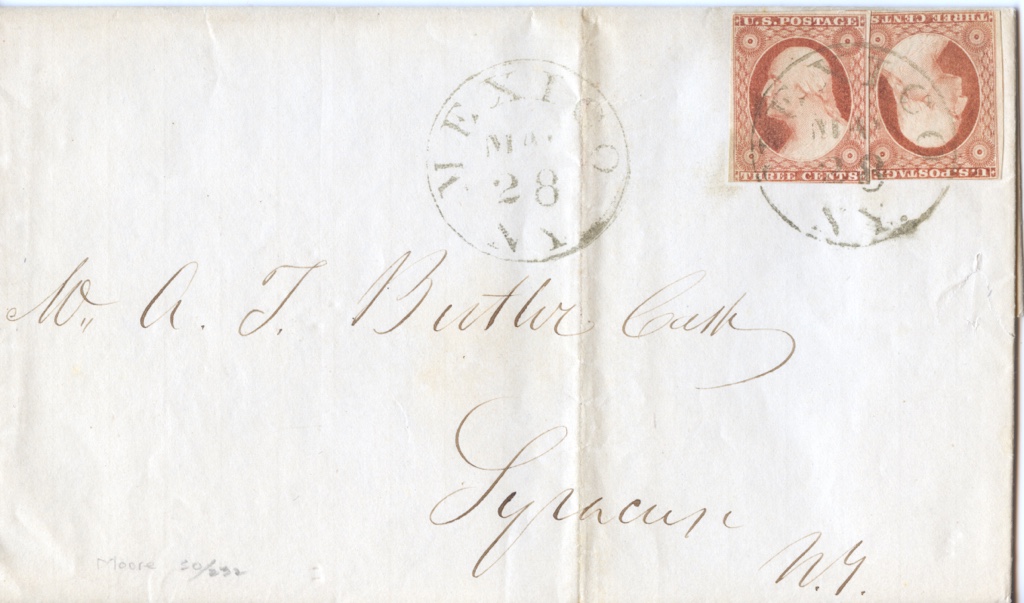 Here are the over lapped stamps. Right hand stamp is the 59L3 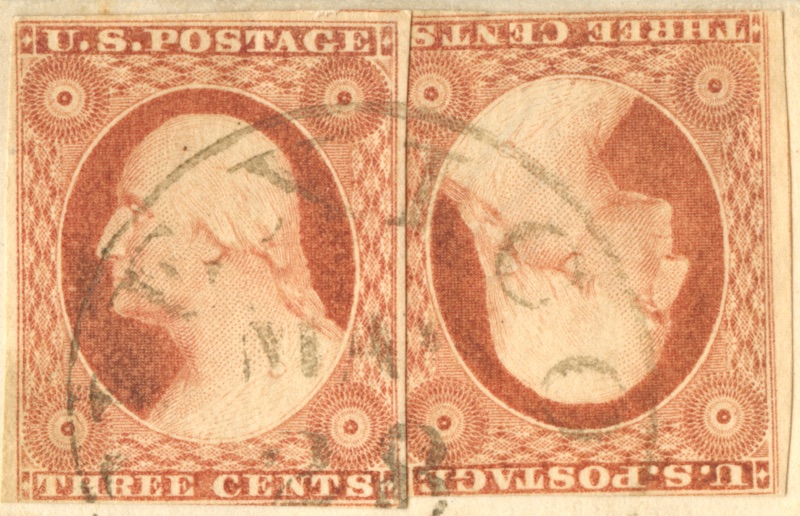 59L3 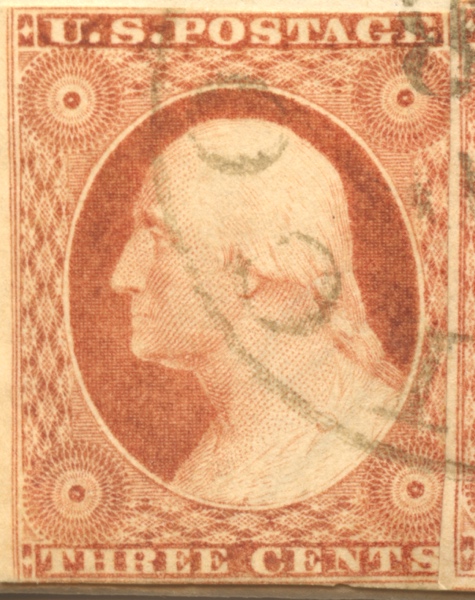 |
|
Send note to Staff
|
|
|
Pillar Of The Community
United States
2230 Posts |
|
|
Moyock13, That's a nice cover with a neat postmark!
Well done, plating the underneath stamp to position 59L3, which is correct.
The top stamp came from the right pane of plate 3, position 26R3. I didn't realize until after I plated it and checked stampplating.com that it has one line recut in the LL triangle (Variety #16), and a guide dot which is partially obscured by the cancel. |
|
Send note to Staff
|
|
|
Pillar Of The Community
United States
939 Posts |
|
|
Nice! Thank you Classic Coins. I had started to look at the 26R3 and was called away for Easter activities. It is an interesting cover and cancel. The cancel is what actually intrigued me. |
|
Send note to Staff
|
|
|
Valued Member
308 Posts |
|
|
Ioagoa / Classic Coins,
Thanks to both of you for your reply to my post early in the week. Sorry for delayed reply. Last Tuesday I had a very scary cardiac event and spent the last 5 days in hospital returning home today. Unfortunately it required some stents to be placed and I will be out of commission for a while. Even working on my stamps will have to take a back seat until I can regain some strength and be able to sit without pain. I will review your feedback in more detail and hopefully continue on my learning journey.
Thanks again.
Hobsun
|
|
Send note to Staff
|
|
|
Valued Member
United States
469 Posts |
|
|
Hobson I hope you are well and on the mend. It's very humbling to be struck down in health. A new appreciation of our lives is often gained. Take care. |
|
Send note to Staff
|
|
|
Pillar Of The Community
United States
2230 Posts |
|
|
Hobson, That's quite alright. Take your time, and take care of yourself. I wish you the best for a full recovery. Thanks for checking in. |
|
Send note to Staff
|
|
|
Pillar Of The Community
United States
2230 Posts |
|
|
I plated this stamp to sheet position 73R8 today. It is a clear printing in beautiful yellowish rose red, and the print quality enabled me to observe a few interesting things: 1) This position has a consistent flaw in the horizontal lines above the lower-right rosette. I haven't seen this mentioned in the Chase book or elsewhere. 2) The stamp has a partial, doubled right inner line running about half the length of the tessellated area. I believe these very thin inner lines are from the master die. 3) The horizontal line extension into the white oval at lower left shows clearly. I've shown this feature before, and as far as I can tell, it exists on all reliefs.     |
|
Send note to Staff
|
| Edited by Classic Coins - 04/13/2021 12:52 pm |
|
|
Replies: 3,825 / Views: 255,560 |
|



 Posted 03/30/2021 11:45 am


