Hi everyone:
I was away today so did not see the several posts. Thanks Sinclair2010 and banknoteguy for your input.
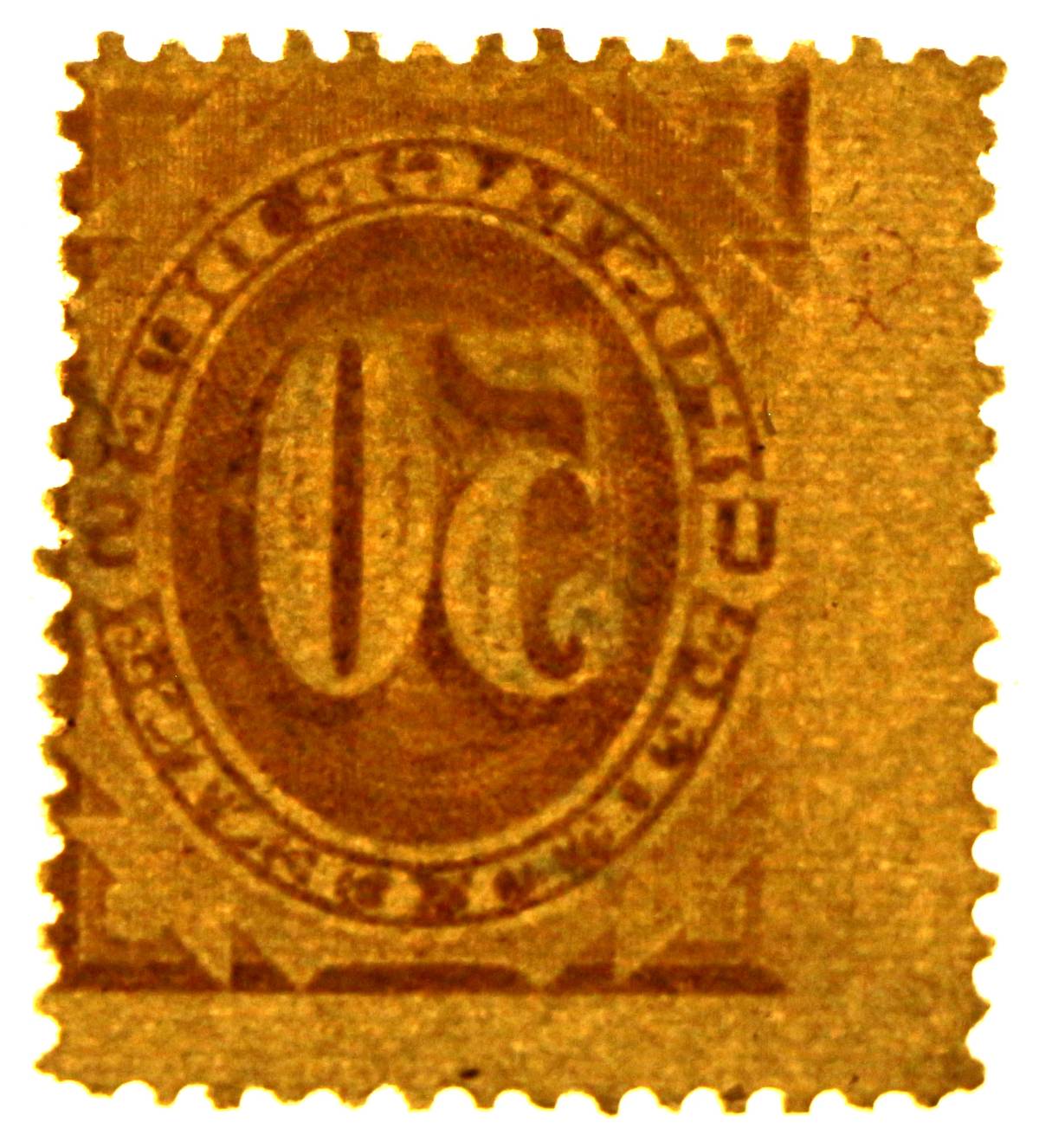
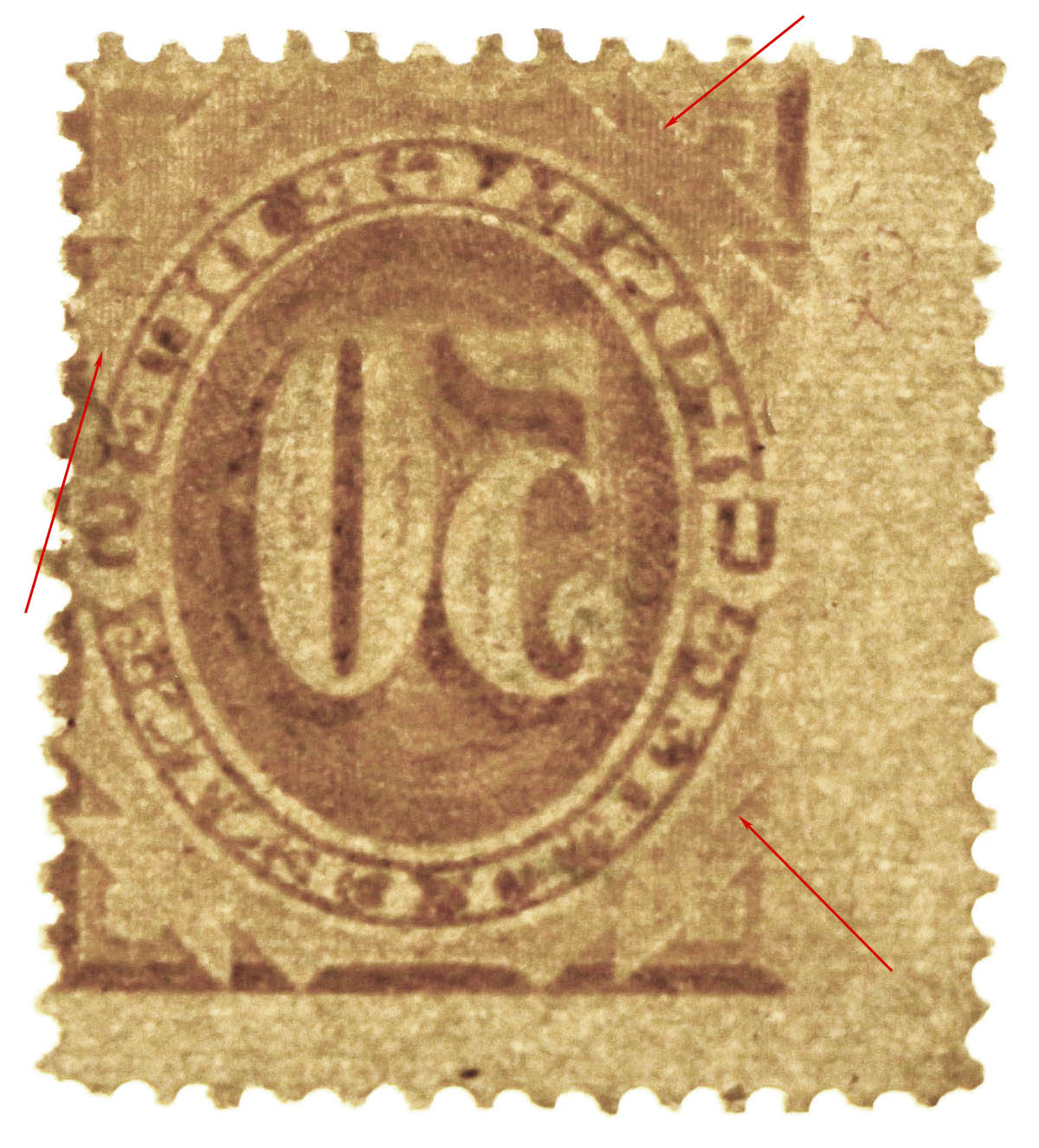
What I was referring to in my prior post was the patterning of the stamp paper resulting in the appearance of horizontal lines. I have loaded my image into Paint and marked off these lines. Being a simplistic thinker I felt encouraged that counting the apparent ribs or lines across the printed design of a stamp might provide a definitive test for differentiating between the ribbed paper mentioned in rlsny's hopeful starting post and the lined paper my J7 is on.
I have marked off the horizontal lines in my J7. I have tried photographing the stamp paper with oblique lighting, but only with a low degree of success.

Sinclair2010, yes, I think what I'm seeing here is an artifact of the mesh used to make the paper. FWIW, the J7 paper pattern I've called "brick wall", because the pattern resembles a brick wall but without obvious diagonal lines. There is another pattern, presumably resulting from use of a different mesh, that produces paper with pronounced diagonal lines--and it is this patterning that is usually used to illustrate soft paper, as in Brookman, Vol II, page 191. Sinclair, I would be most interested in your thoughts here--more than one paper mfgr using more than one mesh? The ribbed paper being produced on a coarser mesh and different yet than either of these? Or the ribs of the "ribbed paper" are produced some other way--not an artifact of the mesh in the paper making process.
It has been immensely frustrating to me that the decision parameters are never brought to one place and laid out in a decision tree. The John Barwis article "Paper Characteristics of US 3 Cent Stamps, 1870-1881" is as good as it gets, and without doing a certain amount of destructive testing to determine paper permeability and sizing, isn't definitive.
The overall experience is something like Justice Stewart's 1964 description of hard core pornography: "I shall not today attempt further to define the kinds of material I understand to be embraced...but I know it when I see it ..."
Certainly the discussion of Bank Note Paper Types in Brookman, Volume II, pages 189 et seq leads you to, and I quote: ". . . knowledge of the unusual papers will gradually come to you as you notice certain copies have characteristics not common to the normal papers." (Page 193, loc cit).
So some kind of process of osmosis is involved. Maybe Justice Stewart and Lester Brookman knew each other!
Help me out, contributors!
BurnsideBob





 Posted 06/23/2020 2:06 pm