| Author |
 Replies: 44 / Views: 5,334 Replies: 44 / Views: 5,334 |
|
|
|
Pillar Of The Community
United States
1565 Posts |
|
|
Funny topic, for me, in that most of my collecting interests are "dead countries ("lost nations")." Former colonies of Portugal and Britain come quickly to mind.
I agree about Newfoundland. I sold the first Newfie collection I had about 30 years ago, and have been building the second for some 16-18 years. While it's not a primary collecting entity, I do belong to the Newfoundland Study Group of the BNAPS, and BNAPS itself. |
Send note to Staff 
|
|
|
Valued Member
United States
83 Posts |
|
|
I wondered if we had folks that exclusively collect non-issuing areas (Dead Nations). I find that fascinating |
|
Send note to Staff
|
|
|
Pillar Of The Community
Canada
1462 Posts |
|
|
I prefer collecting dead countries or countries only during a distinct period - I collect - with varying degrees of focus - French Africa (up to independence), Fiume, pre-USSR Armenia/Azerbaijan, Berlin, Canada (to 1999), Newfoundland and Ecuador (up to 1960). It's actually easier to collect them in many ways - they have a distinct ending date, possible to "complete" a collection & don't have the proliferation of new issue "wallpaper". Many of them are surprisingly inexpensive too. |
|
Send note to Staff
|
|
|
Pillar Of The Community
United States
2830 Posts |
|
|
Quote:
I suppose it depends on the area but is collecting Dead Countries or Lost Nations considered more expensive and harder than ongoing Nations or perhaps less expensive due to limited possibilities? It's likely impossible to assess that question as there are so many variables (and countries). For example, France, Great Britain, USA, Germany, Austria, Monaco, Spain, Portugal, Switzerland, and many others are extant stamp issuers with many expensive stamps to own. Likewise, it depends on how deep you wish to get- face different, shades, perf varieties, paper varieties, etc. The deeper you get, the more expensive a country will become (in most cases). On the other hand Tokelau and Cocos Islands will never be expensive to collect no matter how deep you get. |
|
Send note to Staff
|
| Edited by shermae - 12/17/2020 3:06 pm |
|
|
Valued Member
United States
83 Posts |
|
|
Quote:
On the other hand Tokelau and Cocos Islands will never be expensive to collect no matter how deep you get. I wonder why this is? |
|
Send note to Staff
|
| Edited by MrEd - 12/17/2020 6:02 pm |
|
|
Pillar Of The Community
United States
8622 Posts |
|
|
Because 95% to 99% of their postage stamps sales is thru the Philatelic window to overseas customers/speculators. |
|
Send note to Staff
|
|
|
Valued Member
United States
83 Posts |
|
|
Pillar Of The Community
United States
8622 Posts |
|
|
I collect every "dead " country ,and have a decent showing . I even collect stamps from countries that don't exist {yes that includes "moon postage stamps "},some clown printed up Moon stamps ,they are in my Cinderella collection. |
|
Send note to Staff
|
|
|
Pillar Of The Community
Australia
3299 Posts |
|
|
To complete a simplified New South Wales collection (ignoring BOB issues) will certainly cost a pretty penny.
Taking watermark and perforation varieties into account makes the task all but impossible except for those who are fabulously wealthy. |
|
Send note to Staff
|
|
|
Pillar Of The Community
United States
2830 Posts |
|
|
MrEd- Countries like Tokelau, Cocos Islands, Pitcairn Islands, and many others, first started issuing stamps in the mid- to late 20th century. None have a large literate population yet stamp issues were/are very easy to obtain. Floortrader is correct that most sales are either through philatelic windows, or directly to the trade through agencies.
Barring any major errors no issues from entities like this will ever be scarce or rare. Even major errors would likely have a small audience among collectors. |
|
Send note to Staff
|
|
|
Valued Member
United States
377 Posts |
|
|
I taught for several years at a school with a large Muslim population, particularly Somali. Nice kids. From our conversations about Somalia, I developed an interest in the various pieces of Somalia's postal history - Italian Somalia, French Offices, Somaliland, British Somaliland, Benadir, Trans-Juba, Italian East Africa, etc. It's actually quite interesting.
At one time years ago, I had a separate dead countries collection but have since moved it into my Scott Internationals. |
|
Send note to Staff
|
clay-morgan.com Some philately discussions. Some pontificating.
Member: APS, Haiti Philatelic Society, Scouts on Stamps Society International |
|
|
Valued Member
United States
83 Posts |
|
|
I can't tell you how much geography and world history I have learned in the past week all the while studying stamps. Its crazy fun |
|
Send note to Staff
|
| Edited by MrEd - 12/18/2020 9:31 pm |
|
|
Pillar Of The Community
United States
1565 Posts |
|
|
"....is collecting dead countries or lost nations considered more expensive and harder than ongoing nations......"
Ed: if you want to see a dead country that would be difficult to collect, take a look at Portuguese India, with Scott numbers 1 through 354. Even without including the minor numbers, completing a P. I. collection, until the end in 1961, is near impossible due to issues even finding all those stamps, and then being able to afford them.
Adding to your "fun," forgeries exist of the surcharges on Scott #s 70-112. You'd need certificates of authenticity for the higher priced items. Then, look at #s 113 to 161. The "Crown" issues of all the Portuguese colonies were extensively forged, primarily by Francois Fournier. Same for the overprints. Again, certs are essential for the higher priced items. But you can save time and expense if you can ID the forged "Crowns" on your own. There are several "tell tales."
Next, take a look at the numbering sequence, getting closer to #354, and you will find missing numbers. Supposedly back in the late 1950s, somebody at Scott thought that many of those stamps don't exist and the listings were deleted. You'll see more notes questioning the status of some that Scott still lists. The big surprise is that most of the deleted stamps do exist; I have several in my P. I. collection. However, some of the early 20th century stamps; Scott listed or not; are as difficult to find as many of the early "Native" issues. |
|
Send note to Staff
|
| Edited by Climber Steve - 12/19/2020 11:15 am |
|
|
Valued Member
United Kingdom
363 Posts |
|
|
I'm surprised nobody has mentioned Indian States.
They are a really crazy area to collect, as there are so many different languages and scripts, and so many of them have such primitive production values.
I haven't even started to sort my lot out -- they keep building up, and if I get any more I'll have to do some kind of a sort just to keep the numbers under control.
There's a thread on Stampboards about them that's over a 100 pages long. |
|
Send note to Staff
|
|
|
Pillar Of The Community
United States
1430 Posts |
|
|
Quote:
I even collect stamps from countries that don't exist {yes that includes "moon postage stamps "},some clown printed up Moon stamps ,they are in my Cinderella collection. I enjoy stamps like that, especially if they're relevant to my other interests. I don't have many of them, but I do have some of the Atlantis stamps from the 1930s and some of the Tolkien-themed Shire Post stamps and covers that Tom Maringer produced in the early 1990s. Stamps from micronations are similarly entertaining. I bought a stamp (shown below) from the Archipelago of Tui-Tui, located on a houseboat on Seattle's Lake Union, mainly because of the crazy overprint. 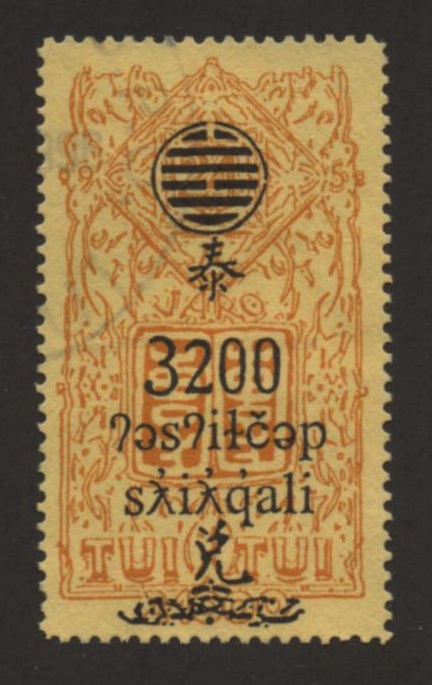 Returning to the actual topic of this thread, my favorite dead country is probably Danzig. I don't actively collect the stamps anymore, but I did buy a couple of postal cards this year. I'd especially love to get a full set of the postal cards issued for the 19th World Esperanto Congress in 1927, but since there are 44 different cards with prices around US $50 or more, I don't expect to achieve that goal soon, if ever. Here's the one that I do have. 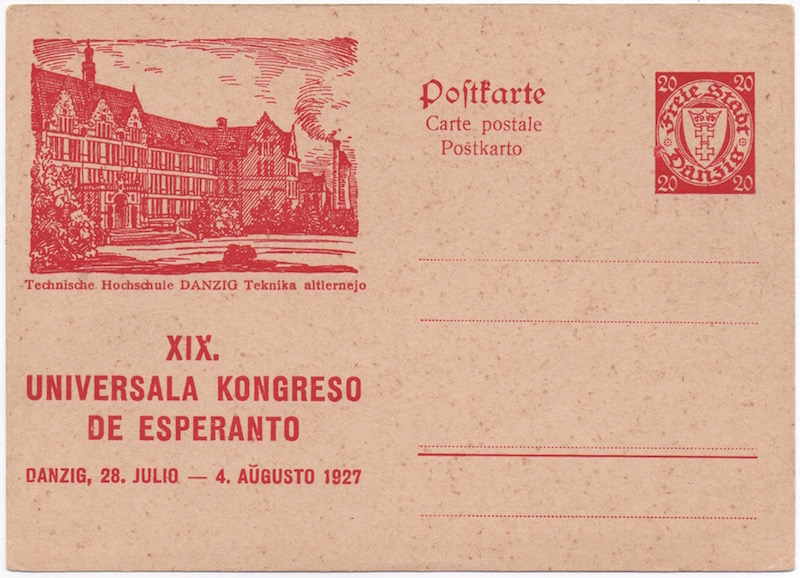 |
|
Send note to Staff
|
|
|
Replies: 44 / Views: 5,334 |
|



 Posted 12/17/2020 10:00 am


