| Author |
 Replies: 31 / Views: 6,155 Replies: 31 / Views: 6,155 |
|
|
|
Moderator

United States
5107 Posts |
|
|
I love a good question and a spirited discussion. Thanks for participating everyone. |
Send note to Staff 
|
|
|
Pillar Of The Community
United States
945 Posts |
|
|
Many of the British Colonies use this type of notation on forms of all sorts. Here is a Red Cross form for civilian communication through the Red Cross in Geneva, printed in Palestine (probably Jerusalem), with a similar number at the lower right.  Here is a close up of the printing lot code:  I interpret this to say that a lot of 10,000 of these forms was printed on 14 Oct 1944. I can only guess at the "G.C.P." but it probably indicates the location where these were printed. I have a series of these forms from Palestine with a series of different quantities and dates. Here is another one, showing 50,000 were printed on Jan 16, 1943...  I have seen this type of code on some USPOD forms used in the later 19th century, but can't put my hands on an example at the moment. If I can locate on in the next few days, I'll post it. Mike |
|
Send note to Staff
|
|
|
Bedrock Of The Community
Australia
38679 Posts |
|
|
Further Response (For the record) from the Postal Stationery Soc
No worries Rodney.
For what its worth, my guess is that the envelopes were printed by the PMG Dept and distributed to Departments by them. The only way I could imaging you could get a definite answer would be to consult the Commonwealth PO archives which may be help in the Commonwealth archives Dept in Melbourne and look for some sort of invoice, or correspondence.
Probably a long shot.
I have seen Permit numbers on PO printed envelopes for Permit mail but that's a bit different. The period I collect is post 1913 -State free mail but there were no such markings on those covers, just the name of the Dept and 'Free Mail" endorsements.
Cant think of anyone who would have a definite answer
Best regards,
Pete
|
|
Send note to Staff
|
|
|
Pillar Of The Community
Australia
937 Posts |
|
|
Bedrock Of The Community
Australia
38679 Posts |
|
|
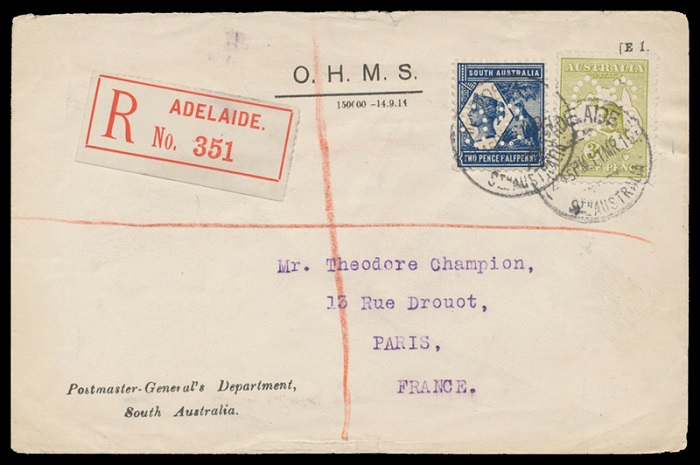
Great! Thanks FDS, we have just about cleared this up  Your cover, Monsieur Champion........  Surprised the addressee was not recognised ! $750.. whew!  |
|
Send note to Staff
|
| Edited by rod222 - 04/05/2021 05:27 am |
|
|
Bedrock Of The Community
Australia
38679 Posts |
|
|
Further response from the Australian Postal Stationery Society Personal Opinion, but which confirms my thoughts right from the start. What was missing, was the cost of every envelope, This now makes even better sense ! quote: I should have added that (as a long-time officer in the Australian Public Service) it is significant that OHMS mail envelopes had a value, 2d in this case, as the surface domestic mail rate was 2d per oz at this time. As such, the envelopes would have been considered as "Accountable" items. Their production, issue and use would have been subject to internal and external audit. Its no different to a 2d Postal Stationery envelope for instance in terms of value and accountability requirements. While an individual envelope is not worth much, a consignment of 5,000 would be worth more than £41 in 1932 The Post Office would have needed some means to identify these items hence the reason for the code . It may have served other purposes but one purpose would be to identify these items. Their production and issue would have been recorded and accounted for without any doubt. This is not dis-similar to the management of postage stamps of a similar value which were again recorded and accounted for at every stage of their journey from printer to Head Post Office to end user. While I have no concrete evidence, this need to identity and record would be standard practice in Australian Commonwealth Government departments for any item of value. It is basically public money after all. great question Partime  PS Thanks to the Australian Postal Stationery Society, for responding and assisting a non member. PS Thanks to the Australian Postal Stationery Society, for responding and assisting a non member.
|
|
Send note to Staff
|
| Edited by rod222 - 04/05/2021 05:47 am |
|
|
Pillar Of The Community
6364 Posts |
|
|
Rod,
No offense, but your Australian Postal Stationery Society guy is giving you garbage. Mike and I and now fairdinkumstamps have given plenty of examples to prove this is nothing more than a printing quantity and a date. The fact that there are examples from the Boy Scouts, letterheads from Canada and on blank forms demonstrates this has nothing to do with accountable paper either - the cost is not relevant. I get the impression the APSS guy had not read this thread? |
|
Send note to Staff
|
|
|
Pillar Of The Community
United States
7105 Posts |
|
|
I now like 10,000 items printed June, 1932. I wonder how many of those markings I've seen and never contemplated? |
|
Send note to Staff
|
|
|
Moderator
United States
5107 Posts |
|
|
This one was well hidden under the cancellation. I wonder if some others are hidden under the put-Stamp-here box? |
|
Send note to Staff
|
|
|
Pillar Of The Community
Canada
877 Posts |
|
|
This is a question I asked back in the late 1950s when I worked for the GPO on the UK. Just about every printed piece of paper had this type of notation. The answer I got was, as previously suggested, the quantity or items printed, the date of the contract and the contract number or printer ID. The main purpose was for quality control purposes: faulty printing could be checked back to the printer and, if necessary, the batch located and returned. Here's an example of this on a notebook from 1947.   And the line from another notebook of the same type.  |
|
Send note to Staff
|
|
|
Pillar Of The Community
6364 Posts |
|
|
Itma,
I agree. Yours has quite a bit of additional information.
Coding is useful for many reasons, both looking backward and forward. Things like order numbers, item numbers, which edition, etc.
I suspect the "TE 201" on the Bunbury Technical School envelope on the first page is an item number. So easy to submit an order for 10,000 more of item TE 201. The printer would know exactly what it was. |
|
Send note to Staff
|
|
|
Pillar Of The Community
India
557 Posts |
|
|
 That APSS guy is dumping trash on Rod. 10M is the printing quantity and 6.32 is the date of placement of the order to the printer. |
|
Send note to Staff
|
|
|
Pillar Of The Community
India
557 Posts |
|
|
Here is an example of printing informations printed on a Br. India 1942 Forces Air Letter Card [Lee type IB sub-type 1/Lang ALS1 (ex-FL1)]. 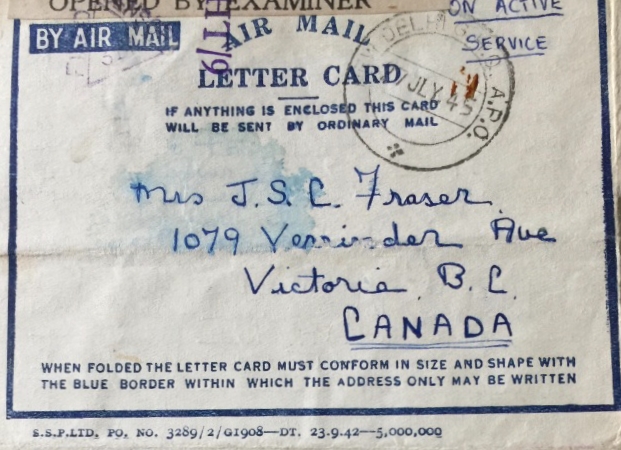 Description of the Printing Information Description of the Printing Information: 1. Initials of the Printer: S.S.P.LTD.(Shri Saraswati Press Limited, Kolkata) 2. Forces Print Order Reference: P.O. No.3289/2/G3. Order No.: 19084. Date of the Placement of the Order: 23.9.425. Quantity Ordered: 5000000 |
|
Send note to Staff
|
|
|
Pillar Of The Community
France, Metropolitan
3756 Posts |
|
|
Whether it is the long or short OHMS it seems strange that 500000 or
50000 thousand envelopes printed with the code so few have survived.
And what about the majority of envelopes that one can find that don't carry a code? (Australia envelopes).
|
|
Send note to Staff
|
|
|
Bedrock Of The Community
Australia
38679 Posts |
|
|
Quote:
Rod,
No offense, but your Australian Postal Stationery Society guy is giving you garbage. No offence taken , John. as long as the verbiage is dignified, I have no issue. I still respect Pete's contribution, it may be incorrect, but there is his personal input, from his experience. I value that in the context of the to and fro of the debate. (I sent him the link to the thread, not aware if Peter read it) I have rather enjoyed this thread, fascinating to see all opinions. which, generally leads to a firm and correct conclusion. Being "right or wrong" just clouds the views from differing angles. PS: Thanks Frank (Itma) for your contribution, really good info
|
|
Send note to Staff
|
| Edited by rod222 - 04/05/2021 9:53 pm |
|
|
Replies: 31 / Views: 6,155 |
|




 Posted 04/04/2021 10:49 pm