|
This page may contain links that result in small commissions to keep this free site up and running.

Welcome Guest! Registering and/or logging in will remove the anchor (bottom) ads. It's Free!
To participate in the forum you must log in or register.
| Author |
 Replies: 55 / Views: 5,384 Replies: 55 / Views: 5,384 |
|
|
|
Pillar Of The Community
1366 Posts |
|
|
Western Europe was where much of stamp collecting began, and it began there (as well as in the U.S. about the same time) because there was a middle class with both money to spend and some time in which to enjoy a hobby. It's the same thing that spurred amusement parks, bicycling, sports, and other hobby-like interests. If you add the attraction of a hobby that appears to be a kind of "investment" that made collecting stamps even more popular -- even though probably 90% of stamp collections were no such thing, most collections being merely cheap stamps worth little. Still, you could imagine you were investing and the people who might criticize you for "wasting" your time and money might think it was an investment. Better for father to spend money on stamps than on beer at your local bar or pub. Better stamps than gambling, old cars, or other things, or so most people would think.
When these factors -- extra money, free time, and the lure of a "serious" hobby that appears practical -- all come together, you have growth in collecting stamps (or coins or whatever appeals to people).
It also helps if there are other factors. A moderate climate helps. If your country is in a tropical zone with lots of humidity, good luck collecting stamps which will get mildewed easily and stick together unless you engineer a dehumidified place to store your stamps (not cheap for most people). So a temperate climate makes for greater likelihood of collecting stamps, hence Western Europe and the U.S. again but not so much sub-Saharan Africa or Southeast Asia or tropical South America.
Also, just as you can't live in a country with an economic system that isn't producing a large middle class in a growing economy, you also aren't likely to collect stamps in an unstable society with social unrest, unstable governments, or war. That rules out a lot of the world, also. It's hard to organize the means to collect stamps in a society that is unstable. How do you deal with no place to buy stamps, inadequate mail services, fear of crime, and so on? I imagine there aren't very many stamp collectors in Afghanistan -- and there weren't many in China until recently due to instability, war, and so on. In unstable societies, just as in poor societies, you're probably just too focused on survival and safety to have time or energy to collect things.
So I think collecting hobbies like stamps are somewhat of a hothouse flower that needs the right climate in which to prosper. In the 1960s Japan became a prosperous and stable middle-class society and stamp collecting grew there.
China took a little longer, but today "investing" in stamps is a fairly big thing for many Chinese people who believe their collections will help stabilize their personal economic futures.
South Korea, Thailand, maybe some prosperous Middle Eastern countries like the UAE may also have a growing number of collectors. The most stable southern African countries are probably Malawi, Botswana, Namibia, and South Africa (well until recently in that last one!), so they might develop collectors, as well.
A number of Latin American countries meet the requirements, too -- Uruguay, for one, Argentina, Chile, Ecuador, mabye Brazil, possibly Mexico if it gets its narco trafficking problem under control. Or maybe they already have a growing number of collectors. Local stamp shows is one way to notice this happening.
And one final thing -- a conservative stamp-issuing policy without flooding the market with junk seems to encourage local collectors to buy stamps. And if those stamps are actually about the country and not Princess Diana, Elvis, or other unrelated topics, people seem more likely to see stamps as a good and practical hobby to get into. A flood of wallpaper does the opposite -- unless you have a very large stamp-buying public, and perhaps even there, as well. China may kill the golden goose (Japan, too) if it continues issuing enormous numbers of stamps. Some of the above African countries do a far better job of limiting their stamp issuance. Just as the United Nations shot itself in the foot with its endless flag series, too many countries work against encouraging collecting their stamps by adopting thoughtless issuing policies. Not too many people collect Equatorial Guinea the last time I looked.
|
Send note to Staff 
|
| Edited by DrewM - 08/23/2021 03:55 am |
|
|
Pillar Of The Community
1366 Posts |
|
|
As for albums, if you're expectation is that a nation can only be collected in a preprinted albums with boxes for each stamp issued, you'll find a lot of agreement about that in Western Europe and the U.S. but not so much in other countries. Early U.S. and British collecting was done primarily in blank page albums, and in Britain even today, albums with quadrille pages are still very popular. Less so in the U.S. where we use preprinted albums mostly.
There were (maybe still are) Japanese preprinted albums for sale in the 1970s and 80s, but they were small multi-volume ring-binder albums long before people in the West began using such albums, so they would have seemed less appealing I think to people in the West. I've seen one or two Chinese albums that look similar. Some have blank pages. Other collectors use stock books and simply put stamps, chronologically or not, behind the glassine or acetate strips and call that their "album". With the price of stamp albums these days, I don't see why more collectors don't do this. Collecting Iceland or maybe Ireland in a preprinted album won't bankrupt anyone, but a lot of other countries will cost thousands of dollars to collect in albums by Lighthouse, Schaubek, Marini, or Davo. Fortunately, Scott makes good albums for a lot less, sometimes a quarter of the price of European albums.
So not only are their necessary conditions for stamp collecting to prosper, there area also varieties of collecting in different parts of the world, and some of them might not seem appropriate to us -- use of stock books, maybe, or just putting stamps into glassine envelopes or other methods that don't involve "real" stamp albums. But it's still stamp collecting.
Scott has abandoned some of its earlier albums, but maintains a pretty decent worldwide variety of stamp albums. They even publish an album for Namibia, and I have one. I had to make my own Tunisia album, though. I think Scott only issued pages for Tunisia as part of its French Africa album. I had those pages, butI wanted to collect beyond Tunisia's independence. The same for Morocco and Algeria. I have an Egypt album I've cobbled together using the photo-copier and some creativity because Scott discontinued its Egypt album. And I've got a Zambia and Botswana album made up of various pages printed on Scott paper. All I need are some stamps! Also Malawi which Scott used to have an album for, but I think they stopped that one, as well. For Malawi, I'm well fixed for stamps. Malawi had a moderate stamp issuing policy, at least until fairly recently. Congo also went fairly berserk in recent years with a flood of nonsense stamps. When one of "my" countries does this like these two, I stop collecting them at that point.
Some methods of making your own albums using Scott Specialty binders and blank pages:
1. Photocopy the smaller Scott International album pages onto larger size all-blank (meaning no border) pages to use in the Specialty binder. To do this, you will have to get all-blank paper, of course, in Scott Specialty size. AlbumPages(dot)net sells this, but local print shops can probably make these pages, too, but be sure to ask about hole punching. The blank album pages from this online supplier will already be hole punched. So some print shop must be doing that! Some minor adjustments on the photocopy machine will be needed to get layouts to line up correctly, but it can be done reliably page by page. Patience!
2. Print Steiner page layouts onto blank Scott Specialty paper or your own all-blank or bordered paper. If you save Steiner pages into Word by using one of a number of programs, you can then delete the borders. Print the borderless page layouts onto any paper you like, even onto bordered album pages. Or buy already-printed Steiner pages in the larger Scott Specialty sizes from the same website. These will have Steiner layouts and Steiner page borders (which I find dull) but will fit Scott Specialty binders perfectly. You can have a Scott Specialty album for any country in the world. Amazing.
3. Photocopy any other album pages you happen to have (Minkus or whatever) onto all-blank Scott Specialty size paper. I did this with some Minkus album pages I liked. Cutting off page borders (a paper cutter works best) would even allow you to print these onto bordered paper if that appeals to you.
Especially where an album maker like Scott no longer makes an album you want (or never did), making such pages for your own home use seems likely to be ethically acceptable (like duplicating software for home-only use). But they could not be sold, of course, with someone else's page layouts on them.
Otherwise, blank or quadrille pages in a good album binder will work just fine. It just takes some "getting used to" if you're used to preprinted albums. You can border your stamps by hand or let stamps mounts be their borders -- or just mount them with not borders at all. I have one blank album (for early Austria) where the collector mounted each stamp, then carefully drew two sides of a border around each stamp using a ruler. The effect is good, like a "shadow box" rather than a complete border, and fairly easy to do. There are 90º straight edge rulers that would make this very easy to do -- just two strokes of an ink pen -- for people who dislike stamps just "floating" on the album page without boxes (like me).
Have fun. |
|
Send note to Staff
|
| Edited by DrewM - 08/23/2021 04:28 am |
|
|
Pillar Of The Community
United States
4506 Posts |
|
|
I am sure there is not much demand for pre-printed albums because they often require a upfront significant outlay. Even at Amosadvantage, many of the Scott US National products are listed as on backorder so demand must be down to always have them in stock. The availability of more DIY options (self produced or Steiner) provide alternatives.
The only seller I have seen to actively market a worldwide selection is Palo Albums.
|
|
Send note to Staff
|
Al |
| Edited by angore - 08/23/2021 07:47 am |
|
|
Pillar Of The Community

United States
890 Posts |
|
|
Quote:
I am sure is not much demand for pre-printed albums because they often require a upfront significant outlay. Even at Amosadvantage, many of the Scott US National products are listed as on backorder so demand way down to always have them in stock. The availability of more DIY options (self produced or Steiner) provide alternatives. Which begs the question of why the major pre-printed album makers have not gone to the POD model (print on demand), as opposed to carrying items "out of stock" for so long... It does increase average cost per unit, obviously - but this cost is passed on to the end user. The POD model has revolutionized the self publishing industry. The model is simplicity itself. The customer orders the product at a price where the profit is built in. The publisher then produces the order (the book, if you will), does quality control and ships it to the customer. As long as the high quality of the product is maintained, the customer could care less the method of production, and the extra production time. I could see some special problems with stamp albums being produced using the POD model, but I have wondered why it is not the norm... The POD model solves nearly all of the demand problems - no stock of albums needs to be maintained or distributed. When an order comes in, you produce it and ship it out... John |
|
Send note to Staff
|
|
|
Pillar Of The Community
United Kingdom
8628 Posts |
|
|
Print on demand doesn't necessarily work. For Lighthouse, Lindner et al to offer albums for relatively unpopular collecting areas, they'd have to design an album, update that design each year, add the mounts when the odd order trickled in … for a few prospective sales, it's probably not worth the candle. |
|
Send note to Staff
|
|
|
Pillar Of The Community
United States
4506 Posts |
|
|
To me it is either print or demand or a lost sale. People will find other alternatives since they may not want to wait unless they are already committed to a system. I see a difference between classic collecting and keeping up with the modern issues which requires maintaining an editorial staff.
|
|
Send note to Staff
|
Al |
| Edited by angore - 08/23/2021 08:53 am |
|
|
Valued Member
253 Posts |
|
|
I would like to offer my perspective on this as a new collector and starting in my middle age. What got me started was when I had to sort through my youngest brother's old "stamp" album which was a collection of stamps ranging from early 20th century to about 1995 with a few 20th century international stamps sporadically appearing kept in a photo album. I was able to salvage some as the collection was small but the "album" used was specifically an old photo album with adhesive to place photos. The stamps were affixed DIRECTLY TO THE ADHESIVE. So I had to soak and cull what I could get and then choose what I liked - the best stamp I got was the USPS $1 Battle of Bourgyne from the early 1990's.
I learned from that experience stamp storage is vital to preserving and enjoying what you acquire -- even for myself who is still a generalist and exploring only a few countries' stamps. So some of the beautiful stamp books devoted to specific countries are really out of the question for me. It isn't practical nor affordable. So the DIY solution works best in my situation - got a few non-PVC binders from an office supply store and purchased Vario pages. One could argue the cost of the Vario pages would add up to a nice stockbook, but that would be true if I were more focused and advanced collector. For example, I could see myself getting a book in the future for TUK stamps under the British Commonwealth in a few years. Right now I have only 5 such stamps with no individual one worth more than $9 on the market.
Another issue for me is I collect coins and that has its own storage supply costs to reckon with. Doing both with great intensity all the time is simply not possible. I am a much more focused coin collector and more of an enthusiast with stamps. So a binder with Vario pages works best - I don't collect stamps all the time as I will switch to coins for a period so I won't have the volume of stamps as a devoted and rapidly maturing collector.
As for income restrictions, the DIY makes it possible for even working class and all but the very poor. I reside in the NYC area and I have met people with very modest means (which has included myself at times) who collect stamps - say USPS Love stamps, Austrian engraved stamps from the 1970's and 1980's, some of the low cost TUK stamps, maybe a Commemorative mint sheet once in awhile, etc. So I imagine in many parts of the world stamps have been collected --- but storage of them can be a challenge in tropical or sub-tropical climates (and heck New York City in the summer requires one to find some good dessicant or dehumidifier to preserve stamps (and coins!)). Political instability and the absence of a stamp collecting culture would be factors deterring stamp collecting (for example I imagine the small island cultures in Oceana where people live on and get their food directly from the sea would be an unlikely hotspot to find collectors. And as we see now in Afghanistan, those desperate to leave do not have their stamp albums at the top of their lists of things to take (well maybe for those collectors one small album).
Finally, the present young generation in the US is known to be minimalists in their possessions - part of it is an effort to preserve the planet, another is their income levels are generally lower than prior generations, and another is experiencing the work heirs have left them to suffer to sort through belongings (acquired at a time of one of the greatest expansion of overall wealth in modern history and the age of exuberant consumerism). Creating your own album seems more inline with the present generation's values and experiences. |
|
Send note to Staff
|
| Edited by chris s - 08/23/2021 10:35 pm |
|
|
Bedrock Of The Community
12736 Posts |
|
|
It also depends upon how you define collecting. An Iraqi that worked for me learned that I collected stamps and brought in his families collection one day. There were various common stamps in an envelope. Was it a collection? It was his Father's collection. It counted. |
|
Send note to Staff
|
|
|
Pillar Of The Community
United States
978 Posts |
|
|
Hi
Like GeoffHa I use quadrille pages exclusively, and have been since day 1. I can put anything related to a stamp on a page. I have pages with stamps and covers, pages with a stamp and its variations, etc..
Jerry B |
|
Send note to Staff
|
|
|
Pillar Of The Community
United States
890 Posts |
|
|
Quote:
Like GeoffHa I use quadrille pages exclusively, and have been since day 1. I can put anything related to a stamp on a page. I have pages with stamps and covers, pages with a stamp and its variations, etc.. For flexibility, this would have to be one of the top solutions. I suppose another might be Vario pages, or something similar - with the added benefit of being able to move things around somewhat easily. Not everyone is fond of a lot of plastic, though... I keep coming back to the idea that No two people will ever agree on what should,
or should not, be included in a pre-printed album.If I were to design a worldwide album, for example, it could be as simple as a quadrille album page, with a space at the top for country and date. These blank pages could be printed in massive quantity, or self-printed one at a time as needed. The only downside I see to quadrille pages (and Varios for that matter) is LABELING. For the artistic among us, it would be an expression of our artistic ability to label, for others probably a chore that might not turn out so nice... How do you label a quadrille album page? What information is included, and what is not necessary? Does the quadrille solution fit every situation? How much time do you spend mounting and labeling? John |
|
Send note to Staff
|
| Edited by johnsim03 - 08/24/2021 05:38 am |
|
|
Pillar Of The Community
United States
571 Posts |
|
|
I struggled with preprinted albums for a long time. None really fit my collecting goals or desires. To each their own but for me, I ruled out quadrille pages quickly. Almost 20 years ago I turned to creating my own and printing them. I tried several software packages at first but settled on MS Publisher to create them. There are several good products out there now that weren't when I started but I am so far down the road with it now and I don't have any reason to change. I have created and printed several thousand pages so far and still have a ways to go.
Once you create your boarder and frames that fit, at least the bulk of the ordinary stamp sizes, they can be applied, arranged, text added as desired, etc. Creating new frames for odd pieces on the fly is easy. You just need to take the time upfront to learn the program and build an object library. Even build a set of basic template pages if you will to speed things up.
Your mileage may vary, but for me, this option gives me the flexibility to create the polished pages I want or need and if I need to tweak them to accept something new, in minutes, I can always print an additional or replacement page. I use an archival safe (tested) light ivory card stock and buy in bulk for consistency. Even misprints are not wasted as I use the back to print the spine labels and make custom divider tabs.
As long as you have a PC and a printer, there are a lot of free and commercial drawing programs available. Search this Forum and you'll find several discussed.
Perfection, or a reasonable facsimile of it for your specific needs and taste, takes a little imagination, artistic expression(?), time and trial.
Just my two cents... |
|
Send note to Staff
|
|
|
Moderator

United States
12330 Posts |
|
|
The pre-computer age of philately had somewhat limited ways to 'roll-your-own' album pages; typically hobbyists had to have pretty good handwriting. Vario (and similar clear view pages) were also not that common and the old manila stock pages were not highly regarded as an album page solution. So 'old school' was to collect the stamps and organize them the way that some publisher dictated to us.
But desktop publishing and affordable clear view stock pages has had a significant impact on how we can present our material. As the current generation of 'old school' hobbyists who nostalgically hold on to their collections and habits, the newer generations of collectors will not have to adhere to the same limitations that preprinted albums pages and catalogs represent. These solutions support more creativity and flexibility in how and what you collect. I assume that there will always be those who want the structure of a preprinted page but 'print-on-demand' certainly does not preclude this approach if desired.
I think we are already seeing the impact of the generational evolution as traditional album page publishers down-size inventory and less frequent updates. Ultimately, I foresee only two viable directions for them; print-on-demand and/or move to true archival preprinted paper. Selling us the paper they have been foisting on us over the decades is not going to be able to compete. And the first to develop a modern 'design-your-own pages' application will be a market winner. To be honest, if you have an existing database of stamps that also contains the stamp dimensions, developing a drag and drop interface is not that hard or expensive. Imagine being able to simply select a stamp, a set of stamps, or an entire year of stamp and drop it onto a page. The app would automatically arrange them as a preliminary draft but you could then drag them around on the page as you see fit. And of course you could add/edit borders, page sizes, and other design elements.
I already have this database but I also already have a collection of cease and desist demand letters too. So I am not touching this nor do I know of anyone else who is willing to invest time only to then face the potential legal costs. So the current solutions are better than years past but in my opinion are transitionary; hopefully in the future there will be a new generation of these foundational products for our hobby. Will this breathe new life into the world-wide collecting hobby? I think it potentially can but our hobby is not exactly known for innovations (or technical vision).
Don
|
|
Send note to Staff
|
|
|
Pillar Of The Community
United States
1434 Posts |
|
|
As a child I followed my dad's footsteps and spent countless hours laying out pages, test fitting stamps, and measuring and cutting mounts. Did it because I didn't know better and other options were hard to find.
I don't have the time to spend (waste, IMO) on that chore. Keeps me from hunting for missing stamps and covers, thinking about new collecting areas, and just enjoying what I already have. Absolutely hate the idea of ever doing the measuring/cutting thing again. Not sure if I hate it more than Palo's terrible binders, though. |
|
Send note to Staff
|
|
|
Pillar Of The Community
United Kingdom
8628 Posts |
|
|
Perhaps you need to think about it differently. The creation of the album can be an integral part of the process, as much as searching for and acquiring the stamps. By contrast, putting stamps into a hingeless album made and designed by someone else is akin to putting your supermarket delivery into the cupboard.
|
|
Send note to Staff
|
|
|
Pillar Of The Community
United States
1430 Posts |
|
|
DrewM wrote: Quote:
In unstable societies, just as in poor societies, you're probably just too focused on survival and safety to have time or energy to collect things.
So I think collecting hobbies like stamps are somewhat of a hothouse flower that needs the right climate in which to prosper. My main interest in topical collecting is Esperanto and other artificial international languages, and the countries where these have a following tend to be roughly the same as those where stamp collecting is popular. If you're just trying to survive, because of poverty or the latest coup, such trivialities won't interest you. This map of the countries that have hosted the World Esperanto Congress (in green) speaks volumes: 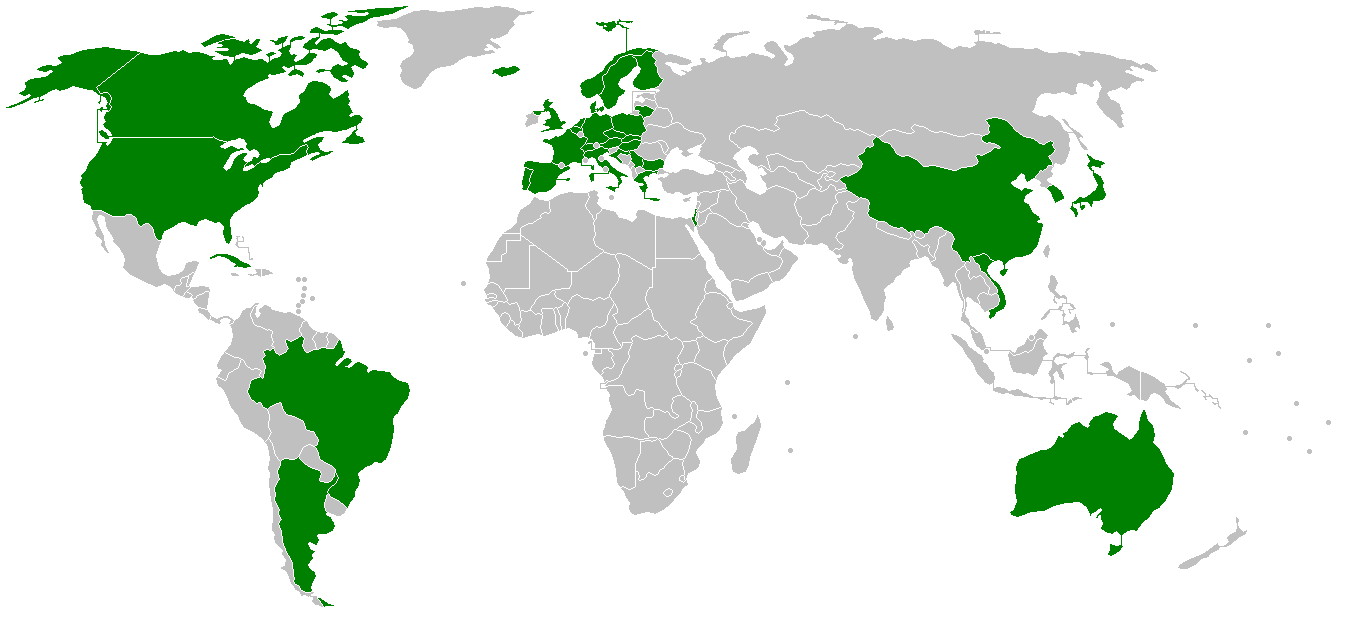 I should note, however, that even though Lithuania is the only former Soviet Republic that has hosted the World Esperanto Congress, the USSR issued a lot of stamps and postal stationery with Esperanto on them in the 1920s and 1930s, more than any other country. |
|
Send note to Staff
|
|
|
Replies: 55 / Views: 5,384 |
|
|
To participate in the forum you must log in or register. | |
Disclaimer: While a tremendous amount of effort goes into ensuring the accuracy of the information contained in this site, Stamp Community assumes no liability for errors. Copyright 2005 - 2026 Stamp Community Family - All rights reserved worldwide. Use of any images or content on this website without prior written permission of Stamp Community or the original lender is strictly prohibited.
Privacy Policy / Terms of Use Advertise Here |
| Stamp Community Forum |
© 2007 - 2026 Stamp Community Forums |
| It took 0.23 seconds to lick this stamp. |
 |
|
|
|


 Posted 08/23/2021 03:34 am


