| Author |
 Replies: 21 / Views: 1,752 Replies: 21 / Views: 1,752 |
|
Moderator

United States
5106 Posts |
|
|
I'm trying to figure out the meaning of something on the back of this cover. It appears to be from Cheltenham to Edinburgh, with a Scott #3 stamp cancelled with 177. 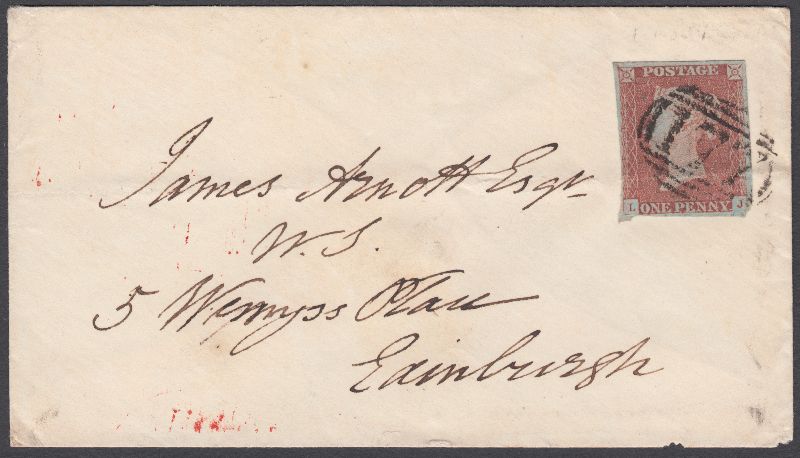 The back has some nice cancellations, confirming, again, Cheltenham with a date of July 20, 1849, and then a secondary stamp of July 21, 1849 in a beautiful red color. (Does this indicate a one-day transit time?) 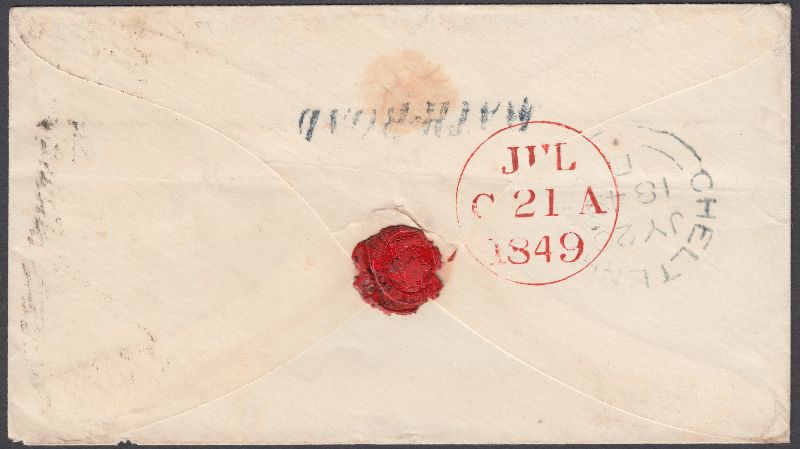 What is of interest to me is the apparent "Math-Road" hand stamp. Is there anything significant about this? 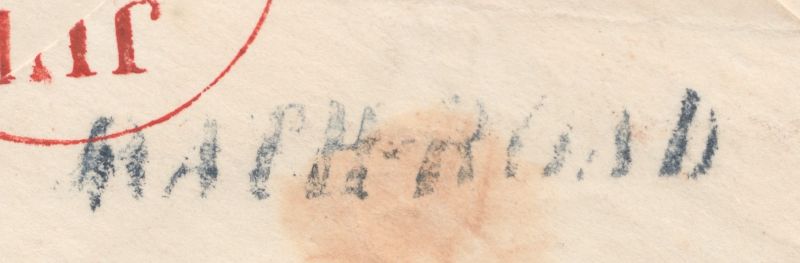 |
|
Send note to Staff
|
| Edited by Partime - 03/13/2022 4:37 pm |
|
|
|
|
Pillar Of The Community
Netherlands
6641 Posts |
|
|
Bath Road post office, maybe?
Bath Road, originally New Bath Road was a toll road into town, leading to its main street.
|
Send note to Staff 
|
| Edited by NSK - 03/13/2022 4:55 pm |
|
|
Pillar Of The Community
Australia
3297 Posts |
|
|
NSK is correct. This is the receiving house stamp for Bath Road. Known used from 10 August 1844 to 14 January 1850. See https://sites.google.com/site/ukpos...cesbycounty/ for more information. The red handstamp is an Edinburgh arrival marking, but I don't know the significance of the C and A codes. Cheltenham to Edinburgh next day delivery. Those were the days!  |
|
Send note to Staff
|
| Edited by Bobby De La Rue - 03/13/2022 5:03 pm |
|
|
Bedrock Of The Community
Australia
38679 Posts |
|
|
James Arnott Esquire, was a solicitor. Identified by the postnominal letters "WS" on the cover. The Society of Writers to Her Majesty's Signet is a private society of Scottish solicitors, dating back to 1594 and part of the College of Justice. Writers to the Signet originally had special privileges in relation to the drawing up of documents which required to be signeted, but these have since disappeared and the Society is now an independent, non-regulatory association of solicitors. The Society maintains the Category A listed Signet Library, part of the Parliament House complex in Edinburgh, and members of the Society are entitled to the postnominal letters WS. Tragically, James lost his 3yo son, Charles, as shown here proving the address at 5 Wemyss Place Ediburgh. https://www.geni.com/people/Charles...167315364533 |
|
Send note to Staff
|
| Edited by rod222 - 03/13/2022 5:39 pm |
|
|
Moderator
United States
5106 Posts |
|
|
Great info from everyone, as usual. The "B" in Bath-Road was somewhat mutilated, making it look like an "M" in my opinion. However, all of the supporting info points to Bath-Road. It will be kept in my collection, along with all of the wonderful information brought in by this group. |
|
Send note to Staff
|
|
|
Bedrock Of The Community
Australia
38679 Posts |
|
|
Quote:
Cheltenham to Edinburgh next day delivery. Those were the days! Astonishing! Bobby, coaches only did 7 miles per hour. 378 Miles, a modern Rail does it in 6 hrs. I am curious as to the "Bath Road", I had thought that was London to Bath in the Southwest and to Dover. I cannot find the "Bath Road" receiving house Can you help? This part of the cover has me discombobulated. Code:
(If it is a code)
CAFirst letter is the hour A to M (without the "J") Second letter is the 5 minute interval (without the J) So CA = 3:05pm ............or...3pm and A = Afternoon. Quote:
Bath Road, originally New Bath Road was a toll road into town, leading to its main street. Any source to the information, NSK? (great info) |
|
Send note to Staff
|
| Edited by rod222 - 03/13/2022 6:37 pm |
|
|
Pillar Of The Community
United Kingdom
8628 Posts |
|
|
Two different things, I think - a large road connecting different parts of the country and a local road leading out of Cheltenham towards Bath.
The Brighton-London train famously took less time before WWII than it does today! |
|
Send note to Staff
|
|
|
Bedrock Of The Community
Australia
38679 Posts |
|
|
Ah! Geoff that helps a bit,
but....why have a Cheltenham Barred numeral postmark, then a Receiving House postmark just out of town?
That doesn't make sense.
|
|
Send note to Staff
|
|
|
Bedrock Of The Community
Australia
38679 Posts |
|
|
Just a subtle point, that may otherwise be missed.
The fabulous condition of the cover, is possibly due to
the regime of a typical solicitor's office.
The use of a paper knife (Letter opener) to cleanly and efficiently
open envelopes.
(I use a scalpel, due to the modern use of sellotape on covers)
|
|
Send note to Staff
|
|
|
Pillar Of The Community
United Kingdom
8628 Posts |
|
|
Postal history and I are not in familiar terms, but … hand-stamp from one place when the letter was dropped off, then the formal cancellation at the main office? |
|
Send note to Staff
|
|
|
Bedrock Of The Community
Australia
38679 Posts |
|
|
Also having trouble researching rail, in 1848
Esp a route Cheltenham to Edinburgh.
Up to 1840 there was only 298 miles of railroad in Scotland.
|
|
Send note to Staff
|
|
|
Pillar Of The Community
United Kingdom
8628 Posts |
|
|
Pillar Of The Community
Australia
3297 Posts |
|
|
Quote:
why have a Cheltenham Barred numeral postmark, then a Receiving House postmark just out of town? The letter would've been dropped off at the Bath Road receiving house, brought to the main PO in Cheltenham and then cancelled with the 177 device. As for the route, is there a possibility the letter went to London and thence by rail to Edinburgh? https://en.wikipedia.org/wiki/East_Coast_Main_Line |
|
Send note to Staff
|
| Edited by Bobby De La Rue - 03/13/2022 7:14 pm |
|
|
Bedrock Of The Community
Australia
38679 Posts |
|
|
Pillar Of The Community
Netherlands
6641 Posts |
|
|
Bedrock Of The Community
Australia
38679 Posts |
|
|
Quote:
I am tempted to go with GeoffHa's suggestion as for the route. Agree. I was not aware of the SPA at Cheltenham. Provides musings on the travel between the two towns, in days of Yore. Spas and pilgrim visiting beautiful Somerset The name "Old bath road" now has meaning for me. 1806 Charlton Turnpike (begun at 'Gallows Oak', Hales Road/Old Bath Road) moved to Beaufort Arms, London Road. 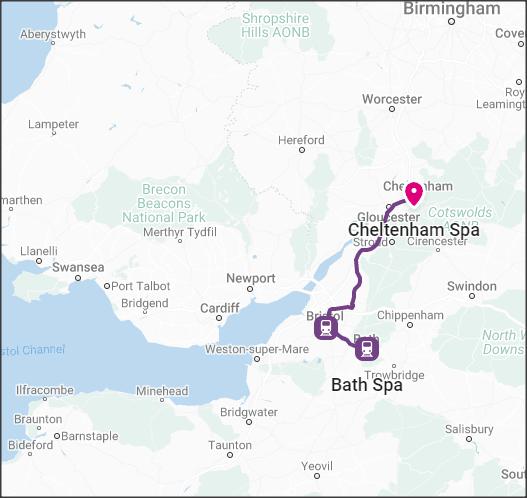 |
|
Send note to Staff
|
|
|
Replies: 21 / Views: 1,752 |
|




 Posted 03/13/2022 4:35 pm


