| Author |
 Replies: 32 / Views: 2,086 Replies: 32 / Views: 2,086 |
|
|
|
Valued Member
United States
8 Posts |
|
|
As for giving a few of you a  chuckle about speaking 1930's German, I figured it would've been a lot more formal than it is now w/ all the conversational slang and all….I know English has devolved quite a bit since the 30's.  |
Send note to Staff 
|
|
|
Pillar Of The Community
Israel
1242 Posts |
|
|
Quote:
English has devolved quite a bit since the 30's Is devolved the opposite of evolved? Indeed many adjectives and adverbs, widely used a century ago, are now rarely used (try to read "Pygmalion") and the assimilation of text message shorthand writing doesn't make me ROTFL but rather exclaim OMG W.T.F.?! and reply to those newly hatched STFU. |
|
Send note to Staff
|
| Edited by Rob Roy - 04/19/2023 8:43 pm |
|
|
Pillar Of The Community
United States
1434 Posts |
|
|
Quote:
Donaudampfschiffahrtsgesellschaftskapitän There's no actual recorded use of this construction, it's entirely hypothetical. The longest word recognized by Duden is Kraftfahrzeughaftpflichtversicherung (motor vehicle liability insurance). My native Czech is still very much structured around formal/informal forms of address (like German, French, Italian, Mandarin, Portuguese, Spanish, etc); it also has three genders, seven cases, and 42 letters in its alphabet. So what? I can still read one of Masaryk's letters from the 1920s. English speakers can still read Moby Dick, Paradise Lost, or The Adventures of Tom Sawyer; German speakers can still read anything by Schiller and Heine. I would think that modern speakers would have a much easier time reading older works, than anyone from earlier eras would have reading modern. |
|
Send note to Staff
|
|
|
Pillar Of The Community
Netherlands
6643 Posts |
|
|
Quote:
Yes, I clicked on the link and sent them the info about this letter, just waiting to hear back, if at all.  It would be interesting to know whether they are interested. Quote:
I figured it would've been a lot more formal than it is now w/ all the conversational slang and all… Luckily, Germans are quite formal. Slang, mostly, is spoken or written by people struggling with language. Then again, in schools, you learn formal languages. Language classes prepare you to read literature, not to have a discussion with a teen (if you even can discuss with a teen). |
|
Send note to Staff
|
|
|
Valued Member
Bulgaria
398 Posts |
|
|
I could also give the same example with Bulgarian language. It has changed and evolved a lot in time .
It has been influenced first by Turkish language (we have many words from it still used in every day conversations),Russian and now, from English language.
Regarding,communication with theens ,I could only say tath
I hardly understand the modern slang on which they speak. Some times I tink tath I need to have a dictionary to interpret it. |
|
Send note to Staff
|
|
|
Pillar Of The Community
Netherlands
6643 Posts |
|
|
The script that adds advertisements to this page read my post. I was shown an ad for a Dutch course. Maybe I can understand teens after taking it. |
|
Send note to Staff
|
|
|
Valued Member
United States
8 Posts |
|
|
Quote:
May I suggest you contact the 'Bundesarchiv' to offer them a scan Ok folks, I got a reply but of course it's in German. Can somebody help a brother out with a translation? 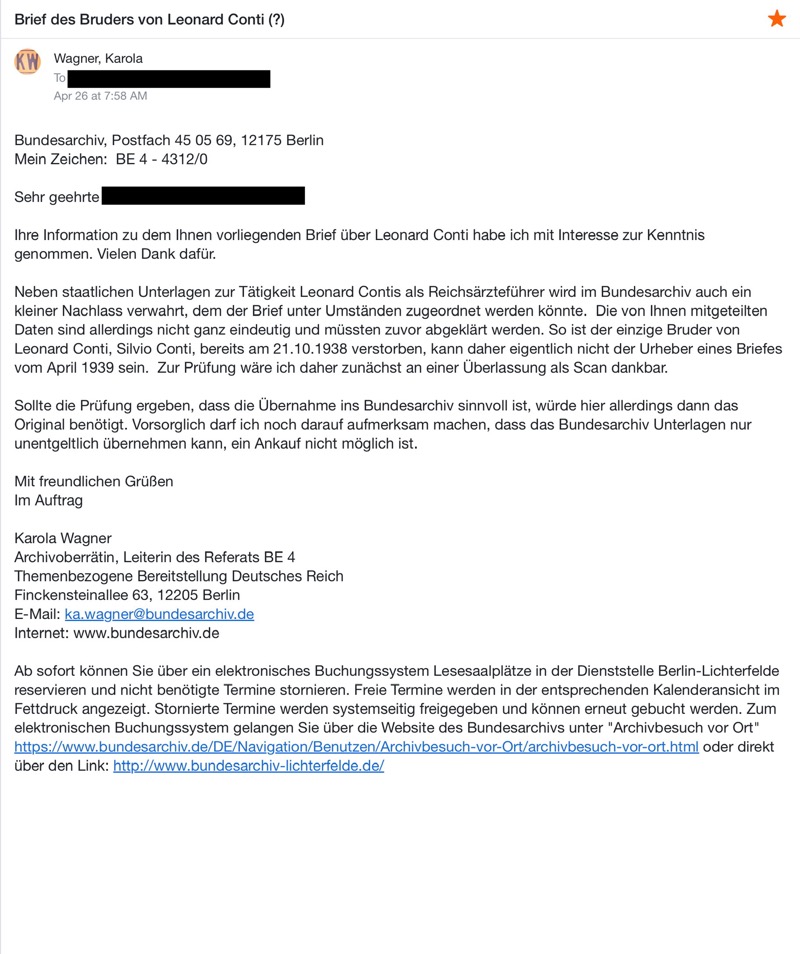 |
|
Send note to Staff
|
|
|
Pillar Of The Community
United States
1434 Posts |
|
|
Quote:
Dear XXX,
I noted with interest your information on the letter you received about Leonard Conti. Thank you very much for this.
In addition to state documents on Leonard Conti's activities as Reich Medical Leader, the Federal Archives also keeps a small estate [German probate law probably assigned his belongings to the state] to which the letter could be assigned. However, the information you provide is not entirely clear and would have to be clarified beforehand. Leonard Conti's only brother, Silvio Conti, died on October 21, 1938 and can therefore not actually be the author of a letter from April 1939. I would therefore be grateful for a scan as the first step.
If the examination shows that it makes sense to take it to the Federal Archives, the original would be required. As a warning, I would like to draw your attention to the fact that the Federal Archived can only accept documents as a donation, a purchase is not possible.
Best regards, |
|
Send note to Staff
|
| Edited by classic_paper - 04/28/2023 12:05 pm |
|
|
Pillar Of The Community
Netherlands
6643 Posts |
|
|
So, uncle Carl was not Carlo Conti.
In this part of the world, we do have a habit of calling close friends of mum and dad 'uncle.' So it may be Carl is not the brother of Leo. |
|
Send note to Staff
|
|
|
Pillar Of The Community
United States
2941 Posts |
|
|
Sorry I'm late to this thread. Let me see what I can find.
Fred Schwarzmann was Frederick Gustav Schwarzmann, born 17 Sep 1928 in Newark, NJ, to John George Schwarzmann and Elsa Antonia Goecke. I ID'ed him from his draft registration card, which gave the same address as on OP's cover.
John was born in Arkansas to parents from Austria, and didn't have a sibling named Carl or Leo. Elsa was born in Brooklyn to parents from Germany. No Carl or Leo there either. So "Uncle" appears not to be literal. |
|
Send note to Staff
|
|
|
|
Valued Member
United States
8 Posts |
|
|
Hmmmm….  I sent her the scans so maybe she can figure out who wrote this enigmatic letter. |
|
Send note to Staff
|
|
|
Valued Member
Bulgaria
398 Posts |
|
|
Maybe it is just referring the contacts of the original author with the person pointed in the letter .It is possible tath the last "uncle " at the bottom of the letter is not the author at all . It seems tath this "uncle "is just sending his greetings to the family via the person which is the real author of the letter. Of course the name is missing ,and taths why we don't know who wrote it. |
|
Send note to Staff
|
|
|
Pillar Of The Community
Netherlands
6643 Posts |
|
|
The exact wording is "Most heartfelt greetings to all uncle Carl" Quote:
It is possible tath the last "uncle " at the bottom of the letter is not the author at all .
It seems tath this "uncle "is just sending his greetings to the family via the person which is the real author of the letter. Of course the name is missing ,and taths why we don't know who wrote it. A lot is possible, but that exact wording makes it likelier monkeys typed it than someone who is not "uncle Carl." That would have been worded very differently, like "Onkel Carl sendet herzlichste Grüße an Alle." |
|
Send note to Staff
|
|
|
Valued Member
Bulgaria
398 Posts |
|
|
Your frace appears to be different, from the one used in the letter. It seems tath my thinking isn't the right one. Then let's try a nother approach . I would like to draw your attention to the section of the letter were the uncle greets the family once again. If you look closer you could see tath the upper part of the letter H in the first word is missing,it's clearly been cut off by scissors. Maybe the part which was cut off contained more clues about the author of the letter, but of course one could only guess . 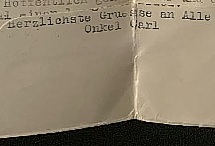 |
|
Send note to Staff
|
|
|
Pillar Of The Community
Netherlands
6643 Posts |
|
|
It looks like the final line above it, partly, is hidden by the flap. It could be because the text was typed on the back of the document and the greeting on the front, when the flap had not been stuck to the back. The typewritten 'H' would have been cut off. Also, if it was typed after the flap was closed, the letter may not have transferred the ink from the ribbon to the back of the envelope as the flap was a raised surface.
A lot is possible, but often the simplest explanation is the correct one.
When I was young, I had many Indonesian uncles and aunts. I have no relatives of Indonesian descend. We just go about calling everyone close to the family aunt or uncle. Germans do that as well.
If there is no uncle Carl that is an actual 'uncle', the next simplest explanation is that "uncle" signifies that Carl either is a distant relative or very close family friend. |
|
Send note to Staff
|
|
|
Replies: 32 / Views: 2,086 |
|




 Posted 04/19/2023 8:13 pm


