| Author |
 Replies: 19 / Views: 1,552 Replies: 19 / Views: 1,552 |
|
Pillar Of The Community
Israel
1242 Posts |
|
|
Sorry I can't have a more specific title, I'm arranging my old Germany stamps and keep finding new issues. Right now it's about cancellation: I read that if a Paul von Hindenburg serries stamp is found with Austrian cancellation, that stamp is attributed to the German occupation of Austria, the Anschluss. Does this stamp fit that description? It seems to be from 1939. Thanks for your opinion. 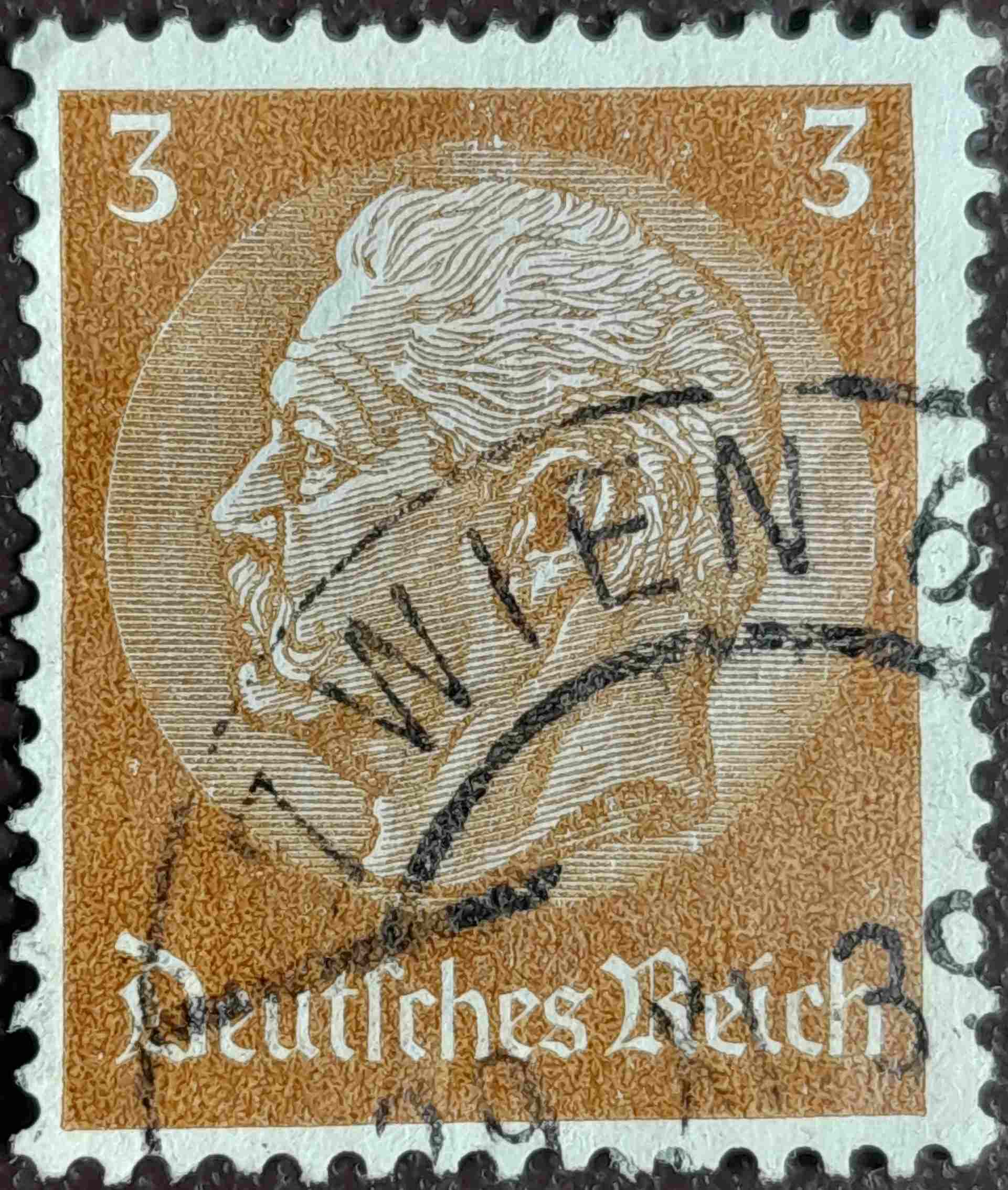 |
|
Send note to Staff
|
| Edited by Rob Roy - 09/20/2023 8:44 pm |
|
|
|
|
Pillar Of The Community
United States
2941 Posts |
|
|
Pillar Of The Community
Israel
1242 Posts |
|
|
Thank you for the interesting article.
Speaking of Austria, was it the only country to use Varnish bars, as they did before WWI? |
Send note to Staff 
|
|
|
Pillar Of The Community
United States
1434 Posts |
|
|
Quote:
Speaking of Austria, was it the only country to use Varnish bars, as they did before WWI? I'm not aware of any other issuer that used varnish bars besides Austria. |
|
Send note to Staff
|
|
|
Pillar Of The Community
United States
7105 Posts |
|
|
Is the process used by Russia different enough to not count? I'd think of them in the same vein. |
|
Send note to Staff
|
|
|
Pillar Of The Community
Israel
1242 Posts |
|
|
I'm not familiar with the Russian example. What did they do? On what years? |
|
Send note to Staff
|
| Edited by Rob Roy - 09/21/2023 12:27 am |
|
|
Pillar Of The Community
Netherlands
6643 Posts |
|
|
Enschedé used varnish bars on Machins. Their purpose was to seal the paper so the phosphor ink (applied after the varnish) would not be absorbed by the paper. |
|
Send note to Staff
|
|
|
Bedrock Of The Community
12759 Posts |
|
|
France also employed varnish for quadrille paper. Russia is another one that used it. |
|
Send note to Staff
|
|
|
Pillar Of The Community
Israel
1242 Posts |
|
|
Can you bring an example of these stamps, like the catalog number of one of each (Russia, Netherlands, and France) so I can see how the catalogs refer to it? |
|
Send note to Staff
|
|
|
Bedrock Of The Community
12759 Posts |
|
|
Type the country name and "varnish" into the SCF search engine and you will see it all. |
|
Send note to Staff
|
|
|
Pillar Of The Community
Netherlands
6643 Posts |
|
|
Pillar Of The Community
Israel
1242 Posts |
|
|
Scott catalogue mysteries (for me):
In SG and online catalogs like StampWorld there were 4 main categories:
Joint Allied Occupation stamps, British-American Occupation stamps, French Occupation stamps, and USSR Occupation stamps.
Scott mentions the French (4N, 5N, 6N, 8N stamp numbering sets), the "M" in Circle series of the British-American (3N), but combines the rest of the British-American and the Joint Allied Occupation with the rest of the regular German stamps. I couldn't find the USSR Occupation stamps.
Scott also includes all of the Berlin stamps, up to the 90's, under occupation stamps.
Can anyone explain why this is so?
As for the perforation of the "M" in Circle series of the British-American occupation stamps, Scott writes "Perf. 14, 14 1/2 and Compound" or "Perf. 11, 11 1/2 and Compound". What does "compound" mean in this context?
Thank you for reading. |
|
Send note to Staff
|
| Edited by Rob Roy - 09/23/2023 01:11 am |
|
|
Pillar Of The Community
Netherlands
6643 Posts |
|
|
Normally stamps have the same perforation gauge on opposite sites. If this is not the case, catalogues use "compound."
E.g., top 11, right 11 1/2, bottom 11 1/2, left 11, would be a "compound" perforation.
When the horizontal and vertical gauges differ, but are the same for top and bottom and for left and right, most catalogues will [b]not[/b[ use "compound" but simply give top x bottom gauges. |
|
Send note to Staff
|
|
|
Pillar Of The Community
Israel
1242 Posts |
|
|
Thank you, NSK, for your answer and your previous answer about varnish (thanks rogdcam too).
How does Scott refer to the possibility of more un-named perforations, like in addition to 14 and 14 1/2 there might be 14 1/4 and 13 3/4?
Or if there are many more perforation sizes that did not get to have a unique catalog number? |
|
Send note to Staff
|
|
|
Pillar Of The Community
Netherlands
6643 Posts |
|
|
Normally, the perforation gauges not listed separately appear in the header to the listing or in a footnote to the listing. I do not know what Scott does.
Of course, if a catalogue editor is not aware of other gauges, you will not find a reference to them. Also, there always is the issue with rounding and exact measurement that causes one editor to round up and the other to round down. And then there are the listings the editor forgot to update when he or she rounded to quarters rather than halves as before. |
|
Send note to Staff
|
|
|
Pillar Of The Community
Israel
1242 Posts |
|
|
Since I ran into too many undocumented perforations, with 1/4 to 1/2 off of the documented perforation, maybe I'm doing it wrong.
What is the accurate way to measure: stamp perf edge/pick against gauge holes, or stamp-gauge perf picks align against each other? |
|
Send note to Staff
|
| Edited by Rob Roy - 09/23/2023 09:21 am |
|
|
Replies: 19 / Views: 1,552 |
|




 Posted 09/20/2023 8:43 pm


