| Author |
 Replies: 20 / Views: 2,382 Replies: 20 / Views: 2,382 |
|
New Member
Canada
2 Posts |
|
|
Hey All, I am new to this site and a novice when it comes to philately. I used to collected stamps when I was in elementary school and I still have a sizeable (though not valuable!) collection. My father in law sent me a picture of paired 1937 King George VI - 2 cents stamps.  My question specifically is in regards to what a pairing does to this particular stamps value (I know there is wear but I am doing my due diligence to assist them) but also more in general, how do you value paired stamps and in general, those in blocks? All sites I have seen value single stamps. How do you assign values to stamps with more than one connected together? I would appreciate any help in this matter you can offer :) Thanks! |
|
Send note to Staff
|
|
|
|
|
Pillar Of The Community
United States
1115 Posts |
|
|
With regard to catalog pricing, generally if there is a premium value for multiples, it is listed in the catalog. For unused stamps you may see pricing for blocks of 4, but there is not generally a premium for pairs. For more recent and common stamps (read 1930s on), there is no premium for multiples (except plate blocks, or other multiples with attached selvage with markings).
There are exceptions, but primarily for scarcer or early stamps, and also for used multiples (and early revenues). Also, for coil stamps, pairs, line pairs and multiples with plate numbers may have premiums and be listed in the catalog. Coil pairs or multiples of more recent or common issues have no premium value. |
Send note to Staff 
|
| Edited by orstampman - 11/20/2023 11:16 am |
|
|
Pillar Of The Community
United Kingdom
8628 Posts |
|
|
Where stamps were paired within a sheet, and are collected as such, eg the South African issues alternating English and Dutch text, the catalogue price will reflect that, with single stamps not being priced. As orstampman says, where blocks have a collectable element - eg the coin daté (dated corner) on French stamps, they'll often be catalogued and will have a premium. And early stamps in blocks will be desirable. For most stamps, there's no premium. |
|
Send note to Staff
|
|
|
Pillar Of The Community
United States
745 Posts |
|
|
When checking for the presence or absence of watermarks, multiples are far preferable to singles, as only a tiny part of the watermark may appear on a given stamp. With multiples, you have a much better chance of seeing the watermark, if there is one. The absence of a watermark in a multiple is also good news for identification purposes. Also helpful for different watermark orientations, as with Great Britain's sideways and inverted watermarks. VIVA MULTIPLES! I actually prefer to collect joint or line pairs, especially with the U.S. flat plate Washington/Franklin coils, which can be very hard to identify properly, as there are so many fakes made from trimmed or imperforate versions. Many of these can be quite expensive, so I want to be sure of what I've got. I either buy them already certified or send them for certification if my initial identification indicates they are worth the cost. YMMV.  |
|
Send note to Staff
|
| Edited by uboatnut - 11/20/2023 7:02 pm |
|
|
Pillar Of The Community

United States
1139 Posts |
|
|
Nice set of coils, uboatnut.
For stamps where the popular albums include spaces for coil pairs (e.g. Scott National, Lighthouse US, etc.), there may be a larger market for coil pairs than other areas.
Same with se-tenants, they are frequently collected in multiples so they may have a slight premium over single stamps from the block/set. As mentioned earlier, the premiums for multiples aren't really significant though except for earlier stamps.
I collect slogan cancels and usually a pair or larger multiple is needed to capture the complete slogan cancel on the stamp so those are worth keeping intact.
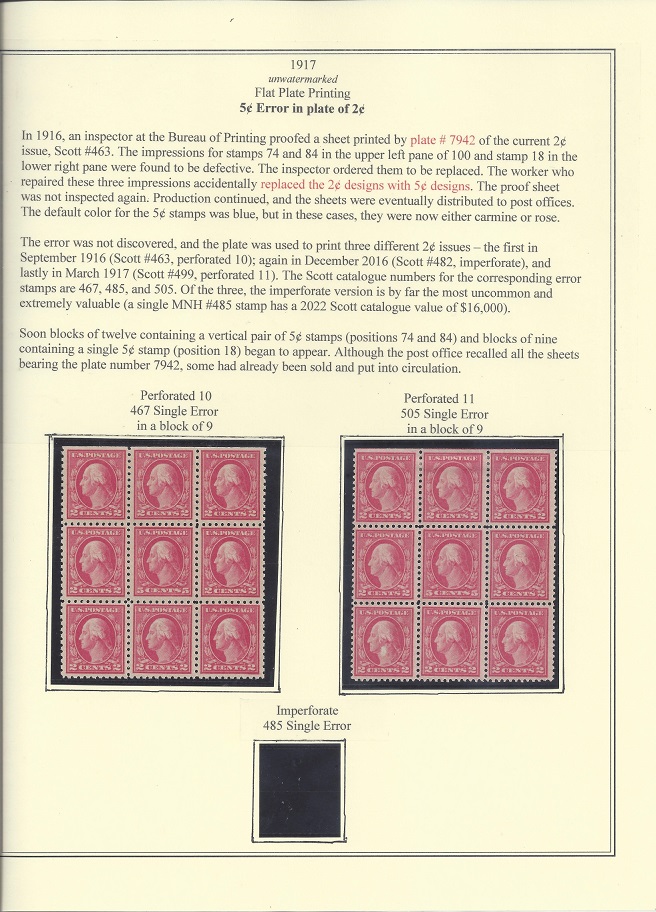
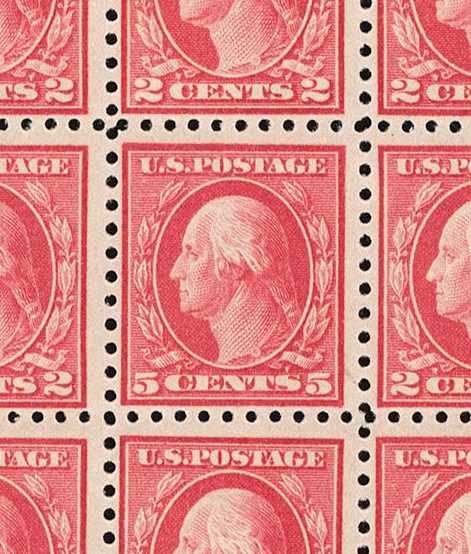
One oddity I have seen in the Lighthouse albums, they have a space for the US 463/467 color error pair (but not the 499/505 color error pair). I've rarely seen these sold as pairs, usually strips of 3 with the error in the middle, or blocks of 6/9/12, but not pairs. Another case where Steiner or other custom printed pages are a good idea to get away from how the album publishers want you to collect. |
|
Send note to Staff
|
|
|
Bedrock Of The Community
12730 Posts |
|
|
To summarize, stamps commonly collected in pairs include:
Se-tenants
Coils
Tete Beche
Multiples with selvedge that has an imprint
Stamps that have differences such as early US (1851 Franklin's, Scott 261-261a etc.) Stamps that are popularly plated fall within this category. |
|
Send note to Staff
|
|
|
Bedrock Of The Community
12730 Posts |
|
|
Quote:
One oddity I have seen in the Lighthouse albums, they have a space for the US 463/467 color error pair (but not the 499/505 color error pair). I've rarely seen these sold as pairs, usually strips of 3 with the error in the middle, or blocks of 6/9/12, but not pairs. Here is a 499/505 pair I owned: 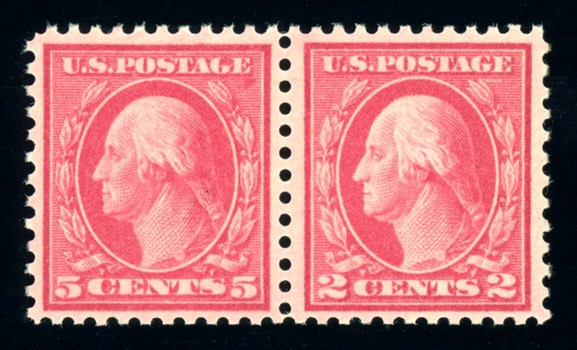 |
|
Send note to Staff
|
|
|
Pillar Of The Community
United States
2830 Posts |
|
|
Combinations of stamps leading to pairs like Rog's are often found from Scandinavian countries and Germany. |
|
Send note to Staff
|
|
|
New Member
Canada
2 Posts |
|
|
Thank you all for your feedback. I really appreciate it! Great first impression of the community here :) |
|
Send note to Staff
|
|
|
Pillar Of The Community
United States
721 Posts |
|
|
I am pretty sure the most popular way to collect early Canadian coils is by pairs. This helps, as noted earlier, to possibly ID watermarks. It also might be a way to combat tampering and fakes. The Unitrade Specialized Catalogue of Canadian Stamps lists most older coils as singles, pairs and strips of four, plus line pairs. There are even more varities with newer coils, such as the 1974 QEII Caricature stamps, with more than a dozen listings per stamp.
I have some as singles, some as pairs. |
|
Send note to Staff
|
|
|
Pillar Of The Community
United States
4445 Posts |
|
|
ZebraMan, to expand upon your statement, it takes a pair of the color errors to establish their position. A single will not do so as it may be from any of three positions. Likewise a simple strip of three, 2-5-2, does not establish positioning either.
2
5
2 would establish the single position. As would
2
5 with a straight edge at top.
For the pair
2
5
5
2
Just the
5
2 with straight edge at bottom or the
2
5 without straight edge at the top
would Identify the individual stamp position of the pair.
That is why I and others prefer blocks of 9 and 12 with the single or pair in the center.
This same holds true for the imperf 5 cent errors of color, Scott 467. (Perhaps some day I will own one or all three positions.)
Lastly, as with the postage due any missing a value is assumed to be just one Scott number, J89a ( unless you prove the value with a pair or larger showing what the missing value is. Here unless you prove the error is from a pair's position, all singles are assumed to be from the single error position.
EDIT: added the needed "out" to "with" to read as without. |
|
Send note to Staff
|
| Edited by Parcelpostguy - 11/20/2023 7:39 pm |
|
|
Bedrock Of The Community
12730 Posts |
|
|
Quote:
That is why I and others prefer blocks of 9 and 12 with the single or pair in the center. Which is what I ended up doing to supplement the pairs:  |
|
Send note to Staff
|
|
|
Pillar Of The Community
United States
745 Posts |
|
|
Pillar Of The Community
United States
7103 Posts |
|
|
Valued Member
United States
397 Posts |
|
|
Sweden has issued many stamps in booklets, wherein two opposing sides of a booklet pane are imperforate, so that a pair from a pane from the booklet will have either one straight side on the left side of the left stamp and a straight side on the right side of the right stamp or a similar situation for a vertical pair, with one straight edge at the top and one at the bottom. My Kabe album has specific spaces for these pairs. I don't believe Scott lists them separately, but the Facit catalogue (published in Sweden) does, and for the vast majority, there is no premium over the two separate singles, and at best maybe a 10% premium for the pair. |
|
Send note to Staff
|
|
|
Pillar Of The Community
United States
4445 Posts |
|
|
Quote:
My question specifically is in regards to what a pairing does to this particular stamps value (I know there is wear but I am doing my due diligence to assist them) but also more in general, how do you value paired stamps and in general, those in blocks? As noted in prior posts there are general conventions for collecting pairs and large multiples. Usually to show some specific attribute of the method of issue, coil pairs, coil line pairs, plate blocks, parts of a booklet pane, when more than one stamp number is in a pane etc. When used, there are still the same reasons to show multiples but also there is a chase to show the largest number of a stamp on cover as well as the largest multiple (means the stamps are still joined together). Now staying with the 5 cent error of color, this cover looks like a block of six plus a single parcel post stamp. However, it is not a block of six, rather it is two horizontal strips of three plus the single parcel post stamp. For some issues it would matter if it was a block of six rather than only strips of three. However, this item is so rare it does not change how it is viewed nor valued.  (PFC# 452591) Here is an example of another reason to collect in multiples. Note the upper right stamp has only half of the red Olympic ring present. This is know as the Broken Ring variety. It is commonly collected in one of four ways; it can be collected as a single stamp, as a pair (with either top, bottom, left or right stamp) which allows for the comparison of the normal with the adjacent variety, as a zip block of 6 (or greater) thus showing the variety along with its constant position at which it is found, or as a full pane of 50 showing both the variety's position and the plate numbers of the pane.  Now I am not suggesting you have a variety in one of the stamps of your pair (I am not a Canada expert), but if you did you would diminish the interest slightly if you were to break up the pair. In general the larger the multiple the more information can be discerned. That said, the entropy of philately is to start with a full paper sheet as coming from the press, then it becomes the panes as sold in the post office, then to pieces of a pane until all piece of a pane are individual stamps with no selvage attached. Each phase allow less and less information to be obtained from what it is your are looking at. Lastly the individual stamps become pieces and up being recycled, fed to worms, composed or heating the house. And just because I like math, remember a pair of stamps is at most only half as common as single stamps. |
|
Send note to Staff
|
|
|
Replies: 20 / Views: 2,382 |
|




 Posted 11/20/2023 10:57 am