|
This page may contain links that result in small commissions to keep this free site up and running.

Welcome Guest! Registering and/or logging in will remove the anchor (bottom) ads. It's Free!
To participate in the forum you must log in or register.
| Author |
 Replies: 225 / Views: 38,877 Replies: 225 / Views: 38,877 |
|
|
|
Pillar Of The Community
1369 Posts |
|
|
I just read this entire thread. I must have ignored it before because I'm not on the Minkus team but on the Scott International team! I do not dislike Minkus, however, but I just don't use them. In fact I kind of like them for what they are.
What they originally were when Jacques Minkus began publishing them, I think was an attempt to publish albums at a somewhat lower price using slightly different standards than Scott. Minkus' country ("specialty") albums were very nice, but the paper was originally (or permanently?) thinner than the paper in Scott Specialty albums maybe to cut costs? I don't know if Minkus' thinner pages then transitioned to thicker ones at the same time as Scott did. When Amos Media decided to "adopt" the Minkus worldwide albums (not the Minkus country albums, though), that may have been the point at which Amos decided to reprint them on thicker paper since they were also doing with Scott International pages. I imagine they got a lot of grief for the thinner pages whose holes tore much too easily. I'm not sure what year that was, though. In any case, buying older Minkus albums, you may end up with the much thinner, flimsier pages, so keep that in mind.
As has been said many times, Minkus page layouts were more crowded -- also like the thinner paper, maybe to save pages and paper costs? The whole effect, though certainly perfectly good was not quite up to Scott's more austere and spread-out standards -- or mine, anyway. I like more space around my stamps, but I know many collectors like more stamps per page. "You pays your money, and you makes your choice."
One thing Minkus did better than Scott always appealed to me. That was to combine semi-postals and air mails with the other stamps available at the same time. The Scott practice of separating each type of stamp has never made any sense to me. In fact, in al my Scott albums, I insert all semi and air mail pages with the other pages from that era so they are all (more logically) together. Clearly, once Scott decided to list stamps this way in its late 19th century catalogs and albums, they were pretty much stuck with it forever. Collectors who got used to that approach consider it "correct" even if maybe it's not. So I appreciate Minkus' common sense in combining stamps from each year together in the same way they were used at the time, not artificially separating them. When I was young, I did own a few Minkus albums and liked them very much for this and other reasons.
Interleaving is pretty much essential in any album where stamps face each other on opposite pages -- or they snag each other and pull stamps off the page. In my (now 40-volume - yikes!) Scott Internationals which also have stamps on facing pages, I use clear acetate (I think that's right) interleaving. I purchased it from Subway Stamp Shop, but I'm not sure they still sell this. I do not like the alternative "glassine" interleaving as much, thought it's fine You cannot see through it, and I want to. Glassine also ages badly. Not to mention it "crinkles" as you turn the pages! Yes, "crinkles". I like the fact that, as you turn the pages, the acetate interleaving often static-clings to the pages it's protecting. The only type of interleaving I've ever seen for Minkus albums is glassine, but maybe some aftermarket company makes the other kind? I'm not sure why Amos doesn't make and sell this better type of interleaving, but they don't market a number of things I consider completely logical money-makers. They drop the ball once in awhile.
Adding one interleaf between every pair of pages with stamps facing each other is a lengthy process best done while watching a week of football games or listening to music. But once you're done, the albums look really nice AND your stamps are now protected better. My entire Scott International albums took me a few leisurely weeks to do. I'm sure someday some auction house somewhere is going to be impressed by this, and I'll get an extra 10 bucks for my collection! I'm sure of it.
Given their enormous size and weight, these Global Minkus binders are difficult to use (though they are massively impressive! It's like owning a Gutenberg Bible. Or the entire federal tax code in one huge volume). I wonder if there is a good alternative? Besides other Minkus binders still sold new (by Amos Advantage), are there any other smaller-narrower binders you could use? I only use narrow binders about 2.5" wide give or take. That way, I can hold them securely and the weight isn't overwhelming. I'd imagine many other collectors might feel the same way.
Or you can (slowly and laboriously) three-hole punch the pages and put them into narrow three-ring binders. They'd better be the thicker pages since turning pages on rings really does wear out the holes pretty fast.
Anyway, good stuff! Interesting thread. |
Send note to Staff 
|
| Edited by DrewM - 11/12/2025 9:13 pm |
|
|
Pillar Of The Community
United States
8616 Posts |
|
|
DrewM----Interesting article .
I grew up with both Minkus albums and the Scott series of Internationals and the Speciality series .
I moved over to the Steiner pages ,because my main collection was in the International . Many of my problems was the expensive binders and pages needed , then the size of each binder was just too big and thick to work with . I went to having each country in a half inch ,one inch and two inch binder , some countries were placed into 2 two inch binders .
You would also like these new 3 ring binders that are "D" ring binders ,ending my need for Interleaves , the binders lay flater and stamps don't get hung up on each other . Try using a "D" binder ,you will see the difference working with it . The printing of Steiner pages is so easy and cheap that I print only one side . |
|
Send note to Staff
|
|
|
Valued Member
126 Posts |
|
|
As a kid I had Minkus Italy and Harris USA, Canada and Citation/ww
More recently I have acquired feeder pages and albums from big red and move the stamps to Steiner. I like the layout and mapping of Steiner to Scott catalogue and can appreciate more what I have (and mostly don't have) of a country set by set. I have enjoyed spreading out a Big Red and mostly Big Blue set of stamps into Steiner although I need a good number before that makes sense or I have too few stamps per page and a lot of blank paper!
I have an almost complete set of big red Greece pages that I have moved and noticed the more recent pages are less dense and more appealing
I have now been accustomed to Scott BoB approach —which is a big change for Greece with many BoB
With Italy I like the fully illustrated pages but not the thin paper. What is the biggest challenge is the different number system vs Scott as guide to Steiner. I like the Minkus country binder size and have supplemented my Italy binder with Steiner cut to Minkus
|
|
Send note to Staff
|
| Edited by Quanah - 11/13/2025 10:06 am |
|
|
Valued Member
Canada
304 Posts |
|
|
DrewM I have considered printing my own pages. However, the source of the 9.5" x 11.25" pages is what is holding me back. I can buy them from AMOS at approximately $1 per page, but that would be cost prohibitive to recreate an annual supplement. I have not been able to locate a local print shop that may be able to supply blank pages of that size. The same paper concern holds me back from trying to photocopy the damaged 1981 supplement that I recently purchased. How would you even attempt to filter out this type of water stain? 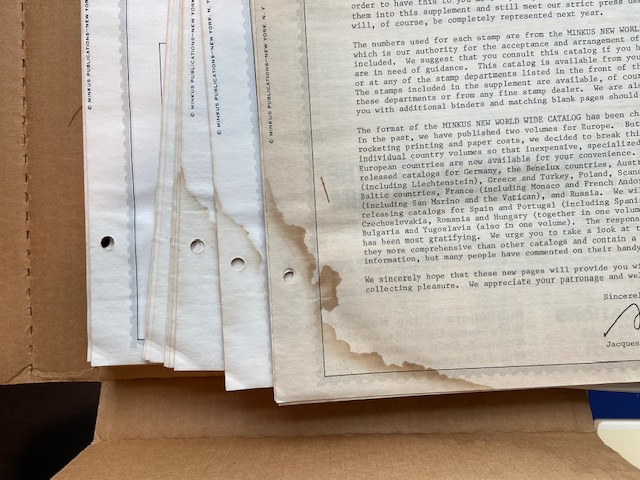 |
|
Send note to Staff
|
|
|
Pillar Of The Community
1369 Posts |
|
|
PMStamp: Scott "blank" (but with a border) pages sell for about 50c a page. Adding the cost of photocopying, a printed page that way would be maybe 70c each which is competitive to printed albums. If you have a large-format printer (I don't), your home-made pages would be even less than that.
I print Bill Steiner's page layouts on these blank Scott bordered pages and put them into Scott binders where they look just like Scott pages but nicer -- since they have Steiner's stamp identifying information which, for some reason, Scott chooses to leave out of most of its albums, though I have no idea why. They only use stamp identifiers in their National album and maybe one other one.
For binders for Scott pagees, I prefer the two-post style rather than the three-ring binders Scott sells. I don't use three-ring binders for most of my stamp collection. I think they make it look too much like a schoolboy notebook instead of the elegant album filled with hard-won, long-sought and sometimes expensive stamps I want it to look like. If FDR or King George V were browsing through my collection, I think they would appreciate that! It's why my collection is mounted on actual album paper. Each to their own, of course.
PM Stamp: How to filter out that water stain? It's pretty dark, isn't it? You might try setting the "contrast" on the copying machine to somewhat lighter and see if that reduces the stain. It might help. I mentioned I photocopied a bunch of water-stained Davo album pages onto brand new white Davo blank pages, and by setting the contrast a to less dark, no water staining was apparent on the new pages. With yours being stained so dark, it may not work -- but it might be worth trying.
And another idea you could try. Photocopy a good page. Cut off the lower left corner -- since the stains all appear to be on the lower left -- and carefully place it (double-sided tape might work) on the stained corner page-by-page so the border lines up and it covers the stain. I wonder if the resulting page would be stain-free? I've done this a few times to block out print I did not want on a page, and it does work. It takes some time, though. Somewhere out there in the world of archival work, there may be some way to remove water stains, but darned if I know how. Try searching online and maybe you can find the magic way to do that?
Floortrader; Yes, I have used three-ring binders with the squared off sides, the D-rings. All my work notebooks (I was a teacher) were that style so pages lay flatter. As you say, round rings don't work as well. But D-rings can still 'catch' on the holes as you turn the pages. They do not prevent that. Better binders do line up the rings better, though, so I'd look for the better ones and avoid the "cheapies".
Scott now makes its own green-covered three-ring binders, as you'll know. The large size which is the popular one since it holds more pages is so massive, though, that not only is it hard to pick up, but it also extends far off the bookshelf. It's that wide. The smaller Scott three-ring binder I like much better. It's designed for Scott size pages, of course, so not for notebook or printer-size paper.
There is one particularly good three-ring binder out there, and it's also sold by Scott/Amos Advantage. It does have the round-rings, not the D-rings which is unfortunate, but otherwise it's the best normal-sized binder I'm aware of. And its rings do not seem to catch on the pages I put in them. They are available in blue or black, have a padded cover (like Lighthouse binders!) and come with their own slipcase. It's not very expensive like a lot of fancy binders are. Compared to most stamp binders, it's actually a real bargain.
Since I've somehow ended up with a few White Ace albums (but hate the heavy White Ace binders), I've moved all these pages to the Scott padded binders. I'm much happier with them. They don't look like normal (cheap) binders. Lighthouse makes a similar padded three-ring binder but it's TWICE as expensive as these, so no thanks. You might look at them. I'm using over a dozen of them now for all these White Ace pages, including an entire United Nations album I seem to have. Where does all this stamp stuff come from? |
|
Send note to Staff
|
| Edited by DrewM - 11/14/2025 04:43 am |
|
|
Bedrock Of The Community
12787 Posts |
|
|
You can usually remove the water stains with a mixture of equal parts H2O and white vinegar. Dab at the stains with solution dampened cotton balls and when clean let dry. |
|
Send note to Staff
|
|
|
Pillar Of The Community
United States
775 Posts |
|
|
Removing water stains. You might try scanning the page and then use Photoshop, or a similar editing program, to remove the stain with Content Aware (or some similarly named tool). That's beyond my modest skills so I can't give you a procedure. I like Rogdcam's idea of lightening the stain. I would try that first and then scan the lightened version. |
|
Send note to Staff
|
| Edited by Germania - 11/14/2025 08:20 am |
|
|
Valued Member
Canada
304 Posts |
|
|
I already tried the diluted vinegar and water solution and a Q tip. The second the moist tip hit the page the paper split. Obviously the water stain and age made the thin page brittle. So that attempt failed for me in under a minute.
Regarding using the Scott blank pages, they are not the same size as the Minkus ones. So my best bet is still to try and find a print shop that can supply a custom paper size. |
|
Send note to Staff
|
|
|
Valued Member
United States
65 Posts |
|
|
I started my worldwide collection with a 3 volume set of the 1966 Minkus Supremes purchased unused off ebay. I added Volume 4, also off ebay and, over the course of several years found almost all of the annual supplements up to my goal of the year 2000. However, I've never been to locate a Part 2 of the annual supplements for the year 2000 (stamps issued through 1999) or 2001 (stamps issued through 2000). A local stamp supply dealer has told me that they don't believe that a Part 2 was ever published for those years. Can anyone verify that a Part 2 was not published in 2000 or 2001? Or has anyone seen a Part 2 from 2000 or 2001? |
|
Send note to Staff
|
|
|
Valued Member
United States
88 Posts |
|
|
Good to see this topic active again. I am loving my MSG (1840-1966 version) and using it to mount my duplicates and the thousands of stamps that have no space in my big blue.My primary collection continues to be in my 1947 BigBlue. My MSG is pristine and has crisp pictures in the stamp boxes. I have placed each page in a scott page protector on the left and a vario page on the right ( where I mount my stamps). They are then housed in the SCott 3 ring metal hinged binders. The MSG is a nice balance/compromise between a BB and a collection mounted in a Steiner. It is so nice to have complete sets. As I move stuff over to my MSG I am getting only a handful of stamps per country that do not have a designated spot. It's very easy to tuck them onto my vario pages without missing a beat. At this point of my philatelic journey I am perfectly happy with an end date of 1966. The only thing I wish for is a Scott number to MSG concordance list. |
|
Send note to Staff
|
| Edited by aragorn - 11/14/2025 5:52 pm |
|
|
Pillar Of The Community
United States
862 Posts |
|
|
Eric99, I checked my 2004 Subway catalog and it says that the Minkus Global supplement for 2000 was forthcoming. Interestingly, the years before that were still being listed as a single supplement. I999 was listed as "Part 18" I remember the Part 9 supplement for Minkus Global was 1983 to 1985. Drew, I agree with you about the thin pages in the original Minkus pages. I think they did that to cram more pages in those binders, as long as one uses hinges. The best is having the back of the book together with the rest of the stamps. Looking at my old Subway catalog one could have got the 1840-1999 pages and binders for about 2K. I like the acetate interleaving too. I've been experimenting with different sizes and acid-free paper for alternative ideas. |
|
Send note to Staff
|
| Edited by landoquakes - 11/15/2025 10:57 am |
|
|
Pillar Of The Community
United States
8616 Posts |
|
|
To understand the lack of Big Red in the philatelic community . You have to understand the 1950;s and early 1960;s when tens of millions of kids started collecting stamps {and me being one of those }.
We got our first album from the local 5 and dime store , this was the 25 cent album and later the 50 cent album . This was made by H.E.Harris Co. of Boston . They printed albums in the layout of the Scott Catalog .The advertising in the back of each album was both H.E.Harris for stamp approvals and from Scott for their bigger and more expensive album series . This is what dreams were made of for millions of kids and the few who continued building collections ,their memory was established on which future albums they needed to buy .
The Big Red was sold in up scale department stores and at stamp shops both had them more expensive than the albums they grew up seeing in their own albums plus the had a lay out that you already understood in your beginner album .This was something different . |
|
Send note to Staff
|
|
|
Pillar Of The Community
United States
862 Posts |
|
|
A 25 dollar album was big money in those days!
I talked with a collector that grew up in Chicago and went to the Minkus shop in the department store . They had the Minkus country albums with the colorful paper covers high on the shelves. He dreamed of owning those albums! I know another collector that goes after those Minkus country albums for all the souvenir sheets, photocopies them on Scott International sized paper to fit in his Bib Blues! |
|
Send note to Staff
|
| Edited by landoquakes - 11/15/2025 11:04 am |
|
|
Pillar Of The Community
United States
862 Posts |
|
|
Pillar Of The Community
United States
4521 Posts |
|
|
Replies: 225 / Views: 38,877 |
|
|
To participate in the forum you must log in or register. | |
Disclaimer: While a tremendous amount of effort goes into ensuring the accuracy of the information contained in this site, Stamp Community assumes no liability for errors. Copyright 2005 - 2026 Stamp Community Family - All rights reserved worldwide. Use of any images or content on this website without prior written permission of Stamp Community or the original lender is strictly prohibited.
Privacy Policy / Terms of Use Advertise Here |
| Stamp Community Forum |
© 2007 - 2026 Stamp Community Forums |
| It took 0.23 seconds to lick this stamp. |
 |
|
|
|


 Posted 11/12/2025 8:22 pm


