| Author |
 Replies: 16 / Views: 1,699 Replies: 16 / Views: 1,699 |
|
Pillar Of The Community
567 Posts |
|
|
|
|
Pillar Of The Community
United States
8956 Posts |
|
|
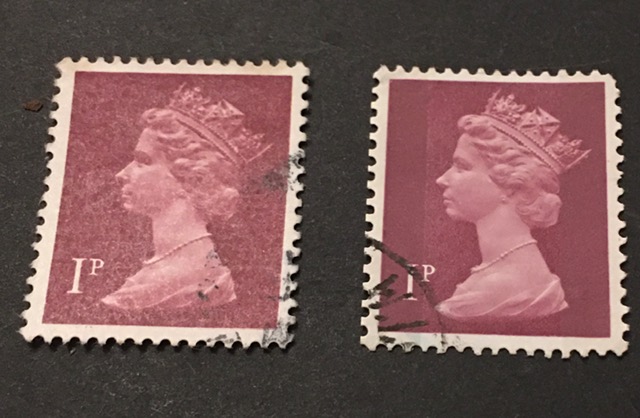
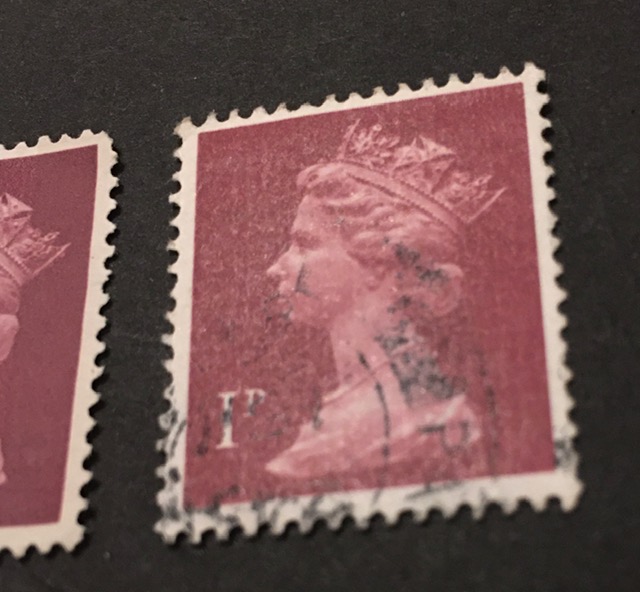
I see clearly phosphor bands in the two last photos. Please remember, these are used and soaked, and that can do strange things. Look at how the cancels look very weak - soaking may have caused that.
Peter |
Send note to Staff 
|
|
|
Pillar Of The Community
567 Posts |
|
|
I can't see them...neither with natural light nor with UV light, just a kind of shiny coverage over the entire surface, which I only usually see in other stamps, limited to the central area between the two bars...
What detail should I pay attention to? |
|
Send note to Staff
|
|
|
Pillar Of The Community
Netherlands
6639 Posts |
|
|
This could be PCP, but it is hard to tell from this picture.
What uv lamp do you use?
Peter4522 makes a valid observation. Soaking can affect the phosphor bars. |
|
Send note to Staff
|
|
|
Pillar Of The Community
6361 Posts |
|
|
I agree with the direction Peter takes. The left and right stamps have the appearence of long-term soaking which (beyond the phosphor reaction) is beginning to cause ink flaking from the paper. This thread points to the additional challenges of the Machins. The initial learning process is better acheived from mint examples than from soaked singles, which have an added (and often unknown) handling element. |
|
Send note to Staff
|
|
|
Pillar Of The Community
567 Posts |
|
|
I think I have found the solution...it is very likely that they could be PCP which were issued between 79 and 84 without bands, from what I understand from the Connoisseur catalogue...I have also found two 12p with the same peculiarities and notorious characteristics that would also be PCP.. |
|
Send note to Staff
|
|
|
Moderator

United States
12330 Posts |
|
|
And that handling could also include being soaked with by someone who added a dishwashing liquid which can contain optical brighteners (used to make dished appear white/cleaner). I would recommend studying mint stamps to reduce the introduction of increased unknown provenance.
Don |
|
Send note to Staff
|
|
|
Pillar Of The Community
Netherlands
6639 Posts |
|
|
The left (first pic) or right (second pic) stamps show something that also is seen on unmounted mint PCP1 stamps from the philatelic bureau. Still, it requires closer inspection to be sure. |
|
Send note to Staff
|
| Edited by NSK - 02/20/2024 02:53 am |
|
|
Pillar Of The Community
567 Posts |
|
|
PCP for sure!!! NSK you were right from the beginning...thanks to your advice and hours under UV Light, I'm starting to distinguish OCP, FCP and PCP...I still can't distinguish between PCP1and PCP2...The difference would be 10 euros on the stamp on the right... |
|
Send note to Staff
|
|
|
Pillar Of The Community
Netherlands
6639 Posts |
|
|
Since there are stamps from multi-value strips that show both PCP1 and PCP2 charateristics, that may remain difficult. |
|
Send note to Staff
|
|
|
Pillar Of The Community
567 Posts |
|
|
My first attempt to learn to distinguish pcp1 or pcp2...I will take advantage of these 2 15 1/2p models, both are exactly the same with the thin value type. I know for sure that they are PCP because they do not have bars and they also share characteristics with other stamp that I have already identified as PCP. The first difference between them is that the one on the left has a shiny coverage that can be seen collecting the light (I have seen it in other PCPs and, if not very similar, between the bars of the FCP), while the stamp on the right lacks completely of this coverage. The second difference is that under UV light, the stamp without the coating appears to have a more powerful and cleaner shine that is completely homogeneous over the entire surface. I am inclined to say that the one on the left with coverage is PCP1 and the one that does not have coverage and shines cleaner would be PCP2...This is my deduction... 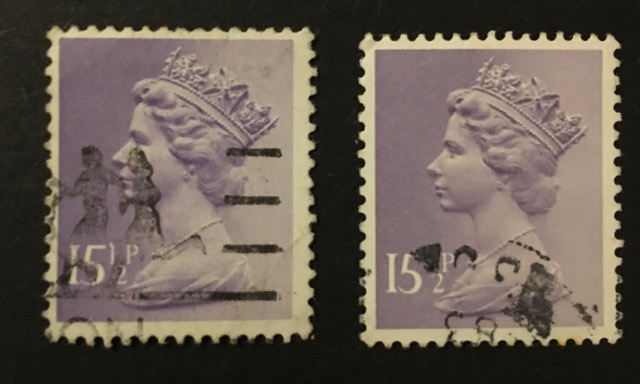 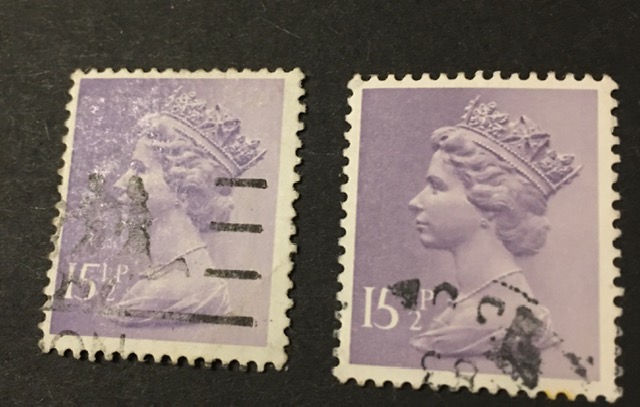 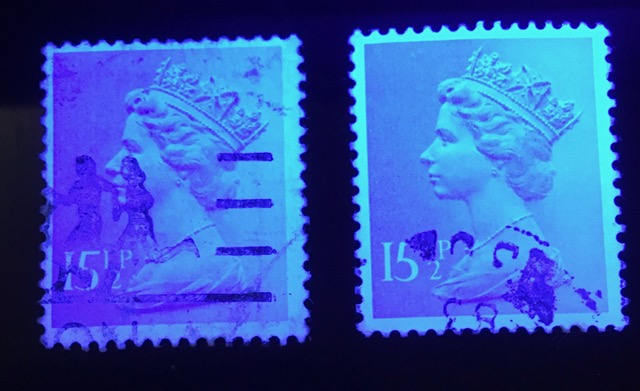 |
|
Send note to Staff
|
|
|
Pillar Of The Community
Netherlands
6639 Posts |
|
|
You might want to check that right stamp for its perforation. I think you will find it is irrelevant whether it is PCP1 or PCP2: wrong printer. |
|
Send note to Staff
|
|
|
Pillar Of The Community
567 Posts |
|
|
Yes, it's true, unfortunately it's misaligned, but it has a nice cancellation with little people that I like...
|
|
Send note to Staff
|
|
|
Pillar Of The Community
Netherlands
6639 Posts |
|
|
I do not know what misaligned means, but there is nothing wrong with that righthand stamp. I think it is a perf. 14 (13 3/4) lithographed stamp. The left one is a perf. 15 (14 3/4) photogravure stamp. That one is not perfectly centred. |
|
Send note to Staff
|
|
|
Pillar Of The Community
567 Posts |
|
|
Indeed, the perforations are as you indicate... the truth is that I am not paying attention to the perforations, I am guided by Connoisseur's decimal lists and in principle I did not see anything about the perforations and their significance...
|
|
Send note to Staff
|
|
|
Pillar Of The Community
Netherlands
6639 Posts |
|
|
Please, understand that there is more to Machins than just looking at the listings. You have created a number of posts in which you jumped to conclusions that do not correspond with the available information. Ignoring the printer - Harrison & Sons is easy to exclude when the perforation gauge is 14 - may result in incorrect conclusions about PCP1 and PCP2, where there is discussion about whether they exist and if so, how to identify them. Another example is identifying a coating with from one without an added fluorescent brightening agent by looking at a brighter fluorescence on the back for the one that does not have it. The publisher of the Connoisseur Catalogue discontinued his business last year. So, a new catalogue will not be available and I think the last one that was printed is a few decades old. The one on the web is not complete. Information on the printings is in the introduction that was not made available for free online. If you are interested in identifying Machins correctly, I recommend you buy a recent editions of the Deegam Machin Handbook that has a lot of information that helps identifying the stamps. https://www.deegam.com/Also, consider that used stamps can have undergone all kinds of treatment and may be contaminated. There are people who hate the Machins. Personally, I love them. These stamps are a chronicle of the Post and postal mechanisation between 1967 and 2023.There were many changes in the production process. I cannot think of any other series that will tell you the story like this one. They can drive you mad. If you are not interested in the technical aspects, they can be boring. If you are interested in the technical aspects, you can build a huge collection with many varieties. |
|
Send note to Staff
|
|
|
Replies: 16 / Views: 1,699 |
|




 Posted 02/18/2024 06:36 am