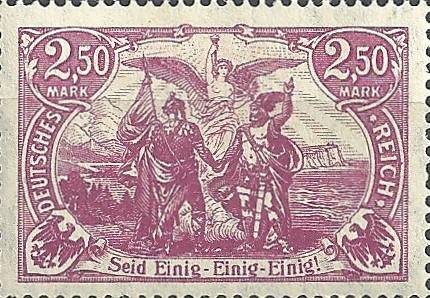
I chose the stamp because of two main aspects
• We see nothing less than a political statement in respect of unity in the so diverse country Germany between two parties of interest who were once enemies and now find themselves in alliance as equal and esteemed partners. The motto on the stamp says "Be united". Put animosities aside and pull together. And unity is strength. For me a great appeal to the strength of alliance and brotherhood (in Germany or elsewhere). All this is intensified by the quote of German scenic areas in the North and the South of my country.
• The bewildering beauty of the female genius - especially when we consider it has been designed in 1900 – shows a surprising sensuality, a sentiment we Germans not allow ourselves often to be felt or expressed. I see it as a tribute to all women, who to me are in the world to inspire men (be it to good or evil – this only to mention just that you see I am not a romantic fool and that you get a feeling of a certain melancholy depth of which we Germans are infamous for)
In respect of the historic background:
It was a long way from the dismemberment of Germany, especially after the Thirty Years' War and the dissolution of the first empire in 1806 by Napoleon I, to the re-establishment of the second empire in 1870. The industrialisation of Germany and the dissolution of old local ties went hand in hand with nationalisation. With accelerated communication (newspapers, post, trains), such ideas could be spread further and also faster. Prussian military victories created the basis for implementation. In 1866, after the German Civil War between North and South, the war declared by France to Prussia in 1870 provided an opportunity to fight together against an external enemy. This filled in any rifts and was simply too good a founding myth not to be used.
In the painting North and South (original in Saarbrücken Town Hall, artist Anton von Werner), a Bavarian warrior and a North German one shake hands over a French standard that has fallen into the dust, invoking reconciliation and unity.
In other words, a political motif behind which the whole of Germany could rally.
In the background of the North German I recognize the Rügen chalk cliffs, in the background of the Bavarian the Alps.
Above both we see the goddess of victory, Victoria. I like the drawing on the stamp better than on the painting. On the stamp, the goddess is (to my taste) clearly more sensual (with very luxuriant hair - even better in first print from 1900 -, draped according to the taste of the time, and shows more youthful, slimmer features). All is reinforced by engraved rays.
It is astounding how freely the goddesses nudity was handled. Thus, the goddess could be a daughter worthy of protection or desirable prey for the gentlemen in the image or for the viewer (there must be a reason why they didn't depict the witch from Hansel and Gretel, a famous German fairy tale). Female beholders might find pleasure in the thought how easy it is to attract and influence the other sex and, steer it and thus wield a position of power not to be underestimated.
I would still like to use the stamp today (which I would see to, if I were King of Germany), but unfortunately that is no longer possible (declared void and devaluated by inflation a long time ago).
And what do external beholders think of Germans? A good opportunity to quote Magret Thatcher, who once was invited to an informal meeting during the time of the talks in respect of the reunion of West and East Germany to the scenic town Deidesheim in Rhineland-Palatine by the former chancellor Helmut Kohl at which stuffed pig's stomach (a local speciality) was an infamous dish put on the table. Her verdict: he was so terribly German and ridiculously sentimental and the dish was hard to swallow (and I can promise you, in her latter assessment, she was simply wrong).





 Posted 03/13/2025 12:10 am



 I really like your short and simple, but funny story. Thanks for sharing!


