| Author |
 Replies: 10 / Views: 2,854 Replies: 10 / Views: 2,854 |
|
|
Valued Member
United States
108 Posts |
|
|
Date looks like 1920 on CDS but Catalog shows 1921 as issue date Card shows Aug 3 but no year 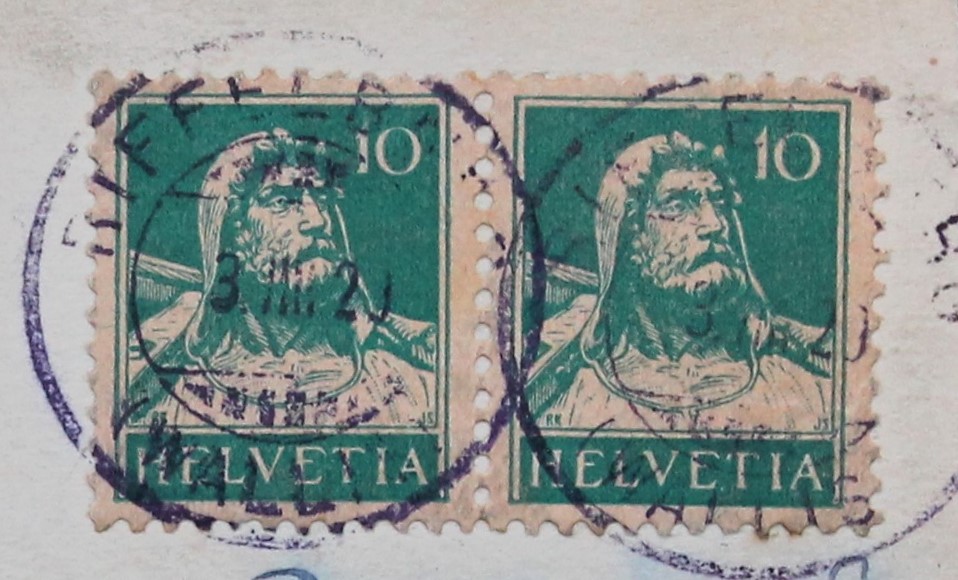 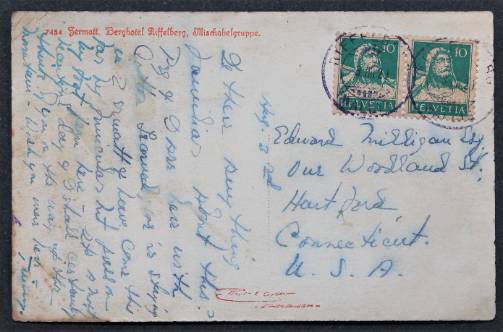 |
|
Send note to Staff
|
|
|
|
|
Pillar Of The Community
Netherlands
6644 Posts |
|
|
It looks like 3.IIII.20, or could it be 29 that would be 3 April1929.
IIII instead of IV is correct use of Roman numerals, but rare. It seems odd.
Then again, AU for August, also, could be possible: 3.AU.29.
Riffelberg (Wallis)? |
Send note to Staff 
|
| Edited by NSK - 08/26/2025 09:51 am |
|
|
Valued Member
United States
108 Posts |
|
|
It's a Dark Purple Hotel Post Office cancel. The postcard photo is of the 4 star Hotel Riffelberg at the base of the alps (Sitll in business). I think the first number is an 8 (Aug), IIII (4th day). and the last number does appear to be a 9
That would match the writer's date of "Aug. 3rd." Mailed the next day after writing.
Wallis = Vallis
Thanks for the second pair of eyes! Sometimes you just need a little nudge to look in a different way.
|
|
Send note to Staff
|
|
|
Pillar Of The Community

United States
1159 Posts |
|
|
Quote:
I think the first number is an 8 (Aug), IIII (4th day). Much of Europe uses Day-Month-Year format rather than the US Month-Day-Year format. Here is a Swiss cover from 1929 showing an Oberwil "27 VII 29" (27 July 1929) cancellation and for confirmation, another CDS in the center bottom from Friedrichshafen (Germany) "31 Jul 29".  Could the handwritten date on your postcard look like Apr 3? Then a 3-IIII-29 cancellation would be correct. |
|
Send note to Staff
|
|
|
Pillar Of The Community
Canada
5821 Posts |
|
|
I would agree with ZebraMan re the European dating D-M-Y format. And also using Roman numerals for the month is most common but I cant recall seeing IIII instead of IV for April although it appears that the postal clerk either didn't know or didn't care. Playing around with the image I get this 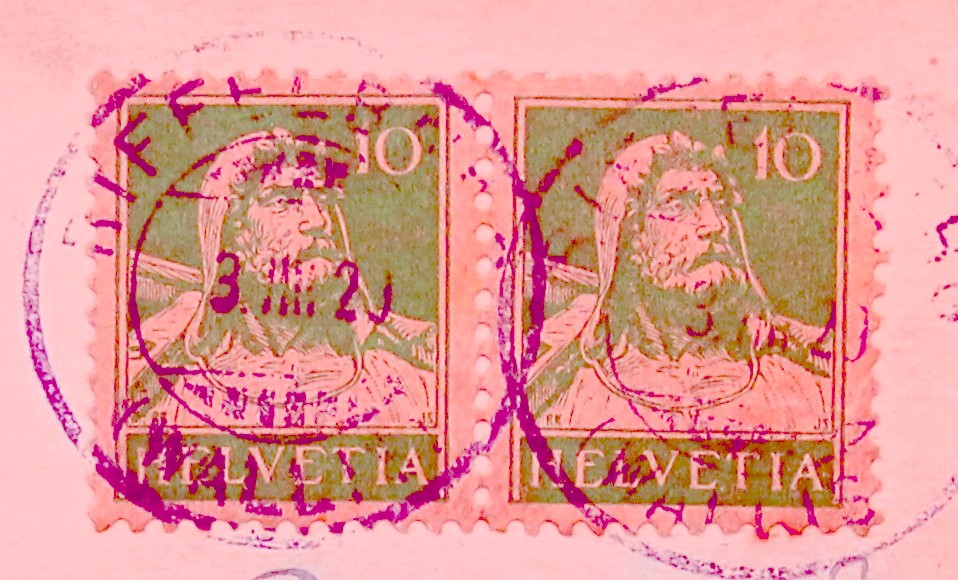 To me it looks like 3.IIII 29 3rd of April 1929 |
|
Send note to Staff
|
|
|
Pillar Of The Community
1367 Posts |
|
|
You say the stamp was issued in 1921. Doesn't that pretty much rule out "1920" as the cancellation date? I suggest it may actually be 1929.
As for how to read a non-American cancellation date, it's read as date-month-year, as you probably know, not as month-date-year which we do in the U.S. So 6-7-25 is NOT June 7th, but the "6th of July". The month date (the middle number) is sometimes a Roman numeral as it is here. These are not just basic facts for stamp collecting but for understanding the rest of the world, something Americans are not so good at. Shall we now discuss the metric system . . . ? |
|
Send note to Staff
|
|
|
Pillar Of The Community
Netherlands
6644 Posts |
|
|
On the European continent, we put the day before the month. So, either that is the perfectly correct Roman numeral IIII, that I cannot remember seeing used in a cancellation, or it is a very incomplete "AU" that I do not really see but coincides with the date on the postcard.
The stamp might be the variant issued in January 1928.
|
|
Send note to Staff
|
|
|
Pillar Of The Community
France
2942 Posts |
|
|
Valued Member
Sweden
136 Posts |
|
|
I think that the most probable date is 3 VIII 29 (=Aug3.1929) It looks as the first letter in what seems to look as IIII is leaning somewhat to the right so it is a V missing the left part. And what seems to be 20 is 29. The handwritten dateline is Aug 3. The foreign postcard rate was 20c in 1929 but lower in 1920 |
|
Send note to Staff
|
|
|
Pillar Of The Community
Netherlands
6644 Posts |
|
|
Valued Member
United States
108 Posts |
|
|
Wow! Great deduction work by all. @vayolene I never thought to look closely at the IIII and consider that it should be a VIII. All you guys on this forum are just incredible! |
|
Send note to Staff
|
|
| |
Replies: 10 / Views: 2,854 |
|



 Posted 08/26/2025 08:26 am